
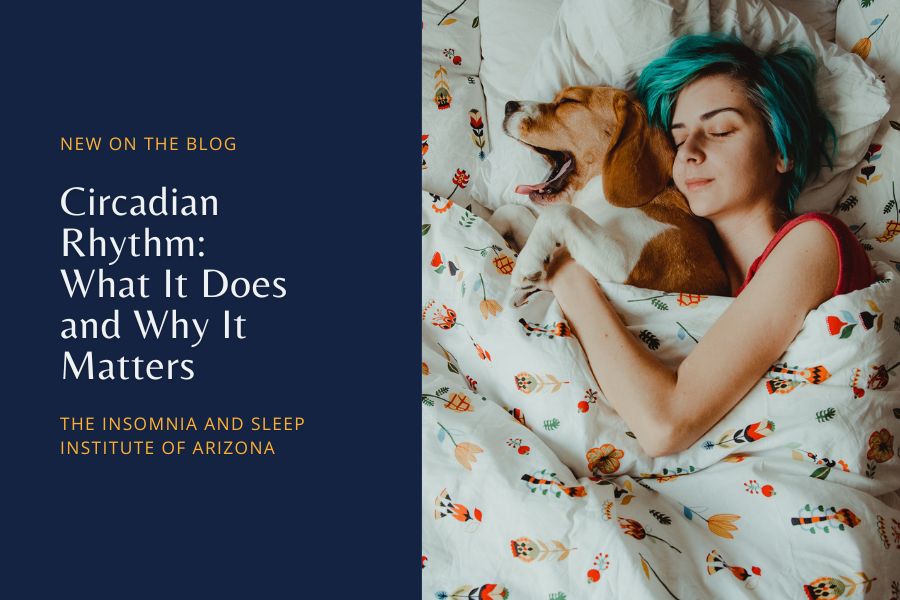
Your circadian rhythm is your body’s internal 24-hour clock. It times when you feel awake, sleepy, hungry, and alert. It regulates sleep cycles, hormone release, core body temperature, and countless other biological processes.
This rhythm responds primarily to light and darkness, syncing your body with the environment. When it’s in sync, you sleep better, think more clearly, and feel more balanced. When it’s off, everything from mood to metabolism can suffer.
How Does the Circadian Rhythm Work?
Your circadian rhythm is controlled by a tiny group of cells in the brain called the suprachiasmatic nucleus, or SCN. This group sits in the hypothalamus and acts as your body’s main clock. It gets signals from your eyes about light and darkness and uses that information to adjust your body’s timing.
When light is present, the SCN tells your brain to lower melatonin levels. Melatonin helps signal biological night and promotes sleepiness.. As it gets darker, melatonin levels rise, helping your body wind down and prepare for sleep.
Other parts of your body, like your heart, liver, and pancreas, also have their own internal clocks. These smaller clocks are guided by the SCN to stay in sync with one another. When the SCN isn’t working properly or your exposure to light is irregular, these body clocks can fall out of step.
This can lead to trouble sleeping, low energy, problems with thinking clearly, changes in blood sugar, and increased risk for long-term health problems such as heart issues and depression.
What Affects Your Circadian Rhythm?
Circadian rhythms are influenced by internal biology and external environmental cues, known as zeitgebers (German for “time-givers”). The most powerful of these is light. But several other factors also impact your rhythm:
- Artificial light exposure at night delays melatonin release. Blue light from phones, tablets, and televisions is especially potent at suppressing melatonin and shifting circadian timing..
- Irregular sleep schedules confuse the SCN. Social jet lag, staying up late on weekends and waking early on weekdays, can shift your rhythm.
- Shift work and night jobs cause chronic circadian misalignment. Studies link night shifts with increased risk of obesity, diabetes, depression, and cardiovascular disease (1).
- Travel across time zones temporarily disrupts circadian rhythm. A useful rule of thumb is that jet lag typically resolves at a rate of one time zone per day (though this can vary and it really depends on many factors, such age, light exposure, etc.).
- Age and development have an impact as well. Teenagers tend to have delayed circadian rhythms, preferring later bedtimes. Older adults often experience advanced rhythms, waking up earlier.
- Sleep disorders like delayed sleep-wake phase disorder (DSWPD) or non-24-hour sleep-wake disorder are rooted in circadian dysfunction.
How to Know If Your Circadian Rhythm Is Off
When your circadian rhythm is off, it can affect your body in both small and noticeable ways. Common signs include:
- Feeling wide awake late at night, even past midnight
- Waking up tired regardless of sleep duration
- Difficulty waking up without multiple alarms
- Alertness peaking in the evening or nighttime
- Poor memory, low motivation, or emotional instability
- Sleepiness during the day despite caffeine use
If you sleep well when allowed to follow your natural schedule but struggle on fixed routines, your circadian rhythm may be misaligned. This is common in teens and young adults.
Another clue is social jet lag, a mismatch between your biological and social clock. If your weekday and weekend sleep patterns differ by more than two hours, your rhythm may be suffering.
Objective assessments, such as actigraphy, sleep diaries, and melatonin onset testing, can confirm circadian phase. These are often used in sleep medicine clinics.
What Are Chronotypes and Why Do They Matter?
A chronotype is your natural predisposition for sleep and activity timing. Chronotypes are biologically based and regulated by genetics, hormones, and age-related changes.
- Morning types (larks): Feel most alert in the early morning, tend to rise and sleep early.
- Evening types (owls): More alert and productive in the evening, sleep later.
- Intermediate types: Fall somewhere in the middle (2).
Your chronotype affects your influences metabolism, decision-making, mood regulation, and even medication timing. According to a 2019 study, genetic factors account for approximately 13.7% of the variability in chronotype, indicating a significant, yet modest, influence on individual differences in sleep patterns and preferences (3).
Ignoring your chronotype may impair performance and increase the risk of health issues. People with depression who identify as evening types often experience more severe symptoms, greater emotional distress, increased anxiety, and more challenges in daily functioning, including at work, along with a higher risk of harmful thoughts (4). Aligning your life with your chronotype, when possible, improves cognitive function, sleep quality, and well-being.
Studies About Circadian Rhythm Disruption
Circadian rhythm disorders are conditions where the body’s internal clock becomes misaligned with the external environment, leading to problems with sleep timing, duration, and quality. These disruptions can cause insomnia, excessive sleepiness, and difficulty functioning during typical waking hours.
Studies show that circadian rhythm disruptions may have serious consequences for mental, cognitive, and physical health. A large 2020 study of over 2,100 medical interns tracked daily mood and sleep using wearables and smartphone apps. The researchers found that people with inconsistent sleep and wake times were more likely to report symptoms of depression. In fact, sleep variability, how much someone’s schedule shifts from day to day, had as much effect on mood as sleep duration itself. Interns who kept more regular bedtimes and wake times tended to feel better the next day, even when their total sleep hours were lower. This suggests that maintaining a consistent sleep routine is crucial for maintaining mental health (5).
The effects of circadian misalignment may be even more serious during adolescence. A 2022 review highlights that teenagers are biologically wired to stay up and wake later, but early school schedules often conflict with this natural rhythm. Since the adolescent brain is still developing critical areas for memory, decision-making, and emotional regulation, chronic sleep misalignment during these years may lead to long-lasting changes in brain function. The review emphasized that problems with sleep timing during adolescence could affect learning, mood stability, and brain health well into adulthood (6).
Circadian timing also affects the immune system. In a 2023 mouse study published in the American Journal of Respiratory and Critical Care Medicine, researchers exposed animals to a shifted light schedule that mimicked circadian misalignment. The mice showed stronger and longer-lasting lung inflammation when exposed to bacteria, compared to mice with a regular light cycle. Researchers identified several genes that were altered by circadian disturbance, many of which are involved in regulating inflammation, tissue repair, and the body’s ability to maintain strong barriers in the lungs. This suggests that when the circadian rhythm is off, the immune system may respond less efficiently and cause more damage (7).
Together, these studies demonstrate that the circadian rhythm is deeply intertwined with how the brain, body, and immune system function on a daily basis. Irregular schedules, particularly during vital developmental windows, may increase the risk of mood disorders, impair learning, and heighten vulnerability to physical illness.
How Can You Protect Your Circadian Rhythm?
Restoring and maintaining a healthy rhythm starts with consistency. Your circadian system needs regular cues to stay on time.
Practical, science-backed strategies include:
- Wake up at the same time every day. This anchors your rhythm and sets the stage for more reliable melatonin production at night.
- Get natural light within 30–60 minutes of waking. Outdoor light is 10 to 100 times brighter than indoor lighting and sends strong signals to the SCN.
- Avoid bright screens or LEDs two hours before bed. Dim lighting helps signal melatonin release and body temperature drop.
- Sleep in complete darkness. Even low light levels from nightlights or electronics can suppress melatonin.
- Eat meals at consistent times. Irregular eating confuses peripheral clocks in the liver and pancreas, leading to metabolic dysregulation.
- Exercise in the morning or early afternoon. Late-night exercise can delay sleep timing.
- Avoid caffeine after 2 p.m.. It blocks adenosine, a chemical that builds sleep pressure during the day.
- Build a wind-down routine. Slow transitions into sleep support a stable circadian rhythm.
Timing is critical. The body doesn’t adapt instantly. Most people can shift their circadian rhythm by about 15 to 30 minutes per day. Gradual adjustments work better than abrupt changes.
Seek Help from a Sleep Specialist
Some circadian rhythm issues require targeted clinical intervention. Consider consulting a sleep expert if:
- You consistently fall asleep well after midnight and struggle to wake up
- You wake up too early and cannot fall back asleep
- Your sleep improves only when your schedule is free of time constraints
- You feel alert at night but groggy in the morning
- You experience fatigue despite getting 7 to 9 hours of sleep
- You suspect delayed sleep-wake phase disorder or non-24-hour rhythm
These patterns go beyond lifestyle habits. They often reflect underlying biological clock dysregulation. Tools like actigraphy, core body temperature monitoring, and dim light melatonin onset (DLMO) testing help pinpoint your circadian phase.
Treatment for these disorders may include chronotherapy, bright light therapy, melatonin at controlled doses, or cognitive behavioral therapy for insomnia (CBT-I). Addressing the issue early improves daytime functioning and reduces long-term health risks.
Get Expert Care for Circadian Sleep Disorders at The Insomnia and Sleep Institute of Arizona
The Insomnia and Sleep Institute of Arizona uses clinical-grade diagnostics, expert analysis, and proven treatment protocols to identify what’s throwing off your rhythm and how to fix it.
Our physicians are board-certified in sleep medicine, with extensive experience treating both common and complex cases.
Many patients arrive after years of battling unexplained fatigue, insomnia, or non-restorative sleep.
Some have been misdiagnosed with depression or anxiety, when the underlying problem is a misaligned biological clock. We examine both internal timing and daily habits to reveal the full picture.
Our Scottsdale, Phoenix, and Gilbert locations serve individuals across the Valley who are ready to stop guessing and start sleeping. We rely on evidence-based methods, offer both in-lab and home-based testing, and ensure physician oversight throughout the entire process.
Sleep influences every organ, hormone, and function in your body. When your circadian rhythm is off, so is your health. Let us help you restore it with expert, personalized care.
Call now to book your appointment with a board-certified sleep doctor in Arizona who truly understands circadian rhythm disorders.
References
- Boini, S., Bourgkard, E., Ferrières, J., & Esquirol, Y. (2022). What do we know about the effect of night-shift work on cardiovascular risk factors? An umbrella review. Frontiers in Public Health, 10. https://doi.org/10.3389/fpubh.2022.1034195
- Zou, H., Zhou, H., Yan, R., Yao, Z., & Lu, Q. (2022). Chronotype, circadian rhythm, and psychiatric disorders: Recent evidence and potential mechanisms. Frontiers in Neuroscience, 16. https://doi.org/10.3389/fnins.2022.811771
- Jones, S. E., Lane, J. M., Wood, A. R., van Hees, V. T., Tyrrell, J., Beaumont, R. N., Jeffries, A. R., Dashti, H. S., Hillsdon, M., Ruth, K. S., Tuke, M. A., Yaghootkar, H., Sharp, S. A., Jie, Y., Thompson, W. D., Harrison, J. W., Dawes, A., Byrne, E. M., Tiemeier, H., & Allebrandt, K. V. (2019). Genome-wide association analyses of chronotype in 697,828 individuals provides insights into circadian rhythms. Nature Communications, 10(1). https://doi.org/10.1038/s41467-018-08259-7
- Kivelä, L., Papadopoulos, M. R., & Antypa, N. (2018). Chronotype and Psychiatric Disorders. Current Sleep Medicine Reports, 4(2), 94–103. https://doi.org/10.1007/s40675-018-0113-8
- Fang, Y., Forger, D. B., Frank, E., Sen, S., & Goldstein, C. (2021). Day-to-day variability in sleep parameters and depression risk: a prospective cohort study of training physicians. Npj Digital Medicine, 4(1). https://doi.org/10.1038/s41746-021-00400-z
- Pifer, G. C., Ferrara, N. C., & Kwapis, J. L. (2024). Long-lasting effects of disturbing the circadian rhythm or sleep in adolescence. Brain Research Bulletin, 213, 110978–110978. https://doi.org/10.1016/j.brainresbull.2024.110978
- Casanova, N. G., De, R. L., Saad Sammani, Sun, X., Sun, B., Kempf, C., Bime, C., Joe, & Parthasarathy, S. (2024). Circadian disruption dysregulates lung gene expression associated with inflammatory lung injury. Frontiers in Immunology, 15. https://doi.org/10.3389/fimmu.2024.1348181
Disclaimer: The information provided in this blog post is for educational and informational purposes only and is not intended as a substitute for professional medical advice, diagnosis, or treatment. Always consult with a licensed healthcare provider for recommendations specific to your individual health needs.







