Yes, you can use a CPAP machine while camping or off-grid. The key is planning ahead and choosing a power source that can provide enough energy for your machine throughout the night.
One of the biggest concerns CPAP users have when traveling is whether their machine will last until morning. That concern is understandable because CPAP therapy relies on continuous airflow to keep your airway open while you sleep. Even one night without treatment can allow symptoms such as loud snoring, repeated breathing pauses, oxygen drops, and poor-quality sleep to return.
Untreated sleep apnea leads to repeated breathing interruptions that can reduce oxygen levels and increase cardiovascular problems over time (1). That is why skipping CPAP, even during travel, is not a small decision.
The good news is that modern CPAP machines can operate on alternative power sources. Whether you’re camping in a tent, staying in an RV, or spending time off-grid, the right setup can keep your therapy consistent wherever you sleep.
Can You Use a CPAP Machine Without Electricity?
A CPAP machine does not need a wall outlet, but it does need power. That distinction matters. Your machine can operate away from home as long as it has a compatible battery or DC power source.
Manufacturers like ResMed confirm that many CPAP devices can operate using a 12V or 24V DC power source when paired with the correct converter (2). This includes batteries designed for CPAP therapy, vehicle power systems, and other compatible DC power sources.
Battery-powered setups are commonly used for camping, RV travel, and other off-grid situations. ResMed recommends deep-cycle or marine batteries for overnight use because they are designed to deliver steady power over extended periods rather than the short bursts needed to start a vehicle. (3).
When connecting to a battery, manufacturers generally recommend using a DC-to-DC converter instead of a standard power inverter. DC connections are more efficient, reducing unnecessary energy loss and helping your battery last longer. (4).
Solar power setups follow the same principle. The CPAP machine does not run directly from solar panels. Instead, the panels charge a battery, and the machine draws power from that stored energy (5). The system works, but only if the battery has enough capacity to support a full night of use.
Power requirements vary depending on the machine. The ResMed AirSense 10 typically uses about 53 watts during operation, with peak power reaching approximately 104 watts. (6). The AirSense 11 has similar requirements, averaging about 56.1 watts with peak use around 73.2 watts. (7). Over an eight-hour night, this can add up to several hundred watt-hours of energy depending on your pressure settings and whether heated features are enabled.
Heated humidification changes the picture. The same manufacturer advises against using a humidifier when running on certain external batteries (8). Heating water through the night increases the load, which shortens battery runtime. For that reason, many off-grid users turn humidification off to conserve power.
The last point is consistency. The National Heart, Lung, and Blood Institute states, “For the treatment to work, you should use your CPAP machine every time you sleep, including during naps” (9). That expectation does not change outside the home. A different setting still requires the same level of use.
In real-world terms, CPAP can travel. It can run without a wall outlet. So, the limitation is whether there is enough stored power to get through the night, not the location.
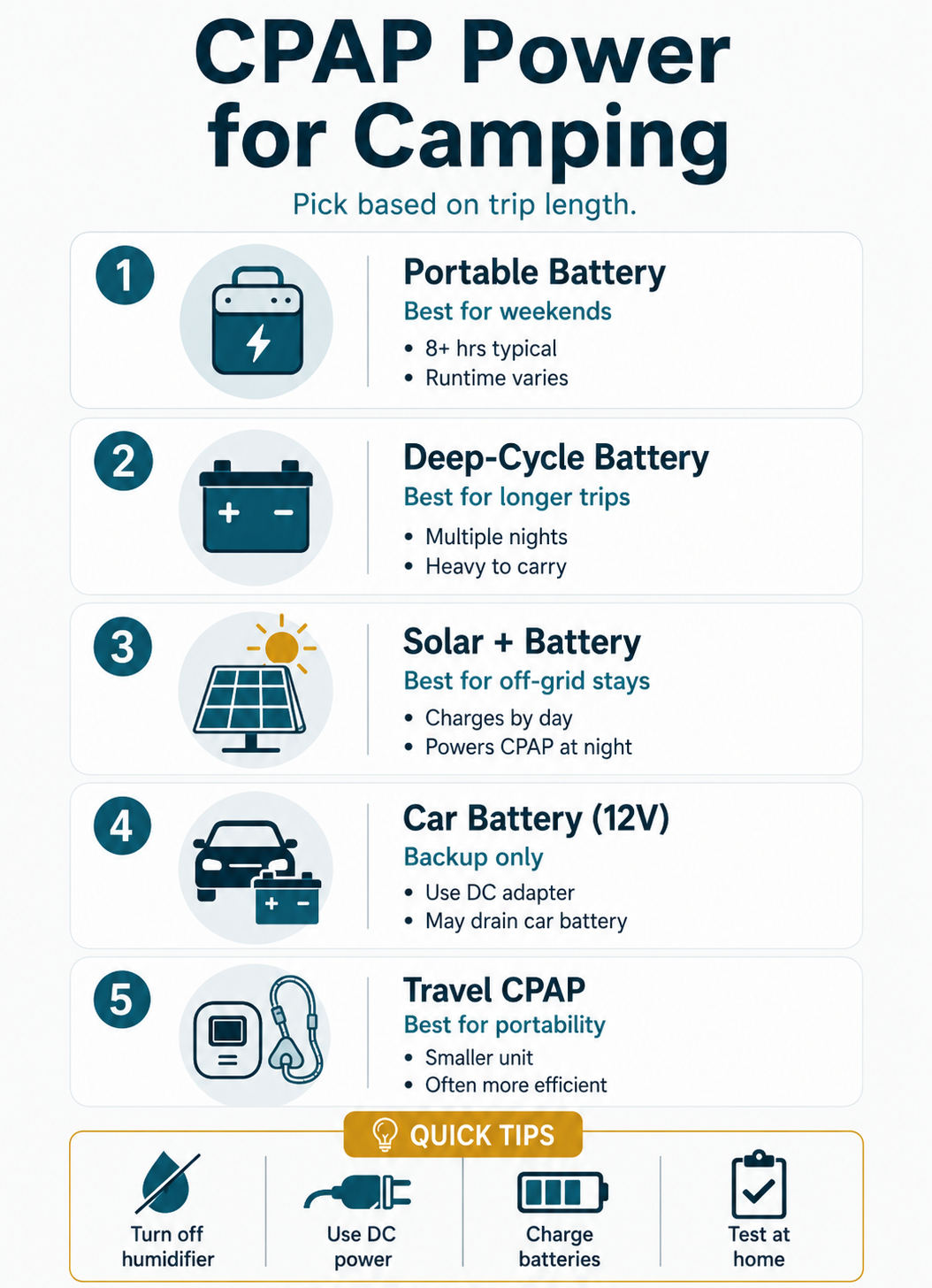
Best Power Options for CPAP While Camping or Off-Grid
The best power source depends on how long you’ll be away from electricity and how much portability you need.
Portable CPAP Batteries
Portable CPAP batteries are specifically designed for travel.. Devices like the ResMed Power Station II are designed to run a CPAP when wall power is not available (10).
Under typical conditions, they can last more than eight hours on a single charge (10). That does not mean the runtime is fixed. According to ResMed, battery runtime varies based on device settings, humidity, and other factors (11). Two people using the same battery can see very different results.
For weekend camping trips or occasional travel, portable batteries are usually the simplest and most convenient option.
Deep-Cycle Batteries
If you plan to spend several days off-grid, a deep-cycle battery may be the better choice.
Unlike vehicle batteries, which are designed to deliver short bursts of power, deep-cycle batteries are built to provide a steady output over long periods. ResMed recommends them for overnight CPAP use when the machine is not connected to a running vehicle. (3).
Although they are heavier and less portable, they can support multiple nights of use. That makes them a better fit for extended camping trips or RV travel.
Battery type also affects long-term use. Lithium-ion batteries can reach around 1,000 to 2,000 charge cycles, while other battery types may fall within a lower range depending on conditions (12). Over time, that difference affects how often a battery needs to be replaced.
Solar Power
Solar panels can help, but they work best when paired with a battery.
Rather than powering the CPAP machine directly, solar panels recharge your battery during daylight hours. The battery then powers your CPAP machine overnight.(5). This approach works well for multi-day camping, provided there is enough sunlight each day to replace the energy used overnight.
Using a Car Battery
A vehicle can serve as a backup power source. Many CPAP machines can connect through a 12V adapter.
Efficiency matters here. A DC connection is preferred because it avoids the extra energy loss that comes with inverters (4).
However, vehicle batteries have limited capacity. Depending on the vehicle, battery capacity commonly ranges from approximately 44 Ah to 80 Ah. (13). Running a CPAP overnight can take a large portion of that.
That creates a risk. If too much power is used, the vehicle may not start the next day. This setup works best as a short-term solution, not a long-term plan.
Travel CPAP Machines
Travel CPAP machines are designed to be smaller, lighter, and easier to transport than standard home units.
Many travel models are also more energy efficient, making them a practical choice for camping or off-grid use. Even so, battery life still depends on your pressure settings, therapy needs, and whether heated features are enabled.
What Matters Most for a Successful Setup
Your CPAP setup off-grid comes down to energy management. Turning off the humidifier, using DC power, and fully charging batteries before your trip can extend runtime significantly.
Perhaps the most important step is testing your equipment before your trip. Running your complete setup at home allows you to estimate how long your battery will actually last under your normal therapy settings, helping you avoid surprises once you’re away from power.
CPAP therapy protects your breathing, oxygen levels, and sleep quality. Those benefits don’t stop when you leave home, and neither should your treatment.
Safety Considerations When Using CPAP Off-Grid
Using CPAP off-grid calls for more attention than using it at home. The machine may be the same, but the environment is not.
- Keep the machine dry at all times: CPAP devices should never be exposed to water or moisture. ResMed states not to immerse the device or connect it to power while wet (7).
- Check and replace filters more often in outdoor conditions: Filters should be replaced more frequently when blocked by dirt or dust, and they should always remain in place to help prevent debris from entering the device (6).
- Avoid heat and extreme temperatures when using batteries: Battery performance can be affected by high heat or extreme temperatures. ResMed notes that high temperatures can stop the battery from powering the device or affect charging and readings (10).
- Never run engines near sleeping areas: The Centers for Disease Control and Prevention warns that carbon monoxide is an odorless, colorless gas that can cause sudden illness or death (14). Running engines in enclosed or partially enclosed spaces increases this risk (15).
Work With a Team That Helps You Stay Consistent Wherever You Sleep
Consistency defines the success of CPAP therapy. That applies at home, during travel, and in outdoor environments.
At The Insomnia and Sleep Institute of Arizona, we help patients build treatment plans that fit real life. Our team serves patients across Phoenix, Scottsdale, and Gilbert, and surrounding Arizona communities.
Led by Dr. Ruchir P. Patel, a triple board-certified sleep physician and six-time Top Doc, alongside a clinical psychologist specializing in insomnia, our team understands both the medical and practical challenges of maintaining successful sleep therapy.
If you are planning a trip or struggling to maintain CPAP use, contact us. We focus on solutions that keep your therapy consistent so you can sleep well wherever you are.
References
- Girardin Jean-Louis, Zizi, F., Clark, L. T., Brown, C. D., & McFarlane, S. I. (2008). Obstructive Sleep Apnea and Cardiovascular Disease: Role of the Metabolic Syndrome and Its Components. Journal of Clinical Sleep Medicine : JCSM : Official Publication of the American Academy of Sleep Medicine, 4(3), 261. https://pmc.ncbi.nlm.nih.gov/articles/PMC2546461/
- Your guide to travelling with CPAP. (n.d.). Retrieved April 7, 2026, from https://document.resmed.com/documents/uk/10111268-Resmed%20Travel%20guide%202019%20EU%20UK%20low.pdf
- Your guide to travelling with CPAP. (n.d.). Retrieved April 7, 2026, from https://document.resmed.com/documents/uk/10111268-Resmed%20Travel%20guide%202019%20EU%20UK%20low.pdf
- https://document.resmed.com/documents/articles/198103_battery-guide_glo_eng.pdf
- Your guide to travelling with CPAP. (n.d.). Retrieved April 7, 2026, from https://document.resmed.com/documents/uk/10111268-Resmed%20Travel%20guide%202019%20EU%20UK%20low.pdf
- User guide. (n.d.). Retrieved April 7, 2026, from https://shop.resmed.com/medias/sys_master/images/images/h8a/h6a/8953488801822/airsense10-afh-device-with-humidifier-user-guide-eur1-eng.pdf
- User guide. (n.d.). https://document.resmed.com/documents/products/machine/airsense-11/user-guide/airsense11_user-guide_amer_mul.pdf
- Your guide to travelling with CPAP. (n.d.). Retrieved April 7, 2026, from https://document.resmed.com/documents/uk/10111268-Resmed%20Travel%20guide%202019%20EU%20UK%20low.pdf
- Sleep Disorder Treatments. (2022, March 24). NHLBI, NIH. https://www.nhlbi.nih.gov/health/sleep-disorder-treatments
- User guide. (n.d.). Retrieved April 7, 2026, from https://document.resmed.com/documents/products/accessory/power-station-ii/user-guide/power-station-ii_user-guide_amer_mul.pdf
- FAQs. (2025, August 7). Resmed. https://www.resmed.com/en-us/sleep-health/resources/faqs/
- (2026). Nrel.gov. https://docs.nrel.gov/docs/fy21osti/79832.pdf
- BCI Assembly Numbers, Cell Layouts, Holddowns and Polarity 10. (n.d.). Retrieved April 7, 2026, from https://batterycouncil.org/wp-content/uploads/2023/10/BCI-Group-Sizes.pdf
- CDC. (2026, January 12). Carbon Monoxide Poisoning Basics. Carbon Monoxide Poisoning. https://www.cdc.gov/carbon-monoxide/about/index.html
- NIOSH alert: preventing carbon monoxide poisoning from small gasoline-powered engines and tools. (1996). https://doi.org/10.26616/nioshpub96118a
Disclaimer: The information provided in this blog post is for educational and informational purposes only and is not intended as a substitute for professional medical advice, diagnosis, or treatment. Always consult with a licensed healthcare provider for recommendations specific to your individual health needs.