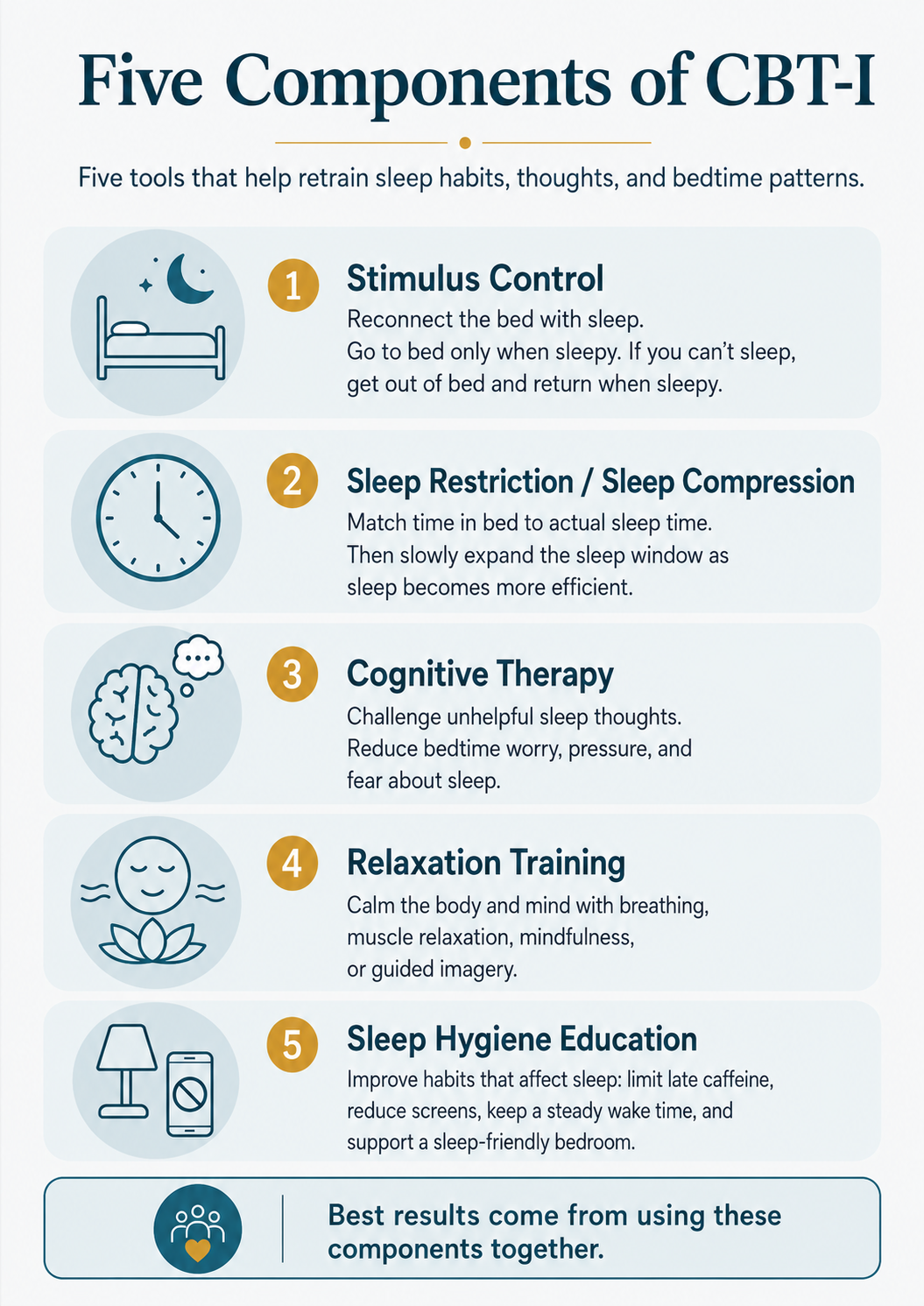
The five components of Cognitive Behavioral Therapy for Insomnia, or CBT-I, are stimulus control, sleep restriction (sleep compression), cognitive therapy, relaxation training, and sleep hygiene education. Together, these five components retrain the way your brain, body, daily schedule, and sleep environment respond to sleep. (1)(2)
CBT-I stands for Cognitive Behavioral Therapy for Insomnia. It is a structured treatment for chronic insomnia, which means repeated difficulty falling asleep, staying asleep, waking too early, or getting poor-quality sleep for at least three nights per week for at least three months. Chronic insomnia can affect daytime energy, mood, concentration, driving safety, work performance, and overall health. (3)
Many people with insomnia already know the usual sleep advice. They know late caffeine can be a problem. They know screens can keep the mind alert. They know stress can make bedtime harder. What many people do not realize is that insomnia can become a learned pattern, where the bed starts to feel like a place for thinking, waiting, and worrying instead of sleeping. (1)(4)
CBT-I helps break that pattern through practical sleep retraining. It does not depend on one tip, one supplement, or one perfect bedtime routine. Instead, it uses evidence-based behavioral and cognitive strategies that are practiced consistently and adjusted using sleep diary data. (1)(2)
Why CBT-I Is a First-Line Treatment for Chronic Insomnia
CBT-I is considered a first-line treatment because it targets the habits, thoughts, and body signals that keep chronic insomnia going. Major clinical guidance recommends CBT-I as the initial treatment for adults with chronic insomnia, and sleep medicine guidelines strongly support multicomponent CBT-I for chronic insomnia disorder. (2)(5)
This matters because chronic insomnia is common and often under-treated. Research estimates that about 10% of adults meet the criteria for insomnia disorder, while around 20% report occasional insomnia symptoms. That means the person lying awake at 2 a.m. is not dealing with a rare problem. They are experiencing one of the most common sleep disorders, and it deserves evidence-based care. (6)
CBT-I typically includes sleep diaries, clinical review, schedule changes, cognitive work, and home practice. Treatment usually takes several sessions, with the plan adjusted based on sleep efficiency, bedtime patterns, wake time, naps, fatigue, and daytime functioning. (1)(2)
Five Components of CBT-I
CBT-I works through five core components that train the brain and body to sleep better. Each one targets a different part of insomnia, from bedtime habits to racing thoughts.
1. Stimulus Control: Teaching the Bed to Mean Sleep Again
Stimulus control therapy helps the brain reconnect the bed with sleep. When a person spends long hours awake in bed, the brain can begin linking the bedroom with frustration, alertness, phone use, problem-solving, clock-checking, or anxiety. Stimulus control works to reverse that learned connection. (4)(7)
The main idea is simple: the bed should become a strong cue for sleep. This usually means going to bed only when sleepy, maintaining a consistent morning wake time, getting out of bed when sleep is not happening, returning only when sleepy, and avoiding long daytime naps. (7)
This part of CBT-I can feel strange at first because many people with insomnia want to stay in bed and “try harder” to sleep. Unfortunately, trying harder often makes the brain more alert. Getting out of bed during prolonged wakefulness helps weaken the association between the bed and being awake. (4)(7)
A common example is the person who feels sleepy on the couch but becomes fully awake after climbing into bed. That pattern can develop when the bed becomes associated with pressure and worry. Stimulus control gives the brain repeated opportunities to relearn a much simpler message: the bed is for sleep. (4)
2. Sleep Restriction or Sleep Compression: Building Stronger Sleep Pressure
Sleep restriction therapy reduces the amount of time spent awake in bed. The goal is not to take away healthy sleep. The goal is to match time in bed more closely with the person’s actual sleep time, then gradually expand the sleep window as sleep becomes stronger and more efficient. (1)(8)
For example, someone may spend eight hours in bed but only sleep five and a half hours. That extra wakeful time trains the brain to treat the bed like a waiting room. A clinician may temporarily reduce the sleep window using sleep diary data, then gradually increase time in bed as sleep efficiency improves. (8)
Sleep compression uses a gentler approach. Rather than making a larger schedule change all at once, time in bed is reduced more gradually. This approach may work well for older adults, people with higher anxiety, or anyone who may feel overwhelmed by a stricter sleep schedule. (1)
This part of CBT-I should be guided carefully. Sleep restriction can temporarily increase daytime sleepiness or affect concentration, making clinical screening especially important for people with high-risk jobs, seizure disorders, bipolar disorder, fall risk, or severe daytime sleepiness. (9)
3. Cognitive Therapy: Quieting the Thoughts That Keep Sleep Away
Cognitive therapy targets the thoughts and beliefs that reinforce insomnia. People with chronic insomnia may think, “I will be useless tomorrow,” “I have lost control of sleep,” or “If I wake up again, the whole day is ruined.” These thoughts can increase stress and make the brain even more alert at bedtime. (1)(10)
Cognitive therapy does not ask people to fake positivity. Instead, it helps the person test sleep-related fears against real patterns, sleep diary data, and more balanced thinking. The goal is to reduce panic around sleep so the brain stops treating bedtime like a performance test. (1)(10)
A more useful thought might sound like this: “I may feel tired tomorrow, but I have handled tired days before, and one difficult night does not mean my sleep is broken forever.” That type of thinking is calmer, more realistic, and less likely to trigger the body’s alert system.
This matters because insomnia often feeds on fear. When bedtime becomes a nightly test, the body responds with tension, racing thoughts, and heightened alertness. Cognitive therapy helps reduce that pressure and rebuild confidence around sleep. (10)
4. Relaxation Training: Lowering the Body’s Alert System
Relaxation training helps calm the physical and mental arousal that keeps many people awake. Some people feel exhausted all day but are wired at night. Their body is in bed, but their nervous system is still acting like there is a deadline, a problem, or a threat to solve. (1)(2)
Relaxation training may include diaphragmatic breathing, progressive muscle relaxation, guided imagery, mindfulness-based exercises, or other counter-arousal skills. These strategies help reduce muscle tension, shallow breathing, racing thoughts, and bedtime stress. (2)
Relaxation works best when practiced consistently, not only during the worst parts of the night. If the first practice happens during a 3 a.m. spiral, the skill may feel less effective. Daily practice helps the body recognize the relaxation response more quickly when bedtime arrives.
This component is helpful for people who describe their insomnia as “tired but wired.” It provides a reliable way to shift the body out of alert mode instead of waiting for sleep to arrive by chance. (1)(2)
5. Sleep Hygiene Education: Fixing Habits That Work Against Sleep
Sleep hygiene education looks at the daily habits and environmental factors that can make insomnia worse. This can include caffeine timing, alcohol use, nicotine, irregular schedules, late naps, bright light at night, bedroom temperature, noise, screen habits, and activity too close to bedtime. (1)(2)
Sleep hygiene is useful, but it is rarely enough by itself for chronic insomnia. Many people with long-term insomnia have already tried a cooler room, less coffee, a different pillow, sleepy tea, blackout curtains, calming music, and a long list of other bedtime rules. Those changes can help, but chronic insomnia usually requires the deeper retraining provided by stimulus control, sleep scheduling, cognitive therapy, and relaxation practice. (2)(9)
That is why sleep hygiene is only one component of CBT-I. It removes obvious barriers to sleep while other CBT-I components address the learned cycle that keeps insomnia going.
For example, reducing late caffeine may lower physical alertness. Maintaining a consistent wake time may strengthen the body’s internal clock. Reducing phone use in bed may help the brain stop associating the bed with scrolling. These habits are most effective when they support—not replace—the other components of CBT-I. (1)(2)
What Happens During CBT-I?
CBT-I usually begins with a detailed sleep history. A clinician may ask about bedtime, wake time, naps, caffeine, alcohol, medications, medical conditions, mood, pain, snoring, breathing pauses, restless legs, nightmares, and daytime sleepiness. These details matter because insomnia can appear on its own or alongside sleep apnea, restless legs syndrome, circadian rhythm disorders, anxiety, depression, chronic pain, or medication effects. (3)
A sleep diary is often used because insomnia can distort memory. A night can feel like zero sleep, even when the person slept in short periods. A diary provides a more accurate picture of sleep timing, awakenings, sleep efficiency, and patterns across the week. (1)(2)
CBT-I requires practice between visits. Patients follow a sleep schedule, use stimulus control techniques, practice relaxation skills, review sleep-related thoughts, and track progress. The process can feel uncomfortable at first because it asks people to change habits that may have been reinforced for years. (1)(8)
Who May Benefit From CBT-I?
CBT-I may benefits adults who regularly struggle to fall asleep, stay asleep, wake too early, or feel anxious about bedtime. It may also help people who spend too much time awake in bed, dread nighttime, rely heavily on sleep aids, or feel tired after enough time in bed. (1)(3)
A sleep evaluation is important when symptoms suggest another sleep disorder. Loud snoring, gasping, witnessed breathing pauses, morning headaches, restless legs, unusual sleep movements, severe daytime sleepiness, or sudden sleep attacks may point to conditions that need medical testing. (3)
The right treatment starts with understanding what is actually happening during sleep. Some people benefit from CBT-I alone, while others need CBT-I alongside treatment for sleep apnea, circadian rhythm disorders, chronic pain, mood symptoms, or another sleep condition. (3)
Sleep Better With The Insomnia and Sleep Institute of Arizona
Sleep advice can help, but it does not always explain why you are struggling. If your nights still feel restless, frustrating, or unpredictable, The Insomnia and Sleep Institute of Arizona can help you find answers. We are a physician-owned and operated sleep medicine center with locations in Phoenix, Scottsdale, and Gilbert, and our team works with adult and pediatric sleep disorders every day.
If your mind gets louder the moment your head hits the pillow, contact us for a consultation. We can review your symptoms, determine whether CBT-I may be appropriate, and evaluate for other sleep disorders that could be affecting the quality of your sleep.
References
- Walker, J., Muench, A., Perlis, M. L., & Vargas, I. (2022). Cognitive Behavioral Therapy for Insomnia (CBT-I): A Primer. Klinicheskaia I Spetsial’naia Psikhologiia = Clinical Psychology and Special Education, 11(2), 123. https://doi.org/10.17759/cpse.2022110208
- Edinger, J. D., Arnedt, J. T., Bertisch, S. M., Carney, C. E., Harrington, J. J., Lichstein, K. L., Sateia, M. J., Troxel, W. M., Zhou, E. S., Kazmi, U., Heald, J. L., & Martin, J. L. (2021). Behavioral and psychological treatments for chronic insomnia disorder in adults: an American Academy of Sleep Medicine clinical practice guideline. Journal of Clinical Sleep Medicine, 17(2), 255–262. https://doi.org/10.5664/jcsm.8986
- McNamara, S., Spurling, B. C., & Bollu, P. C. (2025, March 28). Chronic Insomnia. Nih.Gov; StatPearls Publishing. https://www.ncbi.nlm.nih.gov/books/NBK526136/
- Sharma, M., & Andrade, C. (2012). Behavioral interventions for insomnia: Theory and practice. Indian Journal of Psychiatry, 54(4), 359. https://doi.org/10.4103/0019-5545.104825
- Qaseem, A., Kansagara, D., Forciea, M. A., Cooke, M., & Denberg, T. D. (2016). Management of Chronic Insomnia Disorder in Adults: A Clinical Practice Guideline From the American College of Physicians. Annals of Internal Medicine, 165(2), 125–133. https://doi.org/10.7326/m15-2175
- Morin CM;Jarrin DC. (2022). Epidemiology of Insomnia: Prevalence, Course, Risk Factors, and Public Health Burden. Sleep Medicine Clinics, 17(2). https://doi.org/10.1016/j.jsmc.2022.03.003
- Stanford Health Care. (2017, September). Stanfordhealthcare.Org. https://stanfordhealthcare.org/medical-treatments/c/cognitive-behavioral-therapy-insomnia/procedures/stimulus-control.html
- Stanford Health Care. (2017, September). Stanfordhealthcare.Org. https://stanfordhealthcare.org/medical-treatments/c/cognitive-behavioral-therapy-insomnia/procedures/sleep-restriction.html
- Arnold, M. J. (2022). Behavioral and Psychological Treatments for Chronic Insomnia Disorder: Updated Guidelines From the American Academy of Sleep Medicine. American Family Physician, 105(1), 97–98. https://www.aafp.org/afp/2022/0100/p97
Disclaimer: The information provided in this blog post is for educational and informational purposes only and is not intended as a substitute for professional medical advice, diagnosis, or treatment. Always consult with a licensed healthcare provider for recommendations specific to your individual health needs.