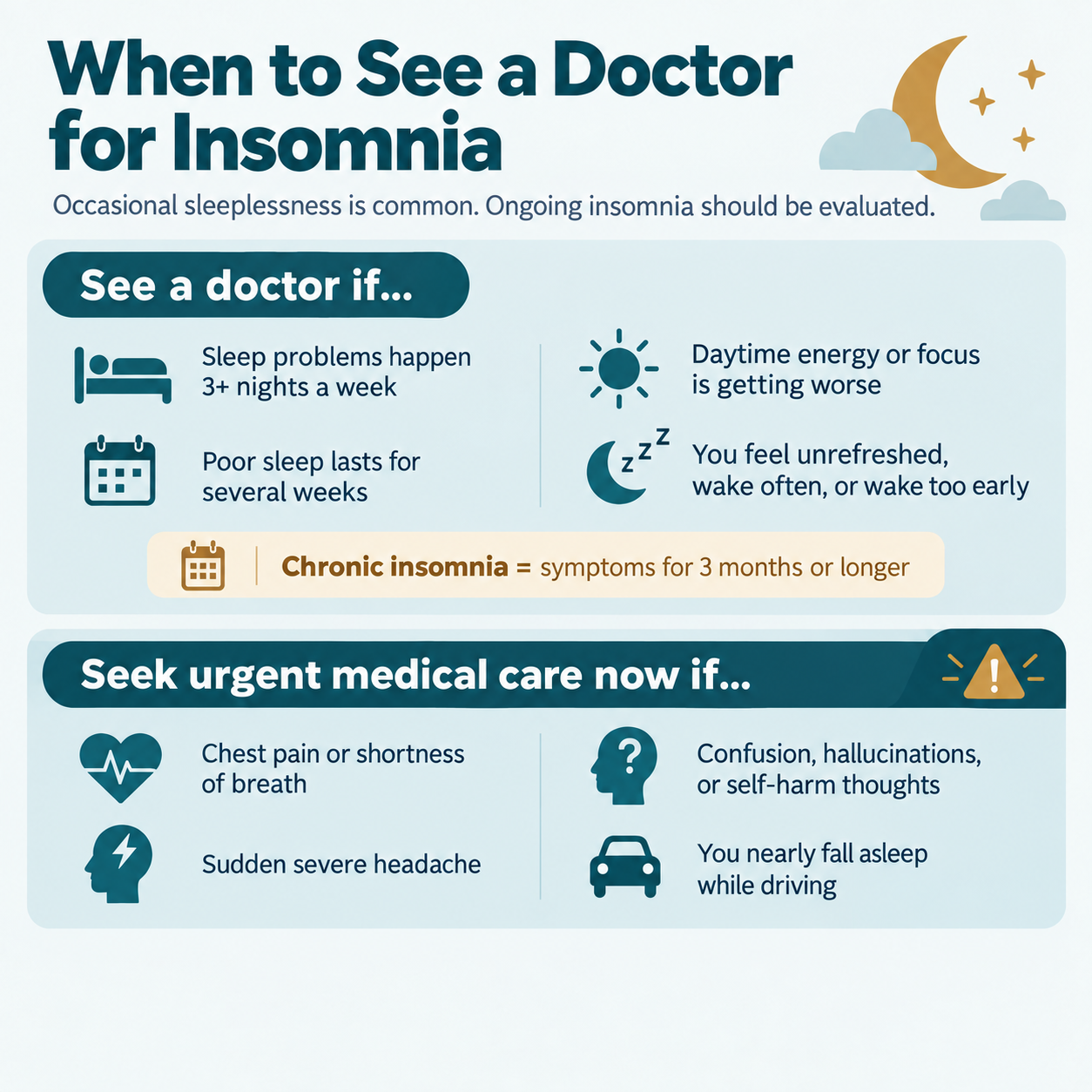
You should see a doctor for insomnia when sleep difficulties occur at least three nights per week, persist for several weeks, or begin to impair your daytime energy, concentration, and emotional well-being. Occasional sleeplessness is common, but clinical insomnia is a distinct medical condition. Insomnia disorder affects approximately 10% of adults on a chronic basis, while another 20% experience transient or occasional symptoms (1)(2).
Insomnia includes trouble falling asleep, frequent nighttime awakenings, waking up too early, or experiencing unrefreshing sleep despite having adequate time in bed (1). Short-term insomnia typically develops after acute stress, illness, travel, or major life disruptions (1). In contrast, chronic insomnia persists for three months or longer and often becomes self-sustaining even after the initial trigger has resolved (1).
Many people suffer in silence for years before seeking clinical guidance. For example, actress Jennifer Aniston, who partnered with a sleep medication brand to raise insomnia awareness, has spoken publicly about decades of sleep problems, telling Healthline that poor sleep eventually affected her energy, motivation, and concentration. After years of trying different ways to improve her sleep, she sought help from her doctor. When bedtime begins to trigger performance anxiety rather than rest, professional evaluation is the most effective way forward.
How Does Insomnia Harm Your Daily Function and Health?
Medical attention is necessary when sleep loss affects your cognitive performance, safety, and physical health. Ongoing sleep deficiency impairs learning, memory retention, reaction times, emotional regulation, and decision-making (3)(4). In everyday life, this often presents as constant caffeine dependence, workplace errors, uncharacteristic irritability, or fighting off drowsiness during long commutes (4)(5).
The consequences of unmanaged sleep loss extend well beyond feeling tired. Chronic sleep deficiency is clinically linked with an increased risk of cardiovascular disease, hypertension, diabetes, stroke, obesity, depression, and accidental injury (3)(4). Proper medical intervention helps prevent chronic sleep problems from contributing to long-term systemic conditions (3)(4)(5).
Why Is Basic Sleep Hygiene Often Not Enough?
Patients often arrive at our practice frustrated because conventional sleep tips such as taking warm baths, buying blackout curtains, or cutting out afternoon caffeine have failed to work. While sleep hygiene establishes healthy habits, it is rarely sufficient to cure chronic insomnia on its own (6).
Chronic insomnia frequently involves conditioned arousal. Over time, the brain learns to associate the bed with frustration, clock-watching, and alertness rather than rest. The classic film Fight Club captured this state of chronic exhaustion with the line: “When you have insomnia, you’re never really asleep, and you’re never really awake” — Fight Club (1999).
When the sleep environment itself triggers alertness, structured behavioral treatment is necessary. Clinical guidelines from leading medical bodies recommend Cognitive Behavioral Therapy for Insomnia (CBT-I) as the first-line treatment for chronic insomnia disorder (6)(7)(8). CBT-I is a structured, multi-week program that uses stimulus control, sleep restriction, relaxation techniques, and cognitive restructuring to reset the brain’s sleep drive and eliminate conditioned bedtime worry (6)(7)(8).
What Should You Know About Sleeping Pills and Long-Term Care?
Prescription sleep medications are sometimes used for acute crises or severe short-term distress, but they do not resolve the underlying behavioral mechanisms of chronic insomnia (6). Clinical guidelines from the American Academy of Sleep Medicine indicate that while combination therapy may benefit select patients, behavioral therapy with CBT-I is preferred over long-term medication use alone (8)(9).
Sedative-hypnotic medications, including Z-drugs like zolpidem and eszopiclone, require careful clinical oversight. These medications carry potential side effects, including next-day grogginess, dependency, and rare complex sleep behaviors where individuals walk, drive, or prepare food while not fully awake (9). A sleep specialist helps patients navigate treatment options safely, ensuring that temporary medications do not replace long-term solutions (9)(9).
Could Another Medical Condition Be Behind Your Sleeplessness?
In a clinical setting, sleep physicians frequently discover that insomnia is a symptom of another unrecognized sleep disorder or medical condition:
- Obstructive Sleep Apnea (OSA): Upper airway collapse during sleep causes brief oxygen drops and frequent micro-arousals (10). Patients often report light sleep, morning headaches, dry mouth, or waking up gasping, without realizing their airway is obstructed (10).
- Restless Legs Syndrome (RLS): This neurological sensorimotor disorder creates an uncomfortable urge to move the legs during rest, particularly in the evening (12). It is frequently associated with iron deficiency, pregnancy, or nerve conditions, making medical evaluation essential (11).
- Hormonal Changes: During perimenopause and menopause, fluctuations in estrogen and progesterone frequently trigger night sweats, hot flashes, and disrupted sleep architecture (12).
Accurate medical screening ensures that underlying conditions like sleep apnea or restless legs are properly treated rather than mistakenly managed with standard sleeping pills (10)(11)(12).
What Should You Expect During a Clinical Sleep Evaluation?
An initial clinical sleep evaluation focuses on identifying the specific factors disrupting your sleep. A sleep physician will review your medical history, current medications, daily schedule, and symptom timeline (1)(5).
To prepare for your visit:
- Keep a 2-Week Sleep Log: Track your approximate bedtimes, wake times, nighttime awakenings, daytime naps, caffeine consumption, and energy levels (1).
- Compile Your Complete Medication List: Include prescription drugs, over-the-counter sleep aids, melatonin, vitamins, and herbal supplements (6)(9).
- Note Secondary Symptoms: Record any observations from a bed partner regarding snoring, gasping, leg kicking, or teeth grinding (10)(11).
If symptoms suggest sleep apnea or movement disorders, an overnight diagnostic sleep study may be ordered to measure brain activity, airflow, heart rhythm, and oxygen levels (10)(11).
When Should You Seek Immediate Medical Attention?
You should seek prompt emergency medical care if your sleep loss is accompanied by chest pain, shortness of breath, sudden severe headaches, confusion, hallucinations, or thoughts of self-harm (4)(5). Urgent care is also critical if extreme daytime sleepiness causes near-miss driving accidents or nodding off at the wheel (3)(4).
If you are currently taking prescription sleep medication and experience nighttime memory lapses, sleepwalking, or complex behaviors without awareness, contact your prescribing physician immediately (9).
Consult The Insomnia and Sleep Institute of Arizona for Insomnia Care in Arizona
If insomnia is affecting your nights, mornings, mood, work, driving, or daily energy, our team at The Insomnia and Sleep Institute of Arizona can help you find out what is really happening during sleep. We evaluate insomnia with a medical sleep lens, so we look at sleep habits, chronic insomnia patterns, sleep apnea symptoms, restless legs, medication effects, and other sleep disorders that can keep sleep broken.
We help patients move past random sleep tips and into evidence based sleep care. Our team understands how exhausting insomnia can feel when you have already tried better routines, less caffeine, melatonin, white noise, earlier bedtimes, and phone limits with little relief.
Contact us for a consultation so we can help you understand your insomnia, check for hidden sleep disorders, and build a care plan guided by sleep medicine.
References
- What Is Insomnia? (2022, March 24). Nhlbi, NIH. https://www.nhlbi.nih.gov/health/insomnia
- Morin CM;Jarrin DC. (2022). Epidemiology of Insomnia: Prevalence, Course, Risk Factors, and Public Health Burden. Sleep Medicine Clinics, 17(2). https://doi.org/10.1016/j.jsmc.2022.03.003
- CDC. (2025, February 5). Sleep. Chronic Disease Indicators. https://www.cdc.gov/cdi/indicator-definitions/sleep.html
- What Are Sleep Deprivation and Deficiency? (2022, March 24). Nhlbi, NIH. https://www.nhlbi.nih.gov/health/sleep-deprivation
- Brasure, M., MacDonald, R., Fuchs, E., Olson, C. M., Carlyle, M., Diem, S., Koffel, E., Khawaja, I. S., Ouellette, J., Butler, M., Kane, R. L., & Wilt, T. J. (2015, December). Introduction. Ncbibooks; Agency for Healthcare Research and Quality (US). https://www.ncbi.nlm.nih.gov/books/NBK343490/
- Treatment. (2022, March 24). Nhlbi, NIH. https://www.nhlbi.nih.gov/health/insomnia/treatment
- Edinger, J. D., Arnedt, J. T., Bertisch, S. M., Carney, C. E., Harrington, J. J., Lichstein, K. L., Sateia, M. J., Troxel, W. M., Zhou, E. S., Kazmi, U., Heald, J. L., & Martin, J. L. (2021). Behavioral and psychological treatments for chronic insomnia disorder in adults: an American Academy of Sleep Medicine clinical practice guideline. Journal of Clinical Sleep Medicine, 17(2), 255–262. https://doi.org/10.5664/jcsm.8986
- Qaseem A;Kansagara D;Forciea MA;Cooke M;Denberg TD. (2016). Management of Chronic Insomnia Disorder in Adults: A Clinical Practice Guideline From the American College of Physicians. Annals of Internal Medicine, 165(2). https://doi.org/10.7326/M15-2175
- Buysse, D. J., Arnedt, J. T., Buenaver, L., Chang, J. L., Fernandez-Mendoza, J., Patel, S. I., Zhou, E. S., Falck-Ytter, Y., Hyer, S., Kazmi, U., Singh, M., & Wickwire, E. M. (2026). Combination treatment for chronic insomnia disorder in adults: an American Academy of Sleep Medicine clinical practice guideline. Journal of Clinical Sleep Medicine : JCSM : Official Publication of the American Academy of Sleep Medicine, 22(1), 56. https://doi.org/10.1007/s44470-025-00038-8
- Slowik, J. M., Abdulghani Sankari, & Collen, J. F. (2025, March 4). Obstructive Sleep Apnea. Ncbibooks; StatPearls Publishing. https://www.ncbi.nlm.nih.gov/books/NBK459252/
- Restless Legs Syndrome. (2026). National Institute of Neurological Disorders and Stroke. https://www.ninds.nih.gov/health-information/disorders/restless-legs-syndrome
- Menopause symptoms and relief | Office on Women’s Health. (2025). OASH | Office on Women’s Health. https://womenshealth.gov/menopause/menopause-symptoms-and-relief
Disclaimer: The information provided in this blog post is for educational and informational purposes only and is not intended as a substitute for professional medical advice, diagnosis, or treatment. Always consult with a licensed healthcare provider for recommendations specific to your individual health needs.