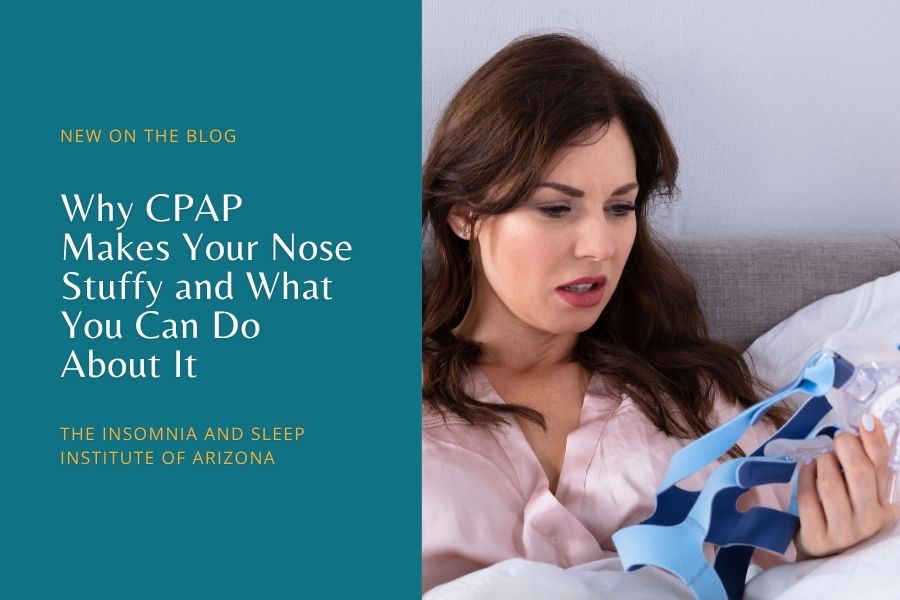
Waking up with a congested, dry, or dripping nose is one of the most frequent reasons patients struggle with continuous positive airway pressure (CPAP) therapy. When pressurized air continuously flows across sensitive nasal membranes, the tissue can swell in defense, creating a sensation of congestion even when you do not have a cold.
A stuffy nose does not mean CPAP is failing or that you cannot tolerate treatment. In most cases, it simply indicates that your humidity settings, mask seal, or underlying nasal health require fine-tuning.
CPAP works by sending a steady stream of air through a mask to keep the upper airway open during sleep. As medical literature establishes, CPAP “delivers a continuous flow of air to open the airways” (1). However, because that air is pressurized, it directly impacts the delicate mucous membranes lining your nasal passages. Nasal congestion, dryness, and a runny nose as some of the most common early side effects of PAP therapy.
Why Your Nose Swells Under Pressure
The inside of your nose is lined with delicate vascular tissue called turbinates. Their job is to filter, warm, and humidify every breath you take before that air reaches your lungs. When CPAP introduces a continuous draft of dry or cool air, these tissues lose moisture rapidly.
To protect themselves from drying out, the blood vessels inside your nasal lining expand, causing the tissue to swell. This swelling physically narrows the nasal airway, leaving you feeling congested before morning.
In other instances, the irritation triggers an overproduction of thin fluid. A 2022 study on CPAP-related nasal symptoms found that rhinorrhea, or a persistent runny nose, was one of the most widespread complaints and was directly linked to lower CPAP adherence (2). If nasal symptoms make wearing the mask uncomfortable, patients are far more likely to take the mask off in the middle of the night.
The Role of Mask Leaks and Airflow Dryness
When room air is pulled into a CPAP machine, it is often cooler and drier than the air your nasal passages prefer. Uncontrolled air leaks make this worse by creating a high-velocity draft that strips moisture directly from your mucous membranes.
Air leaks around the mask cushion frequently lead to a dry or stuffy nose, irritated eyes, dry mouth, and skin sores (3). When air escapes through gaps in the seal, the CPAP machine often increases airflow to compensate, accelerating the drying process.
Heated humidification can reduce nasal dryness and irritation for many patients, and is generally the first adjustment recommended when nasal symptoms develop (1) (2). By warming the air and delivering controlled moisture, the humidifier keeps the nasal lining hydrated so it does not swell defensively.
Mask Fit and Sleeping Dynamics
A common reaction to a leaking mask is pulling the headgear straps as tightly as possible. In practice, over-tightening compresses the silicone cushion, distorting the seal and causing more air to escape around the bridge of the nose.
To resolve mask instability and persistent leaks, the American Thoracic Society recommends readjusting the headgear, using a tubing management arm or specialized pillow to keep the hose from pulling, increasing the humidifier temperature, and utilizing saline sprays (4).
Finding the right mask style is equally important. Some patients thrive with minimalist nasal pillows, while others require a full-face mask because they breathe through their mouth when asleep. If mouth breathing occurs while wearing a nasal mask, pressurized air escapes through the lips, causing severe dryness in the throat and triggering additional nasal swelling.
Environmental Factors and Allergies
Your CPAP machine does not operate in a vacuum. If your nasal passages are already irritated before you go to bed, CPAP airflow will amplify that inflammation.
Allergies are especially prevalent among sleep apnea patients. A clinical meta-analysis revealed that allergic rhinitis is present in approximately 35.2% of adults with obstructive sleep apnea (5). In arid environments, such as the desert climate across Phoenix, Scottsdale, and Gilbert, indoor air conditioning and low outdoor humidity irritate the nasal lining during the day. When you put on your mask at night, the airway is already prone to congestion.
Practical Steps to Relieve CPAP Nasal Congestion
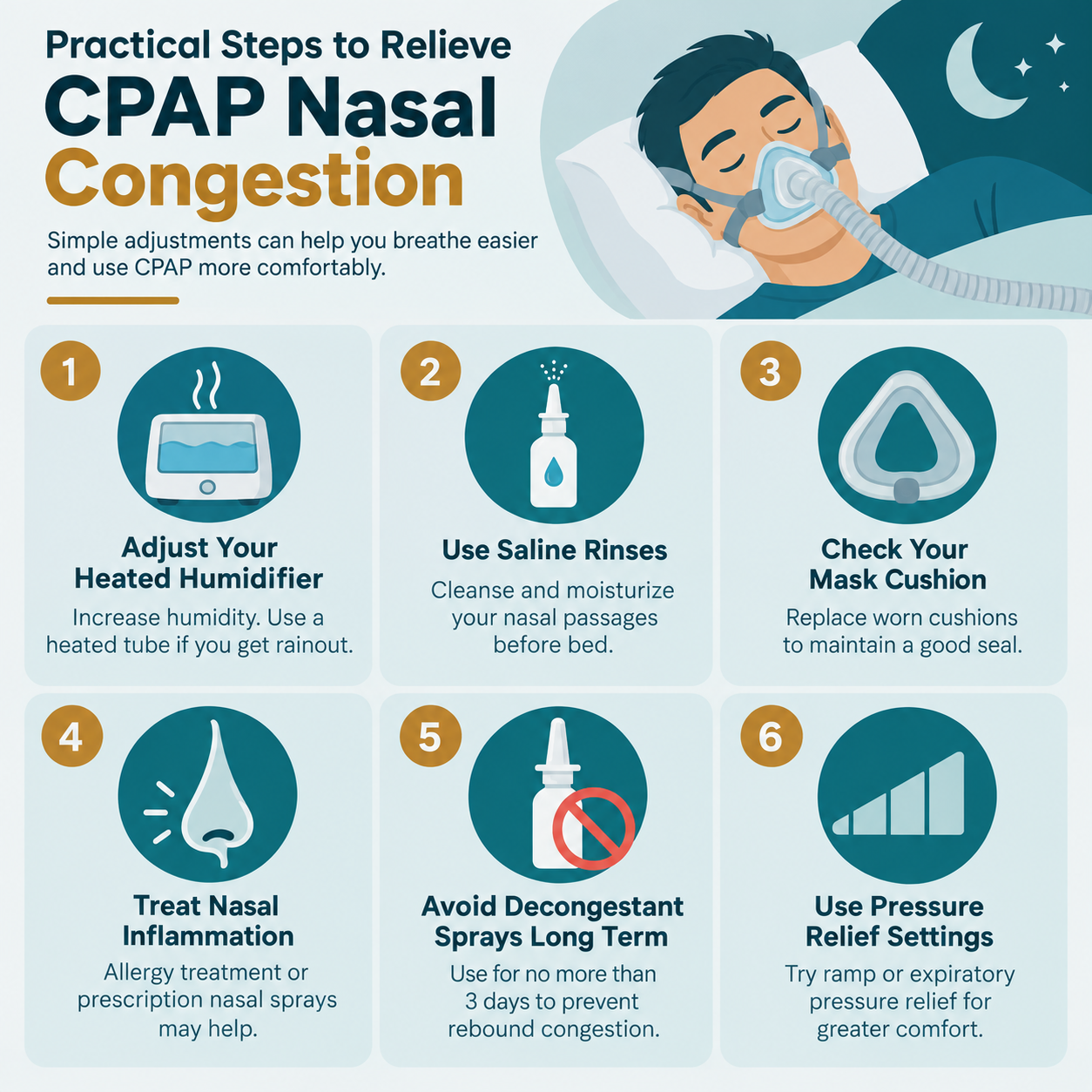
If you are dealing with nasal congestion or irritation, several targeted adjustments can help restore comfort:
- Adjust your heated humidifier: Gradually increase your humidifier level. If you notice moisture droplets pooling in your tube (known as rainout), pair the humidifier with a heated tube to keep the air warm throughout the hose.
- Use daily saline rinses: Rinsing with sterile saline spray or gel before bed moisturizes the nasal lining naturally without medication.
- Inspect your mask cushion: Silicone cushions lose their elasticity over time. Replacing cushions on schedule ensures a proper seal without over-tightening the headgear.
- Treat underlying nasal inflammation: For patients with chronic allergies or inflamed turbinates, prescription nasal steroid sprays or antihistamines can calm the tissue.
- Avoid prolonged use of over-the-counter decongestant sprays: While oxymetazoline sprays provide fast relief, DailyMed drug safety labeling warns that using them for more than three consecutive days can cause rebound congestion, making the blockage worse once the medication stops (6).
- Explore pressure relief settings: Features like ramp settings or expiratory pressure relief temporarily lower the pressure while you fall asleep or exhale, reducing the force against your nasal lining.
Finding Lasting Comfort
The Insomnia and Sleep Institute of Arizona helps people in Phoenix, Scottsdale, and Gilbert with sleep apnea testing, CPAP concerns, mask problems, pressure issues, nasal symptoms, and treatment alternatives when CPAP is not working well enough.
We review symptoms, therapy data, mask fit, leak patterns, nasal concerns, and sleep quality so treatment feels more realistic for nightly use.
If CPAP makes the nose stuffy, dry, or runny, do not stop treatment without getting rechecked. Contact The Insomnia and Sleep Institute of Arizona to schedule a sleep consultation and get help using CPAP more comfortably.
References
- Pinto, V. L., Abdulghani Sankari, & Sharma, S. (2025, July 7). Continuous Positive Airway Pressure. Nih.Gov; StatPearls Publishing. https://www.ncbi.nlm.nih.gov/books/NBK482178/
- Chaidas, K., Lamprou, K., Munnings, A., Stradling, J. R., & Nickol, A. H. (2022). Nasal Symptoms in Patients with Obstructive Sleep Apnoea and Their Association with Continuous Positive Airway Pressure Usage. Life, 12(2), 305. https://doi.org/10.3390/life12020305
- CPAP machines: Tips for avoiding 10 common problems. (2026). Mayo Clinic. https://www.mayoclinic.org/diseases-conditions/obstructive-sleep-apnea/in-depth/cpap/art-20044164
- American Thoracic Society | PAP Therapy–Quick Tips for…. (2021). American Thoracic Society. https://site.thoracic.org/advocacy-patients/patient-resources/pap-therapy-quick-tips-for-troubleshooting-to-address-problems-with-use
- Cao, Y., Wu, S., Zhang, L., Yang, Y., Cao, S., & Li, Q. (2018). Association of allergic rhinitis with obstructive sleep apnea. Medicine, 97(51), e13783. https://doi.org/10.1097/md.0000000000013783
- DailyMed – MAJOR NASAL DECONGESTANT- oxymetazoline hydrochloride spray. (2025). Nih.Gov. https://dailymed.nlm.nih.gov/dailymed/drugInfo.cfm?setid=a302e341-1c00-4c3d-b71f-c4c0b307aa67
Disclaimer: The information provided in this blog post is for educational and informational purposes only and is not intended as a substitute for professional medical advice, diagnosis, or treatment. Always consult with a licensed healthcare provider for recommendations specific to your individual health needs.