A qualified CBT-I therapist in Arizona should be licensed to provide clinical care, trained in cognitive behavioral therapy for insomnia, and able to recognize when insomnia may be connected to sleep apnea, restless legs syndrome, medications, anxiety, depression, pain, or another medical condition. In 2020, 14.5% of U.S. adults struggled to fall asleep most days or every day, and 17.8% struggled to stay asleep that often, showing that people seeking insomnia care are not unusual cases (1).
Chronic insomnia deserves a real clinical evaluation because insomnia symptoms can come from many causes, and strict diagnostic criteria place chronic insomnia disorder at about 6% to 10% of adults (2). Qualified providers must differentiate between sleep habits and underlying disorders, as treatment must be adapted for issues like breathing pauses, chronic pain, or medications (2).
In our clinic, we evaluate insomnia symptoms alongside possible medical, behavioral, and sleep-related causes. When signs suggest another sleep disorder, our team may recommend further testing before determining whether CBT-I or another form of treatment is appropriate.
What Qualifications Should a CBT-I Therapist in Arizona Have?
A CBT-I therapist in Arizona should have three layers of qualification:
- Active Professional License: Ensures the provider meets state rules for clinical practice.
- Specific CBT-I Training: Demonstrates knowledge of the structured insomnia protocol.
- Practical Experience: Critical because insomnia rarely looks the same from person to person.
For adults with chronic insomnia, CBT-I is the recommended initial treatment before long-term sleeping pill use because it targets the thoughts, behaviors, and schedules that maintain insomnia (3)(4). A qualified provider should explain the following in simple language:
- Sleep restriction and stimulus control
- Cognitive restructuring and relaxation training
- Sleep education and relapse prevention
A strong CBT-I provider goes beyond generic sleep hygiene by:
- Reviewing sleep diaries and calculating sleep efficiency.
- Safely adjusting time in bed.
- Explaining how lying awake in bed trains the brain to associate the bed with frustration.
CBT-I is a structured treatment, not a list of basic tips, and is clinically recommended for chronic insomnia (4). A trained CBT-I therapist addresses the learned patterns that cause insomnia to persist long after the original stressor has passed. By targeting these deeply ingrained behaviors, the therapist helps retrain the brain to restore natural sleep.
We provide this structured form of insomnia care at our Phoenix, Scottsdale, and Gilbert locations.
What CBT-I Training Should Include
A CBT-I provider should know how to use the main parts of the treatment, not only describe them. CBT-I usually includes sleep restriction therapy, stimulus control therapy, relaxation techniques, sleep hygiene education, and cognitive therapy for sleep-related thoughts.
Sleep restriction therapy reduces excess time awake in bed so the body can rebuild stronger sleep drive. Stimulus control therapy helps the brain reconnect the bed with sleep by changing behaviors such as lying awake, clock watching, worrying in bed, watching television in bed, or scrolling in bed. Cognitive therapy targets thoughts such as “I will never function tomorrow” or “I have to force myself to sleep now.”
CBT-I uses specific psychological and behavioral techniques to treat insomnia, with a meta-analysis of 87 randomized trials showing significant improvements in insomnia severity, sleep efficiency, and time to fall asleep (5). A provider who understands those tools should be able to adjust treatment based on the patient’s sleep diary rather than giving the same plan to every person.
While CBT-I programs typically run for six to eight sessions, the exact duration depends on factors like insomnia severity, medical complexity, and adherence (6). A qualified therapist will set clear expectations early, as the treatment can feel challenging initially while adjusting sleep schedules.
What Arizona Licenses Can CBT-I Providers Hold?
In Arizona, CBT-I may be provided by different licensed professionals, depending on their scope of practice and training. A provider may be a licensed psychologist, licensed professional counselor, licensed clinical social worker, licensed marriage and family therapist, physician, nurse practitioner, physician assistant, or another health professional with appropriate training in behavioral sleep medicine.
For psychologists, Arizona requires a doctoral degree in clinical, counseling, educational, or school psychology, and Arizona licensing information lists 3,000 hours of supervised professional experience for licensure (7,8). For professional counselors, Arizona board materials describe at least 3,200 hours of supervised work experience for professional counselor licensure (9).
What Is Behavioral Sleep Medicine Certification?
Behavioral sleep medicine certification gives patients another way to identify specialty training. The Diplomate in Behavioral Sleep Medicine, or DBSM, is offered by the Board of Behavioral Sleep Medicine to clinicians who meet eligibility requirements and pass a specialty examination (10).
The DBSM credential does not replace Arizona licensure, and the credentialing board clearly notes that state licensing laws still control what a clinician may legally do (10). That distinction matters because a sleep credential shows specialty knowledge, but an Arizona license shows legal authority to practice a clinical profession in the state.
In 2026, the Board of Behavioral Sleep Medicine testing page lists a Cognitive Behavioral Therapy for Insomnia Credential Examination, called CBTI-C, which signals growing formal recognition for CBT-I-specific competency (11). For patients, this means it is fair to ask whether the provider has CBT-I coursework, supervised CBT-I experience, DBSM, CBTI-C, fellowship training, or another sleep-focused credential.
How to Verify a CBT-I Provider in Arizona
Patients can verify a psychologist through the Arizona Board of Psychologist Examiners directory, which serves as primary source verification for credentials issued by that board (12). Patients can check behavioral health licenses through the Arizona Board of Behavioral Health Examiners directory and verification search for counselors, social workers, marriage and family therapists, and substance abuse counselors (12).
This step may feel uncomfortable, but it is a normal part of choosing care. License verification can show whether a license is active, expired, restricted, or connected to discipline. It can protect patients from unqualified coaching that uses medical language without clinical oversight.
Should Online CBT-I Be Done With an Arizona Provider?
Online CBT-I can help some patients, but licensure matters when therapy crosses state lines. For psychologists, PSYPACT allows eligible psychologists to practice telepsychology across participating states after obtaining proper authorization, including Authority to Practice Interjurisdictional Telepsychology (13).
Patients in Arizona should confirm that an online provider can legally treat someone located in Arizona at the time of the visit. This is different from asking whether the provider is friendly, experienced, or available. A provider must follow legal and professional rules for the state where the patient is receiving care.
Online CBT-I may be useful for people who live far from a sleep clinic, have transportation barriers, or need care around work schedules. In-person evaluation may be better when symptoms suggest sleep apnea, abnormal movements, complex parasomnias, severe daytime sleepiness, or medical conditions that need closer assessment.
When a CBT-I Therapist Should Refer to a Sleep Medicine Provider
A CBT-I therapist should refer or coordinate care when symptoms point beyond insomnia. Loud snoring, witnessed breathing pauses, gasping, morning headaches, dry mouth, high blood pressure, restless legs, dream enactment, severe daytime sleepiness, sleep attacks, or unusual nighttime behaviors deserve medical sleep evaluation.
A chronic insomnia evaluation should include medical history, medication history, psychiatric history, substance use, caffeine and alcohol patterns, exercise, stressors, sleep environment, sleep-wake timing, naps, daytime function, prior treatments, and bed partner observations about snoring or breathing pauses (2). A provider who skips those questions may miss a treatable sleep disorder.
This is where a sleep medicine team has an advantage. Insomnia can be behavioral, medical, neurological, psychiatric, circadian, respiratory, hormonal, medication-related, or mixed. CBT-I can still be part of treatment, but it should be used in the right clinical context.
Red Flags When Choosing a CBT-I Therapist in Arizona
When seeking care, be aware of certain warning signs that may indicate a provider is not properly trained in the clinical application of CBT-I. A professional and effective approach should avoid the following:
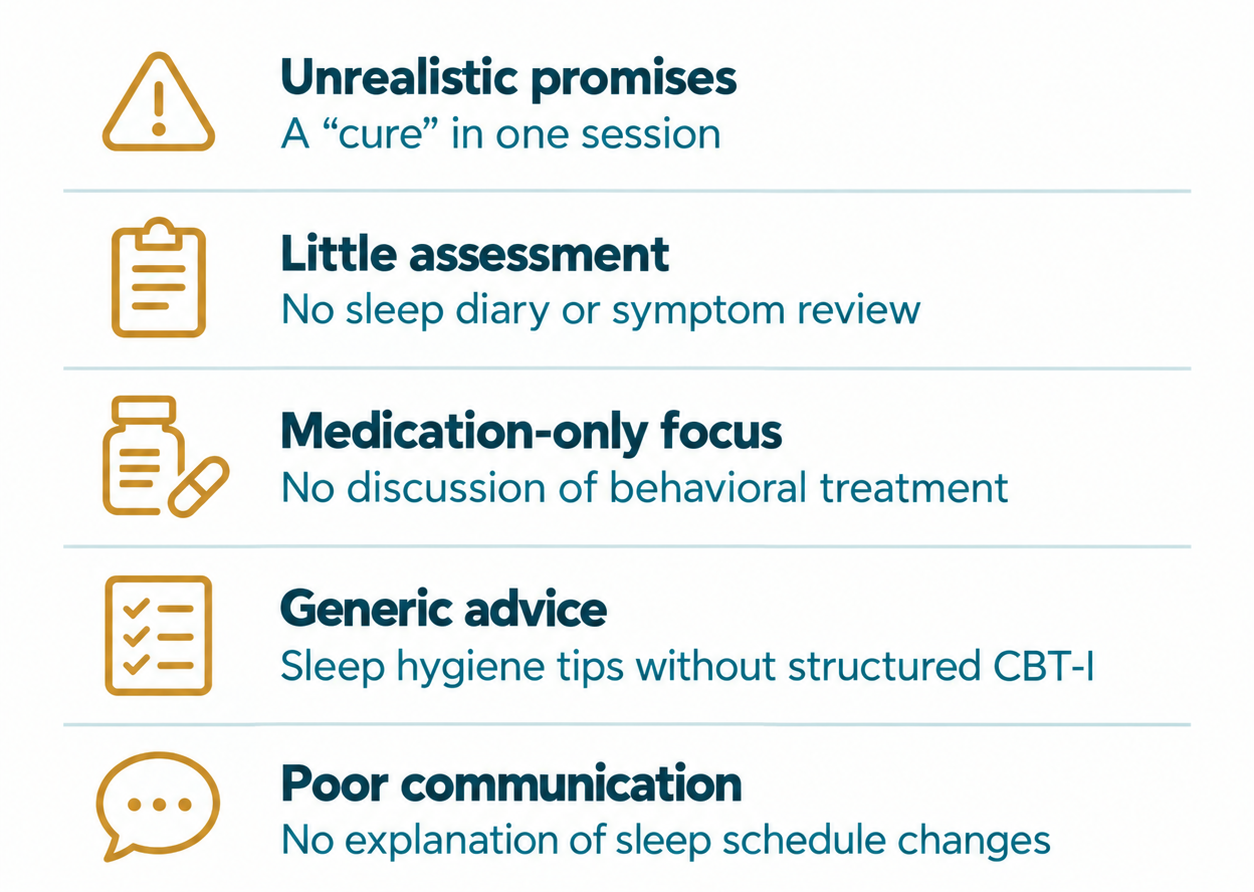
- Unrealistic Promises: Promising a “cure” in a single session or using a one-size-fits-all checklist.
- Lack of Assessment: Avoiding sleep diaries or dismissing symptoms like snoring, gasping, or severe daytime sleepiness.
- Over-Reliance on Medication: Recommending long-term sleep aids without discussing behavioral alternatives.
- Simplistic Advice: Treating insomnia as a willpower problem or providing generic hygiene tips rather than structured protocol.
- Poor Communication: Failing to explain the rationale behind schedule changes or the tracking process.
Experience Matters in CBT-I
Effective CBT-I requires ongoing clinical judgment to adapt treatment protocols based on weekly progress and safely investigate potential underlying diagnoses. We guide patients through challenging schedule changes with empathy, ensuring they understand that techniques like stimulus control are therapeutic tools for retraining the brain rather than rigid rules. Our skilled approach builds the trust necessary for patients to adhere to the plan and achieve lasting sleep improvements.
A good CBT-I therapist should be comfortable saying, “This may feel hard for a short time, but we will track it carefully and adjust it safely.” That kind of explanation builds trust and helps patients stay with the plan long enough to see change. When you visit us, you can avoid these red flags because we use careful assessment, clear explanations, and structured sleep tracking throughout CBT-I.
Why Choose The Insomnia and Sleep Institute of Arizona for CBT-I and Sleep Medicine?
If you are looking for CBT-I therapist qualifications in Arizona because sleep advice has not been enough, we can help you. At The Insomnia and Sleep Institute of Arizona, we are a physician-owned and operated comprehensive sleep medicine center with offices in Phoenix, Scottsdale, and Gilbert, and our team includes sleep medicine physicians and clinical psychologists focused on cognitive behavioral therapy for insomnia.
We evaluate adult and pediatric sleep disorders, and our work is centered on sleep medicine every day.
Book a consultation with our sleep team. We can help you understand your symptoms, discuss CBT-I, check for sleep disorders that may be affecting your nights, and guide you with the experience of a team that works with sleep problems every day.
References
- Adjaye-Gbewonyo, D., Ng, A. E., & Black, L. I. (2022). Sleep Difficulties in Adults: United States, 2020. NCHS Data Brief, no. 436. https://doi.org/10.15620/cdc:117490
- McNamara, S., Spurling, B. C., & Bollu, P. C. (2025, March 28). Chronic Insomnia. Nih.Gov; StatPearls Publishing. https://www.ncbi.nlm.nih.gov/books/NBK526136/
- Qaseem, A., Kansagara, D., Forciea, M. A., Cooke, M., & Denberg, T. D. (2016). Management of chronic insomnia disorder in adults: a clinical practice guideline from the American College of Physicians. Annals of Internal Medicine, 165(2), 125-133. https://doi.org/10.7326/M15-2175
- Edinger, J. D., Arnedt, J. T., Bertisch, S. M., Carney, C. E., Harrington, J. J., Lichstein, K. L., Sateia, M. J., Troxel, W. M., Zhou, E. S., Kazmi, U., Heald, J. L., & Martin, J. L. (2021). Behavioral and psychological treatments for chronic insomnia disorder in adults: an American Academy of Sleep Medicine clinical practice guideline. Journal of Clinical Sleep Medicine, 17(2), 255–262. https://doi.org/10.5664/jcsm.8986
- van Straten, A., van der Zweerde, T., Kleiboer, A., Cuijpers, P., Morin, C. M., & Lancee, J. (2018). Cognitive and behavioral therapies in the treatment of insomnia: A meta-analysis. Sleep Medicine Reviews, 38, 3-16. https://doi.org/10.1016/j.smrv.2017.02.001
- Walker, J., Muench, A., Perlis, M. L., & Vargas, I. (2022). Cognitive Behavioral Therapy for Insomnia (CBT-I): A Primer. Clinical Psychology and Special Education, 11(2), 123–137. https://doi.org/10.17759/cpse.2022110208
- Minimum Requirements | Board of Psychologist Examiners. (2025). Az.Gov. https://psychboard.az.gov/minimum-requirements
- Board of Psychologist Examiners. (n.d.). Psychologist Supervised Experience Requirements. Board of Psychologist Examiners (State of Arizona). https://psychboard.az.gov/psychologist-supervised-experience-requirements
- Supervised Work Experience and Clinical Supervision Requirements R4-6-503 Supervised Work Experience for Professional Counselor Licensure. (n.d.). https://bbhe.az.gov/sites/default/files/2025-01/Supervised%20work%20experience%20and%20clinical%20supervision%20requirements%20-%20counseling.pdf
- tulamin. (2020). About Diplomate of Behavioral Sleep Medicine Certification. Bsmcredential.Org. https://www.bsmcredential.org/index.php/certification#who-is-eligible-to-apply-for-dbsm-certification
- Board of Behavioral Sleep Medicine (BBSM) | Professional Testing Corporation. (2026, June 29). Professional Testing Corporation. https://ptcny.com/test-sponsors/bbsm/
- Directory – Licensee Search | Board of Psychologist Examiners. (2020). Az.Gov. https://psychboard.az.gov/directory-licensee-search
- PSYPACT – ASPPB The Centre. (2021, March 23). ASPPB The Centre. https://asppbcentre.org/focus/psypact/
Disclaimer: The information provided in this blog post is for educational and informational purposes only and is not intended as a substitute for professional medical advice, diagnosis, or treatment. Always consult with a licensed healthcare provider for recommendations specific to your individual health needs.