
Yes, insurance almost always covers Continuous Positive Airway Pressure (CPAP) machines and replacement supplies when you have a documented diagnosis of obstructive sleep apnea. However, some coverage is structured as a rent-to-own arrangement rather than an immediate purchase. Your insurer pays monthly rental fees only if you meet specific medical criteria and prove that you are using the device regularly.
What CPAP Coverage Means
When an insurance provider agrees to cover CPAP therapy, it means the insurer shares the cost of the machine and replacement supplies because a physician confirmed medical necessity. Insurers categorize CPAP machines as Durable Medical Equipment, or DME (1).
Coverage does not imply that your treatment is completely free. Instead, your insurer pays a percentage of the pre-negotiated cost after you satisfy your annual deductible. For instance, Medicare Part B covers 80 percent of the approved cost of a CPAP machine and necessary accessories once you meet your Part B deductible, leaving you responsible for the remaining 20 percent coinsurance (2).
In practical terms, Medicare and some private insurance plans pay for CPAP machines through a rent-to-own structure. The insurance company pays monthly rental fees to an approved medical equipment vendor for a designated period, which is 13 months under Medicare and varies by private plan. Once that rental period is complete and you have met all usage criteria, ownership of the machine transfers entirely to you.
How Private Insurance Handles CPAP Approvals
Most private health insurance plans include PAP therapy as part of their standard equipment benefits (3). However, private health plans do not issue approvals automatically. To secure authorization, the clinical team must follow a strict documentation checklist, providing the insurer with clear clinical evidence.
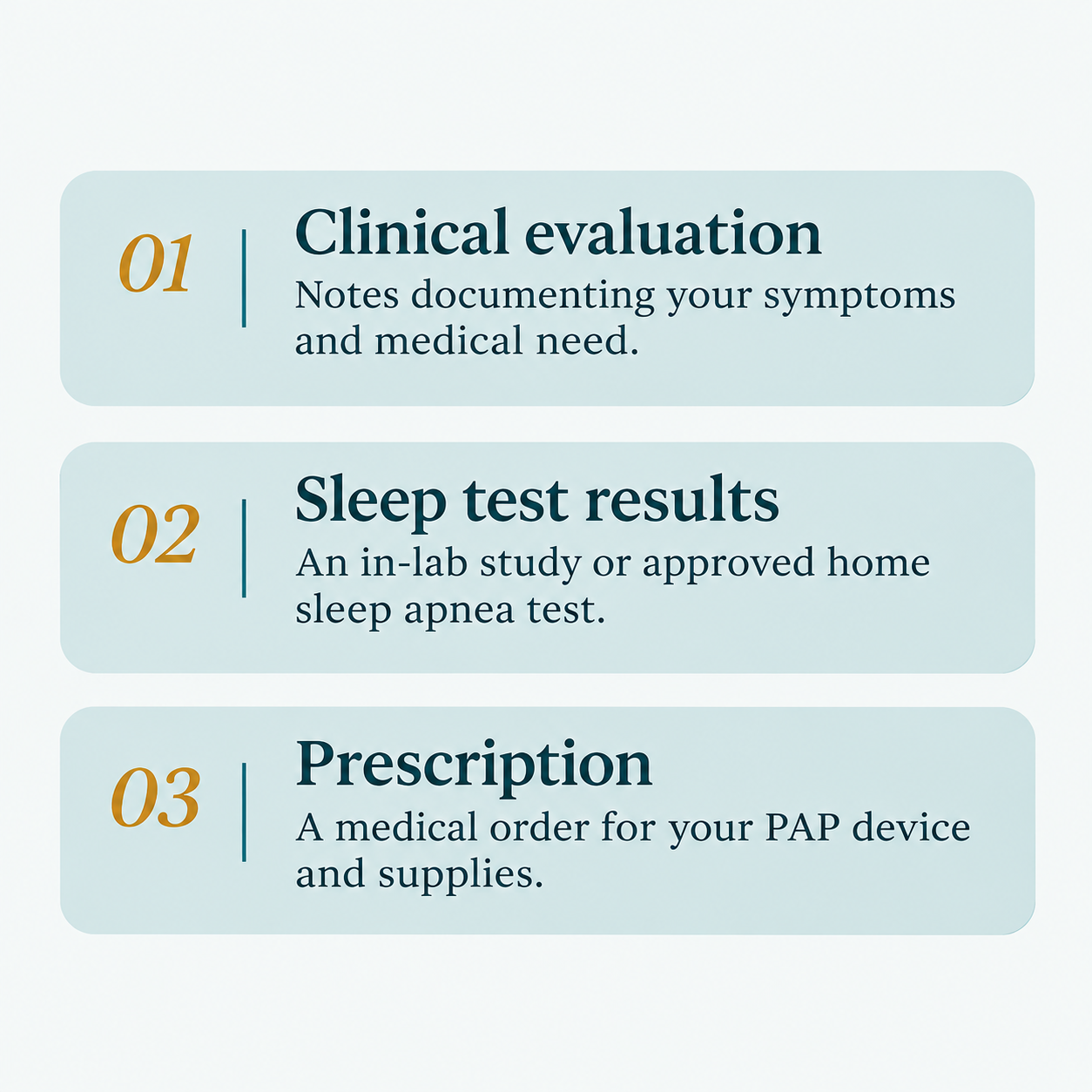
Private insurance guidelines, such as those published by Aetna (4), require three primary components before approving:
- A Comprehensive Evaluation: Detailed clinical notes from our sleep physicians documenting symptoms such as loud snoring, morning headaches, gasping during sleep, or excessive daytime tiredness.
- An Objective Sleep Test: Results from an accredited in-lab sleep study or an approved home sleep apnea test demonstrating an elevated Apnea-Hypopnea Index (AHI).
- A Valid Prescription: A formal medical order specifying the exact device type, pressure settings, mask style, and required accessories.
Depending on your specific policy, CPAP equipment may be covered under specific rental or purchase terms (5). We always advise patients to verify whether their insurance requires a preferred equipment vendor, because seeking equipment from unapproved suppliers often leads to higher out-of-pocket costs (6).
Medicare Rules and Long-Term Coverage Policies
Original Medicare Part B provides comprehensive coverage for CPAP equipment and replacement items when diagnostic requirements are satisfied. The coverage framework established by the Centers for Medicare and Medicaid Services (7) treats CPAP therapy as an ongoing medical treatment.
Under Medicare guidelines, coverage begins with an initial 12-week trial period. During these first three months, our sleep physicians evaluate whether the therapy effectively reduces your breathing pauses and improves your sleep quality. If the trial is successful, Medicare continues paying monthly rental fees for 13 months in total, including the trial, after which you own the device outright.
To keep coverage past the first three months, you need a face-to-face visit with your physician between day 31 and day 91 that documents improved symptoms, plus usage data showing you met the adherence requirement, as Medicare carrier guidelines explain (8). A 2013 cost-utility analysis in the Journal of Clinical Sleep Medicine by Billings and Kapur (9) found that Medicare’s adherence requirement raised net long-term adherence and quality-adjusted outcomes, though at a higher cost than a policy without it.
CPAP Compliance and Adherence
In the sleep medicine field, CPAP compliance refers to using your device consistently enough to achieve therapeutic benefit while satisfying your insurer’s payment rules.
For Medicare, and for many private plans that follow its lead, standard compliance is defined as using your CPAP machine for at least four hours per night on 70 percent of nights during a consecutive 30-day period within the first three months of use (8). Many modern CPAP devices contain built-in modems that transmit usage hours directly to our clinical portal and your equipment provider.
If a patient stops using the machine during the initial trial period, the insurer may discontinue rental payments. As noted in official Medicare carrier notices, failing to meet compliance thresholds can lead to a loss of equipment coverage or claim denials (8).
In our clinic, we recognize that adjusting to a CPAP mask can take time. If you experience mask discomfort, dry mouth, or difficulty exhaling against air pressure, our care team intervenes early. We adjust mask fits, fine-tune pressure settings, or add heated humidification to help you stay comfortable and fully compliant.
Medicaid and State Coverage (AHCCCS in Arizona)
For patients enrolled in Medicaid programs, such as the Arizona Health Care Cost Containment System (AHCCCS), CPAP machines and replacement supplies are covered when clinical documentation supports medical necessity under state training guidelines (10).
AHCCCS coverage policies, which are defined in the AHCCCS Medical Policy Manual (11), require prior authorization and clinical evidence of obstructive sleep apnea. Because Medicaid services are managed through contracted managed care health plans (12), specific supplier networks and administrative steps may vary depending on your assigned health plan. Our administrative specialists can help you ensure all documentation is submitted correctly and without delay.
Why Insurance Claims Get Denied and How We Fix Them
When a CPAP insurance claim is delayed or denied, the issue is usually missing paperwork rather than a lack of medical need. According to data from the Centers for Medicare and Medicaid Services, insufficient documentation accounted for 71.2 percent of improper Medicare payments for CPAP devices in 2024 (13).
The most common documentation errors include:
- Missing or incomplete physician visit notes describing sleep apnea symptoms.
- Sleep study reports that lack required technical parameters or clinician signatures.
- Omission of required prior authorization forms before equipment delivery.
- Incomplete usage data downloads during the initial compliance window.
Because our clinic manages the entire care pathway, from initial consultation and sleep testing to equipment ordering and data monitoring, we catch these documentation gaps early. We verify all insurer requirements before ordering your equipment so your claim moves smoothly through the approval process.
Out-of-Pocket Costs and When Cash Purchase Makes Sense
Even with full insurance approval, patients should anticipate some out-of-pocket expenses. You will typically be responsible for your plan’s annual deductible and coinsurance percentages for the machine, mask, tubing, and filters.
In certain circumstances, buying a CPAP machine out of pocket without using insurance can be a practical option. Patients with high-deductible health plans, individuals who travel frequently and require a compact travel CPAP, or those seeking immediate equipment delivery without waiting for prior authorization sometimes choose to purchase equipment directly.
Even when buying equipment out of pocket, a valid prescription from a licensed physician is legally required. Furthermore, maintaining regular follow-up visits with our sleep specialists remains essential to monitor your treatment progress and catch problems early.
Sleep Apnea in the Public Eye
Obstructive sleep apnea affects tens of millions of people, including high-profile athletes and leaders, and it can be effectively managed with treatment.
- Shaquille O’Neal: The NBA legend has publicly discussed his obstructive sleep apnea diagnosis and experience trying CPAP. He also promotes sleep apnea awareness and treatment through a paid partnership with Eli Lilly, the maker of Zepbound.
- Former President Joe Biden: His physician reported that a 2023 sleep study confirmed sleep apnea and that he has been consistent with CPAP use, which brought national attention to the treatment.
These examples underscore that while sleep apnea is serious, it is entirely manageable with consistent therapy.
Get CPAP Covered And Actually Feel Better
At the Insomnia and Sleep Institute of Arizona, we help patients move past confusion, delays, and denials and into treatment that actually works. We handle the medical evaluation, the sleep testing pathway, and the documentation insurers require, so CPAP approval does not turn into a months-long struggle. Our team understands how private insurance, Medicare, and AHCCCS review CPAP claims, and we know how to document medical necessity correctly the first time.
More importantly, we do not stop at prescribing a machine. We monitor progress, address comfort and tolerance issues early, and guide follow-up care so treatment remains effective and coverage stays intact. If you are overwhelmed by insurance rules, or unsure whether CPAP is right for you, our specialists can help you get clear answers and a clear plan. Contact us to schedule a consultation.
We are offering sleep evaluations and treatment in Phoenix, Scottsdale, and Gilbert.
References
- Durable medical equipment (DME) – Glossary. (2026). HealthCare.gov. https://www.healthcare.gov/glossary/durable-medical-equipment-dme/
- Continuous Positive Airway Pressure (CPAP) therapy. (2026). Medicare. https://www.medicare.gov/coverage/continuous-positive-airway-pressure-devices
- Wilbanks, J. (2021, March 30). PAP and Insurance Sleep Education. Sleep Education. https://sleepeducation.org/patients/pap-and-insurance/
- Obstructive Sleep Apnea in Adults – Medical Clinical Policy Bulletins | Aetna. (2017). Aetna.com. https://www.aetna.com/cpb/medical/data/1_99/0004.html
- Durable medical equipment (DME) coverage. (2026). Medicare. https://www.medicare.gov/coverage/durable-medical-equipment-dme-coverage
- Durable Medical Equipment. (2025). Emblemhealth.com; Emblem Health. https://www.emblemhealth.com/providers/manual/durable-medical-equipment
- Continuous Positive Airway Pressure Devices & Accessories | CMS. (2024). Cms.gov. https://www.cms.gov/training-education/medicare-learning-networkr-mln/compliance/medicare-provider-compliance-tips/cpap-devices-accessories
- Policy Reminder – PAP Devices – Continued Coverage beyond the First Three Months of Therapy – JD DME – Noridian. (2016). JD DME. https://med.noridianmedicare.com/web/jddme/policies/dmd-articles/policy-reminder-pap-devices-continued-coverage-beyond-the-first-three-months-of-therapy
- Billings, M. E., & Kapur, V. K. (2013). Medicare Long-Term CPAP Coverage Policy: A Cost-Utility Analysis. Journal of Clinical Sleep Medicine, 09(10), 1023–1029. https://doi.org/10.5664/jcsm.3074
- AHCCCS Provider Training. (2025, September 3). Division of Fee-For-Service Management: Training Resources. Ahcccs. https://www.azahcccs.gov/Resources/Training/DFSM_Training.html
- Arizona Health Care Cost Containment System (AHCCCS). (2026, October 26). AHCCCS Medical Policy Manual (AMPM). AHCCCS (Arizona Health Care Cost Containment System). https://www.azahcccs.gov/shared/MedicalPolicyManual/index.html
- AHCCCS Health Plans. (2025). Azahcccs.Gov. https://www.azahcccs.gov/healthplans
- Continuous Positive Airway Pressure Devices & Accessories | CMS. (2024). Cms.gov. https://www.cms.gov/training-education/medicare-learning-networkr-mln/compliance/medicare-provider-compliance-tips/cpap-devices-accessories
Disclaimer: The information provided in this blog post is for educational and informational purposes only and is not intended as a substitute for professional medical advice, diagnosis, or treatment. Always consult with a licensed healthcare provider for recommendations specific to your individual health needs.