Alternatives to melatonin include behavioral therapies, medical treatments, natural nutrients, and lifestyle changes that address the underlying causes of poor sleep. Many people move away from melatonin because it can cause grogginess, lose effectiveness over time, or fail to treat conditions such as insomnia or sleep apnea.
Evidence-based options such as cognitive behavioral therapy for insomnia (CBT-I), CPAP therapy, Inspire therapy, magnesium supplementation, lavender, and improved sleep hygiene often provide deeper and longer-lasting benefits. Choosing the right approach depends on identifying the root cause of sleep problems, which is why professional evaluation is needed.
Why Do People Seek Alternatives to Melatonin?
Melatonin is one of the most widely used sleep supplements in the United States. Millions of people take it every night in hopes of improving their sleep. However, a growing number are now seeking alternatives.
Some individuals find that melatonin provides little to no benefit at all (1). Others may experience side effects such as vivid dreams, morning grogginess, headaches, or daytime drowsiness (2).
Many people also question whether it’s safe to take melatonin more than once in a single night. This uncertainty reflects, a more widespread confusion that exists about the supplement’s proper dosing and use.
Melatonin is a hormone naturally produced by the brain in response to darkness. Its primary role is to signal the body that it is time to prepare for sleep. When taken as a supplement, it can be helpful for circadian rhythm disruptions, such as jet lag or shift work disorder (3).
However, in most cases of chronic insomnia, sleep apnea, or restless sleep, the issue is not melatonin deficiency. This explains why supplementation often fails and whypatients increasingly turn to alternatives that target the true cause of their sleep problems.
Common Reasons People Abandon Melatonin
- Ineffectiveness: Melatonin may only reduce sleep latency by a few minutes in adults with chronic insomnia (4). For someone who lies awake for hours, this small improvement can feel insignificant.
- Side Effects: Drowsiness, headache and dizziness are reported, particularly with higher doses (5). Since many people take far above the commonly studied range of 0.5 to 3 mg, these problems are increasingly common.
- Inconsistent Results: Some users experience temporary improvement, followed by nights with little or no benefit. This inconsistency leads to frustration and loss of confidence in the supplement.
- Underlying Sleep Disorders: Conditions such as obstructive sleep apnea, restless legs syndrome, depression, and anxiety frequently drive poor sleep. Melatonin does not treat these disorders, leaving symptoms unresolved.
- Safety Concerns in Children: Parents worry about the potential effects on puberty and long-term hormone development.
These limitations help explain the growing interest in safer, stronger, and evidence-based alternatives.
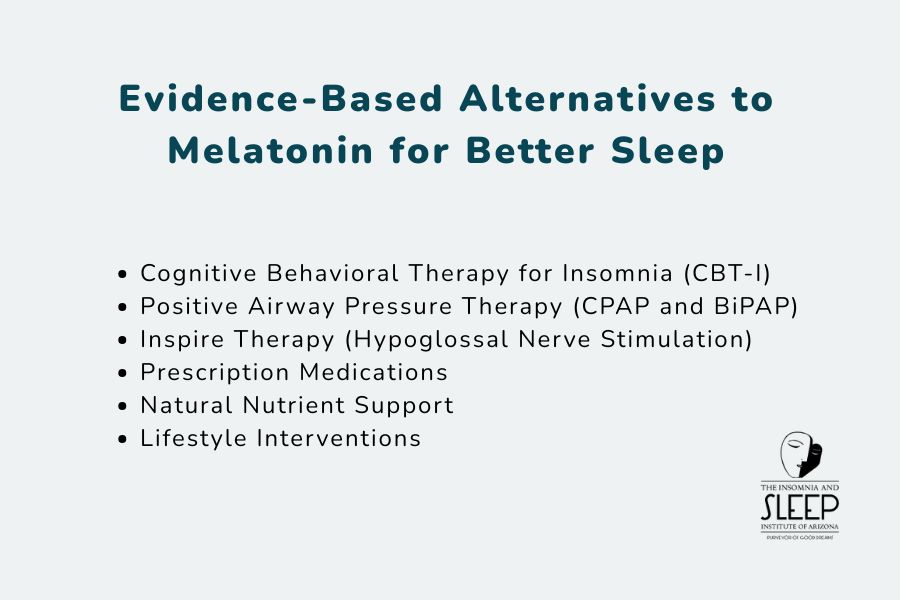
Evidence-Based Alternatives to Melatonin for Better Sleep
Effective sleep care goes far beyond a single supplement. Patients benefit most from treatments that restore restorative sleep without relying on trial-and-error supplementation.
1. Cognitive Behavioral Therapy for Insomnia (CBT-I)
CBT-I is considered the gold standard treatment for chronic insomnia. Research shows it is more effective than sleep medications for improving sleep onset, reducing nighttime awakenings, and maintaining long-term benefits (6, 7).
CBT-I addresses the thoughts and behaviors that perpetuate insomnia through techniques such as sleep restriction, stimulus control, cognitive restructuring, and relaxation training.
Patients learn to reduce sleep-related anxiety and retrain the brain to fall asleep naturally. CBT-I is a core therapy offered at the Insomnia and Sleep Institute of Arizona and is delivered by trained clinicians and board-certified sleep specialists.
2. Positive Airway Pressure Therapy (CPAP and BiPAP)
For patients with obstructive sleep apnea, melatonin is ineffective because the underlying problem is airway collapse, not circadian rhythm disruption. CPAP remains the most effective therapy, keeping the airway open with gentle air pressure.
CPAP has been shown to reduce daytime sleepiness, lower cardiovascular risk, and improve overall quality of life. Many patients who previously relied on melatonin report their first truly refreshing sleep after starting CPAP therapy.
3. Inspire Therapy (Hypoglossal Nerve Stimulation)
Some patients cannot tolerate CPAP. For these individuals, Inspire therapy offers a proven alternative. This FDA-approved implant stimulates the hypoglossal nerve, which controls tongue movement, to keep the airway open during sleep.
Clinical trials demonstrate significant reductions in apnea-hypopnea index and improvement in daytime functioning (8). Qualified patients at our institute can undergo Inspire evaluations to determine whether this therapy is appropriate.
4. Prescription Medications
When behavioral and medical therapies require additional support, prescription sleep medications may be considered under medical supervision. These include:
- Orexin receptor antagonists such as suvorexant and lemborexant, which regulate the brain’s wake-sleep signaling.
- Short-term hypnotics, such as zolpidem or eszopiclone, are effective for sleep initiation and maintenance but require careful monitoring (9).
- Low-dose antidepressants, such as trazodone or doxepin, are sometimes prescribed when insomnia co-occurs with depression or anxiety (10).
All prescription treatments should be overseen by a qualified healthcare provider.
5. Natural Nutrient Support
Some patients prefer natural options backed by research (11, 12, 13):
- Magnesium: Helps regulate neurotransmitters and supports relaxation. Clinical trials suggest it can improve sleep quality in older adults.
- Valerian root: Has mild sedative effects, though results are mixed across studies.
- Chamomile: Contains apigenin, a flavonoid that binds to brain receptors linked with sleep.
- Lavender: Aromatherapy and oral supplements have been shown to reduce anxiety and improve subjective sleep quality.
- Glycine: An amino acid that may lower body temperature and promote deeper sleep stages.
These options may help mild sleep difficulties but are generally insufficient for chronic or medically complex insomnia.
6. Lifestyle Interventions
Some of the most effective sleep improvements require no medication at all. Consistent wake times, morning light exposure, reduced afternoon caffeine intake, and limiting screen use before bed can significantly improve sleep quality (14).
Regular physical activity has also been shown to reduce sleep onset latency and increase total sleep time. These strategies support the body’s natural sleep-wake rhythm, something melatonin alone cannot.
Why This Matters
The growing search for melatonin alternatives reflects a larger truth: poor sleep is rarely solved by a supplement alone. Millions of Americans struggle with sleep disorders that require precise diagnosis and targeted treatment.
Continuing to rely on melatonin without improvement increases the risk of chronic fatigue, impaired concentration, weakened immunity, and accidents. Evidence-based alternatives such as CBT-I, CPAP, Inspire therapy, lifestyle modifications, and physician-led medical care offer real, lasting solutions.
Professional Help Matters for Lasting Sleep Solutions
Long-term sleep improvement requires more than trial-and-error supplementation. Most sleep disorders have identifiable, treatable causes. Insomnia, sleep apnea, circadian rhythm disorders, restless legs syndrome, and parasomnias often present with overlapping symptoms, leading many patients to self-treat with melatonin.
Research shows untreated insomnia is associated with a twofold increase in depression and anxiety risk (15). Untreated sleep apnea increases the likelihood of cardiovascular disease, stroke, and motor vehicle accidents (16) . Professional evaluation is critical.
Sleep specialists assess sleep from multiple angles, including breathing, brain activity, heart function, and lifestyle contributors, using tools such as in-lab polysomnography and at-home sleep testing. Once identified, treatment becomes precise and effective.
Consult The Insomnia and Sleep Institute of Arizona Today
The Insomnia and Sleep Institute of Arizona is recognized as a leader in sleep medicine across Scottsdale, Gilbert, Phoenix, and surrounding communities. Our institute provides physician-led care supported by years of clinical experience and cutting-edge diagnostic testing.
Every patient is evaluated by experts who specialize in sleep medicine, ensuring that treatment decisions are grounded in medical evidence rather than one-size-fits-all solutions.
We offer comprehensive treatment options, including CBT-I, CPAP and BiPAP management, Inspire therapy, and in-lab sleep studies for complex cases. Our approach also integrates mental health and lifestyle factors to create individualized care plans.
Sleep is directly connected to energy, mood, memory, and long-term health. Without proper care, poor sleep contributes to diabetes, hypertension, depression, and accelerated aging. With expert treatment, patients often regain restorative rest, sharper focus, and renewed quality of life.
Contact The Insomnia and Sleep Institute of Arizona today.
References
- Hamel, C., & Horton, J. (2022, May). Melatonin for the Treatment of Insomnia: A 2022 Update. Nih.gov; Canadian Agency for Drugs and Technologies in Health. https://www.ncbi.nlm.nih.gov/books/NBK605080/
- Melatonin as a medication and supplement – Wikipedia. (2022). Wikipedia.org. https://en.wikipedia.org/wiki/Melatonin_as_a_medication_and_supplement
- Costello, R. B., Lentino, C. V., Boyd, C. C., O’Connell, M. L., Crawford, C. C., Sprengel, M. L., & Deuster, P. A. (2014). The effectiveness of melatonin for promoting healthy sleep: a rapid evidence assessment of the literature. Nutrition Journal, 13(1). https://doi.org/10.1186/1475-2891-13-106
- Ferracioli-Oda, E., Qawasmi, A., & Bloch, M. H. (2013). Meta-Analysis: Melatonin for the Treatment of Primary Sleep Disorders. PLoS ONE, 8(5), e63773. https://doi.org/10.1371/journal.pone.0063773
- Schrire, Z. M., Phillips, C. L., Chapman, J. L., Duffy, S. L., Wong, G., D’Rozario, A. L., Comas, M., Raisin, I., Saini, B., Gordon, C. J., McKinnon, A. C., Naismith, S. L., Marshall, N. S., Grunstein, R. R., & Hoyos, C. M. (2021). Safety of higher doses of melatonin in adults: A systematic review and meta‐analysis. Journal of Pineal Research, 72(2), e12782–e12782. https://doi.org/10.1111/jpi.12782
- Rossman, J. (2019). Cognitive-Behavioral Therapy for Insomnia: An Effective and Underutilized Treatment for Insomnia. American Journal of Lifestyle Medicine, 13(6), 544–547. https://doi.org/10.1177/1559827619867677
- van der Zweerde, T., Bisdounis, L., Kyle, S. D., Lancee, J., & van Straten, A. (2019). Cognitive behavioral therapy for insomnia: A meta-analysis of long-term effects in controlled studies. Sleep Medicine Reviews, 48, 101208. https://doi.org/10.1016/j.smrv.2019.08.002
- Olson, M. D., & Junna, M. R. (2021). Hypoglossal Nerve Stimulation Therapy for the Treatment of Obstructive Sleep Apnea. Neurotherapeutics, 18(1), 91–99. https://doi.org/10.1007/s13311-021-01012-x
- Rösner, S., Englbrecht, C., Wehrle, R., Hajak, G., & Soyka, M. (2018). Eszopiclone for insomnia. Cochrane Database of Systematic Reviews, 2018(10). https://doi.org/10.1002/14651858.cd010703.pub2
- Everitt, H., Baldwin, D. S., Stuart, B., Gosia Lipinska, Mayers, A., Malizia, A. L., Manson, C. C., & Wilson, S. (2018). Antidepressants for insomnia in adults. Cochrane Database of Systematic Reviews, 2018(5), CD010753–CD010753. https://doi.org/10.1002/14651858.cd010753.pub2
- Rösner, S., Englbrecht, C., Wehrle, R., Göran Hajak, & Soyka, M. (2018). Eszopiclone for insomnia. Cochrane Database of Systematic Reviews, 2018(10), CD010703–CD010703. https://doi.org/10.1002/14651858.cd010703.pub2
- Guadagna, S., Barattini, D. F., Rosu, S., & Ferini-Strambi, L. (2020). Plant Extracts for Sleep Disturbances: A Systematic Review. Evidence-Based Complementary and Alternative Medicine, 2020(1). https://doi.org/10.1155/2020/3792390
- Ramos-Jiménez, A., Hernández-Torres, R. P., Hernández-Ontiveros, D. A., Melinna Ortiz-Ortiz, Reymond Josué López-Fregoso, José Miguel Martínez-Sanz, Rodríguez-Uribe, G., & Hernández-Lepe, M. A. (2024). An Update of the Promise of Glycine Supplementation for Enhancing Physical Performance and Recovery. Sports, 12(10), 265–265. https://doi.org/10.3390/sports12100265
- Alnawwar, M. A., Alraddadi, M. I., Algethmi, R. A., Salem, G. A., Salem, M. A., & Alharbi, A. A. (2023). The Effect of Physical Activity on Sleep Quality and Sleep Disorder: A Systematic Review. Cureus, 15(8), e43595–e43595. https://doi.org/10.7759/cureus.43595
- Franzen, P. L., & Buysse, D. J. (2008). Sleep disturbances and depression: risk relationships for subsequent depression and therapeutic implications. Dialogues in Clinical Neuroscience, 10(4), 473–481. https://doi.org/10.31887/dcns.2008.10.4/plfranzen
- Girardin Jean-Louis, Zizi, F., Clark, L. T., Brown, C. D., & McFarlane, S. I. (2008). Obstructive Sleep Apnea and Cardiovascular Disease: Role of the Metabolic Syndrome and Its Components. Journal of Clinical Sleep Medicine : JCSM : Official Publication of the American Academy of Sleep Medicine, 4(3), 261. https://pmc.ncbi.nlm.nih.gov/articles/PMC2546461/
Disclaimer: The information provided in this blog post is for educational and informational purposes only and is not intended as a substitute for professional medical advice, diagnosis, or treatment. Always consult with a licensed healthcare provider for recommendations specific to your individual health needs.