At-home sleep studies are useful for detecting moderate to severe obstructive sleep apnea, particularly in adults with a high likelihood of the condition and no major underlying health issues. However, they are not as accurate as in lab sleep studies, and they don’t test for other sleep health issues, such as insomnia or periodic limb movement.
These tests use FDA-approved portable devices to measure airflow, oxygen levels, respiratory effort, and heart rate while you sleep in your own bed. However, they don’t record brain activity, muscle tone, or sleep stages, making them unsuitable for diagnosing other conditions like central sleep apnea, narcolepsy, or REM behavior disorders.
Home Sleep Tests: Surprisingly Reliable for Many
Home sleep tests (HSTs) aren’t perfect, but when used appropriately, they’re surprisingly reliable for detecting obstructive sleep apnea (OSA). Research shows that HSTs can perform quite well compared to in-lab polysomnography (PSG), the gold standard for diagnosis.
For the most commonly used measurement, the Apnea-Hypopnea Index (AHI), studies report [1]:
- Sensitivity: 81–95%, meaning HSTs catch most people who truly have OSA
- Specificity: 66–100%, showing a broad but generally good ability to rule out people who don’t have it
- Positive Predictive Value (PPV): 79.4–96%, so if the test is positive, there’s a high chance you really have OSA
- Negative Predictive Value (NPV): 92%, meaning a negative result is usually correct
When using the Respiratory Disturbance Index (RDI), which includes even milder breathing issues during sleep, HSTs still performed well:
- Sensitivity: 89%
- Specificity: 77%
- PPV: 82%
- NPV: 86%
This shows that home sleep tests might not catch every detail of a sleep disorder. But they do a solid job identifying people who likely need treatment. This is especially true for those with moderate to severe OSA.
Still, accuracy depends on more than just the device. Factors like how well the test is set up, how it’s interpreted, and individual patient differences all play a role. That’s why it’s always best to review results with a qualified sleep specialist.
Why Do So Many People Choose Home Sleep Tests?
Home Sleep Apnea Tests (HSATs) have become an increasingly popular option for diagnosing obstructive sleep apnea (OSA), especially among individuals seeking a more convenient and cost-effective alternative to in-lab studies. Here’s why:
Cost-Effectiveness: HSATs are generally more affordable than in-lab polysomnography (PSG). The cost of a home sleep test typically ranges from $150 to $500, whereas in-lab studies can cost between $1,000 and $2,000+, depending on different factors such as location and insurance coverage.
Insurance Coverage: Many insurance providers cover home sleep tests when prescribed by a qualified healthcare provider for patients with a high likelihood of moderate to severe OSA. However, coverage policies can vary, so it’s essential to verify with your insurance company whether HSATs are included in your plan.
Convenience and Comfort: HSATs allow you to undergo testing in the comfort of your own home, eliminating the need to spend a night in a sleep lab. This can be particularly beneficial for individuals who experience anxiety in clinical settings or have scheduling constraints.
Accessibility: For people in rural areas, home sleep tests make it easier to get tested for sleep apnea. You don’t need to travel far to a sleep center.
Timeliness: Home sleep tests often have shorter wait times compared to in-lab studies, enabling quicker diagnosis and initiation of treatment.
But, What Can Go Wrong with a Home Test?
Even accurate devices can yield inaccurate results if something goes wrong during the test.
- Sensor dislodgement: If your nasal cannula or pulse oximeter falls off during sleep, the device can miss critical data.
- Mouth breathing: If the device only monitors nasal airflow and you breathe through your mouth, apneas might not be recorded.
- Poor sleep quality: One restless night can skew results. If you don’t enter the stages of sleep where apnea typically occurs, you might get a false negative.
- Limited channels: HSTs typically don’t measure brain activity (EEG), leg movements, or EKG. So they miss non-respiratory disorders like periodic limb movement disorder, insomnia, or narcolepsy.
- One-night limitation: Sleep is variable. A single test night doesn’t always reflect your typical sleep.
This is why the interpretation of results is just as important as the numbers themselves.
How Do Doctors Interpret Home Sleep Test Results?
Sleep specialists don’t rely on the device printout alone. They always place your results in clinical context:
- Do your symptoms match the data?
- Was the test night typical for you?
- Were all sensors functioning the entire time?
For example, if your HST shows no apnea but your partner reports you snore and gasp at night, and you’re still exhausted every morning, the result is not “normal” until proven otherwise.
Physicians might repeat the test, explore other sleep disorders, or move to a full PSG. Good interpretation requires training, experience, and patient insight, not just algorithms.
Also important: severity classification. If HST flags apnea but doesn’t clarify if it’s mild, moderate, or severe, a PSG may be necessary to guide treatment (e.g., CPAP vs. surgery).
When Is a Home Sleep Study Not Enough?
Home sleep tests are a first-line tool, not a one-size-fits-all diagnostic solution. They’re best suited for:
- Adults with moderate-to-high likelihood of OSA
- No serious comorbidities (e.g., heart failure, COPD, neuromuscular disease)
- Clear, uncomplicated symptoms
But in other cases, PSG is necessary. Specifically:
- Cardiopulmonary disease: HSTs don’t assess heart rhythm or complex breathing patterns.
- Suspected central sleep apnea: HSTs don’t distinguish between central and obstructive events.
- Neurological disorders: Conditions like Parkinson’s, epilepsy, or narcolepsy require brainwave monitoring.
- Poor initial results: If your HST comes back negative but symptoms persist, further testing is essential.
In short, if you’re the exception, not the rule, a lab study is the gold standard. And your doctor should be honest with you about that.
How Does the Device Work, and Does That Matter?
A home sleep test (HST) relies on simplified equipment, typically a Type III device, to measure basic respiratory parameters while you sleep.
Most devices may include:
- Nasal cannula: Measures airflow through your nose
- Chest or abdominal belt: Detects breathing effort
- Finger pulse oximeter: Monitors blood oxygen levels
- Microphone or snore sensor: Captures snoring vibrations
Some models go even simpler, a watch-like device paired with a chest sensor and oximeter.
What If My Home Sleep Test Was Normal But I Still Feel Terrible?
This happens more often than people think. A “normal” HST doesn’t always mean your sleep is healthy.
- You could have central sleep apnea, a brain-related issue that HSTs often miss.
- Your sensors may have dislodged or failed during the night, skewing results.
- You might suffer from non-respiratory sleep disorders like insomnia, restless legs syndrome, or narcolepsy, none of which HSTs can detect.
- Some apnea events only appear during REM sleep, which HSTs don’t track.
How Do Home Tests Compare to In-Lab Studies?
Here’s a side-by-side breakdown:
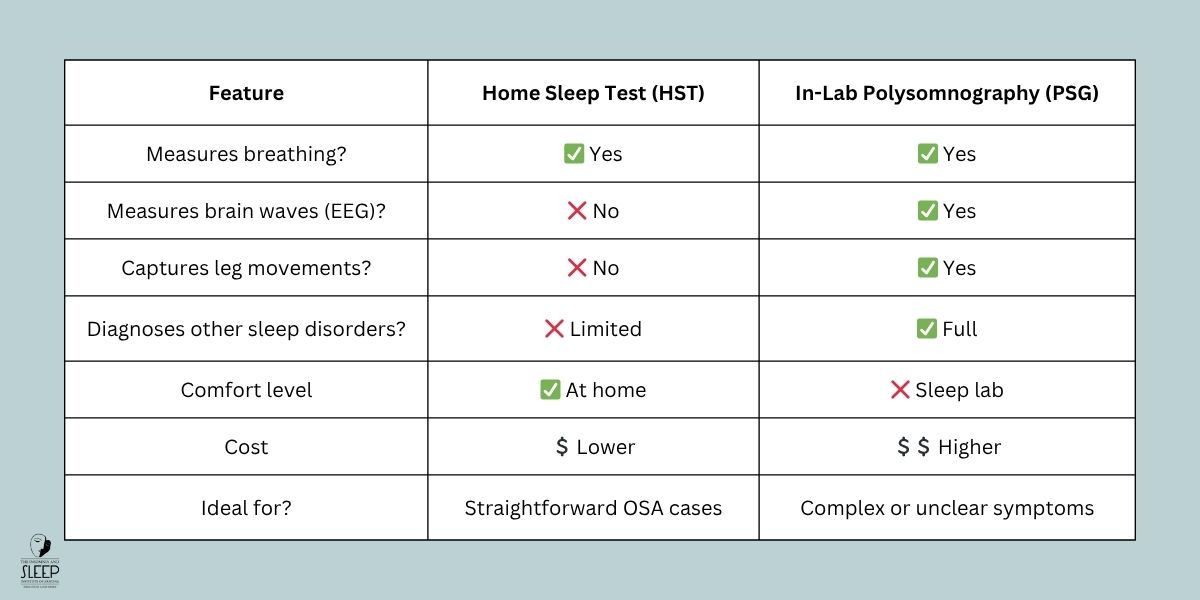
HSTs are excellent screening tools. But PSG remains the gold standard when precision is non-negotiable.
Want Reliable Results and Expert Care? Work with The Insomnia and Sleep Institute of Arizona
Sleep issues aren’t solved by guesswork or generic devices. At The Insomnia and Sleep Institute of Arizona, every test is chosen based on real symptoms, medical history, and clinical need. A home study might be enough, or it might miss something important. That’s why every case is reviewed by board-certified sleep specialists who read the data, make sense of the patterns, and connect findings to treatment that actually works.
Still exhausted after a “normal” test? Don’t settle. Message us today.
Let’s find out what’s really going on and finally get your sleep right.
References
- Campbell CD and Sulaiman I (2023) The role of the WatchPAT device in the diagnosis and management of obstructive sleep apnea. Front. Sleep 2:1148316. doi: 10.3389/frsle.2023.1148316
Disclaimer: The information provided in this blog post is for educational and informational purposes only and is not intended as a substitute for professional medical advice, diagnosis, or treatment. Always consult with a licensed healthcare provider for recommendations specific to your individual health needs.