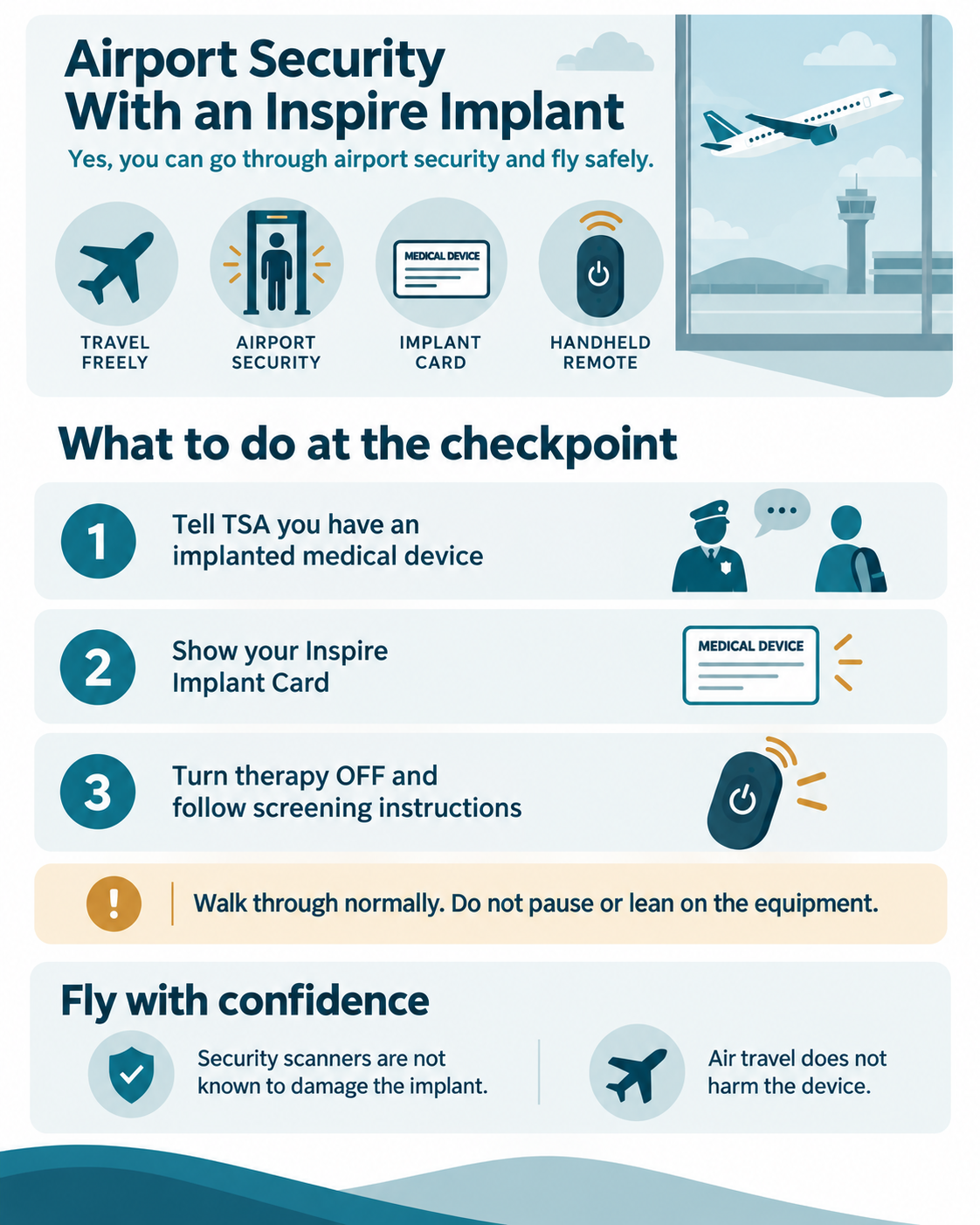
Yes, you can go through airport security and fly safely with an Inspire sleep apnea implant. The process is straightforward: let the Transportation Security Administration (TSA) officer know you have an implanted medical device, present your Inspire Implant Card, make sure your therapy is turned off, and follow the officer’s instructions for screening (1). Security scanners are not known to damage the implant hardware, and air travel does not harm the device (2).
Traveling with obstructive sleep apnea used to mean hauling heavy machinery, hoses, and finding distilled water in hotel rooms. For many patients who cannot tolerate traditional masks, switching to Inspire offers genuine travel freedom because the entire system is self-contained (3). Still, walking through airport security for the first time with an internal generator can cause some nervousness. Here is what you need to know to move through the checkpoint smoothly.
What to Do at the Security Checkpoint
In our sleep medicine practice, we find that preparation eliminates almost all airport travel stress. When you arrive at the security lane, follow three simple steps:
- Inform the officer: Before stepping into any screening machine, tell the security officer that you have an implanted medical device for sleep apnea.
- Present your card: Hand the officer your Inspire Implant Card so they can see the device details.
- Keep therapy switched off: Confirm that your device is powered off with your remote, and walk through the scanner at a normal pace without pausing or leaning against the equipment (1).
Will the Implant Set Off Metal Detectors or Body Scanners?
The Inspire generator contains titanium and sits just under the skin in your upper chest (1). Because of this metal, walk-through metal detectors or advanced imaging body scanners may detect the device.
TSA officers regularly screen passengers with pacemakers, neurostimulators, and joint replacements, so an implanted device is routine for them (4). Federal evaluations have confirmed that millimeter-wave body scanners can be used around sensitive electronic medical implants without causing mechanical disruption (5). Even so, showing your card before you enter the scanner gives the officer immediate context if a small outline appears on their monitor.
Packing and Screening Your Inspire Remote
Your handheld Inspire sleep remote controls your nightly stimulation levels and turns your therapy on or off. Unlike the generator inside your chest, the remote travels with your luggage.
Always keep your sleep remote in your carry-on bag rather than checked luggage. This ensures you still have your therapy controls if your checked bags are delayed. The remote can safely pass through the standard carry-on X-ray conveyor belt along with your phone and laptop (3). TSA officers may inspect the remote manually if it catches their eye on the X-ray screen, which is normal procedure for portable electronics (6).
Is Airport Screening the Same as an MRI?
Patients occasionally worry that airport scanners act like hospital imaging equipment. Airport X-rays and security body scanners do not create the strong magnetic fields found in magnetic resonance imaging (MRI) suites (7). Inspire components are safe for standard airport security, but you should still carry your identification card so security personnel know your exact model.
What Happens if You Need Additional Screening?
Having an implant does not exempt you from checkpoint screening, but TSA provides accommodations to keep the process comfortable. If an alarm sounds or the officer requests extra inspection, they may conduct a gentle pat-down of the chest area or swab your hands for trace materials (4).
If you prefer privacy, you have the right to request a private screening area with a companion present (4). You can also ask to speak with a TSA Passenger Support Specialist if you encounter any confusion at the checkpoint (8). For extra peace of mind before a major trip, the TSA Cares helpline offers advance information and direct checkpoint coordination for travelers with medical devices (9).
Flying Internationally With Inspire
International flights follow the same general safety principles, though security procedures can differ slightly from country to country. Keep your Inspire Implant Card in your wallet or personal item at all times during transit so it is easily accessible at foreign security gates. If you are flying shortly after your initial implant surgery, our sleep specialists recommend confirming with your surgical team that your incisions have healed enough for travel and lifting heavy carry-ons.
Expert Inspire Care in Arizona
Traveling with Inspire is designed to be simple, liberating, and discreet. If you struggle with CPAP therapy and want to explore long-term solutions for obstructive sleep apnea, professional guidance makes all the difference.
The Insomnia and Sleep Institute of Arizona provides comprehensive evaluations for Inspire candidacy across our Phoenix, Scottsdale, and Gilbert clinics, led by Dr. Ruchir P. Patel. We work closely with each patient through diagnosis, surgical coordination, device activation, and long-term sleep wellness. Contact our office today to schedule a consultation.
References
- Inspire Medical Systems, Inc. (2023). Patient manual: Inspire IV Generator Model 3028 (200-271-101 Rev H). https://manuals.inspiresleep.com/content/widgets/manual.php?NTE5fDF8MQ==
- Inspire Sleep Apnea Innovation – Obstructive Sleep Apnea Treatment. (2026). Inspiresleep.Com. https://www.inspiresleep.com/en-us/patient-services/activity-and-lifestyle/airport-security/
- Tips for easier trips: Traveling with CPAP and other sleep apnea treatments. (2026, June 16). Inspiresleep.Com; Inspire Sleep Apnea Innovation – Obstructive Sleep Apnea Treatment. https://www.inspiresleep.com/en-us/blog/traveling-other-sleep-apnea-treatments/
- Disabilities and Medical Conditions | Transportation Security Administration. (2025). U.S. Department of Homeland Security Transportation Security Administration. https://www.tsa.gov/travel/tsa-cares/disabilities-and-medical-conditions
- Read. (2017). The National Academies Press. https://www.nationalacademies.org/read/24936/chapter/6
- What Can I Bring? | Transportation Security Administration. (2025). U.S. Department of Homeland Security Transportation Security Administration. https://www.tsa.gov/travel/security-screening/whatcanibring/all
- Inspire Sleep Apnea Innovation – Obstructive Sleep Apnea Treatment. (2026). Inspiresleep.Com. https://www.inspiresleep.com/en-us/patient-services/imaging-and-other-procedures/
- Complete List (Alphabetical) | Transportation Security Administration. (2025). U.S. Department of Homeland Security Transportation Security Administration. https://www.tsa.gov/travel/security-screening/whatcanibring/all-list
- TSA Cares | Transportation Security Administration. (2025). U.S. Department of Homeland Security Transportation Security Administration. https://www.tsa.gov/travel/tsa-cares
Disclaimer: The information provided in this blog post is for educational and informational purposes only and is not intended as a substitute for professional medical advice, diagnosis, or treatment. Always consult with a licensed healthcare provider for recommendations specific to your individual health needs.