Sleep clinic vs. sleep lab, sleep doctor vs. sleep specialist- there is a lot of terminology in the world of sleep medicine, which can make it challenging to choose the right sleep doctor for you.
Not all sleep doctors are created equally. In fact, some locations that might seem to be sleep centers are actually just sleep testing sites with no sleep specialists on-site.
The Insomnia and Sleep Institute of Arizona is recognized as the Face of Sleep Medicine in Phoenix, and there’s no need for a referral to schedule a consultation with a sleep specialist. This means your first meeting will be with an expert who can diagnose sleep disorders, which is the first step in testing and treatment. We are an outcome-driven facility committed to helping you achieve the quality sleep needed to support your health and well-being.
We provide an exceptional level of clinical support, giving you access not only to sleep specialists but also to a clinical psychologist who specializes in Cognitive Behavioral Therapy (CBT) to treat insomnia, nurse practitioners who are trained in sleep medicine, respiratory therapists, and a physician assistant with a Master’s degree in Sleep Medicine.
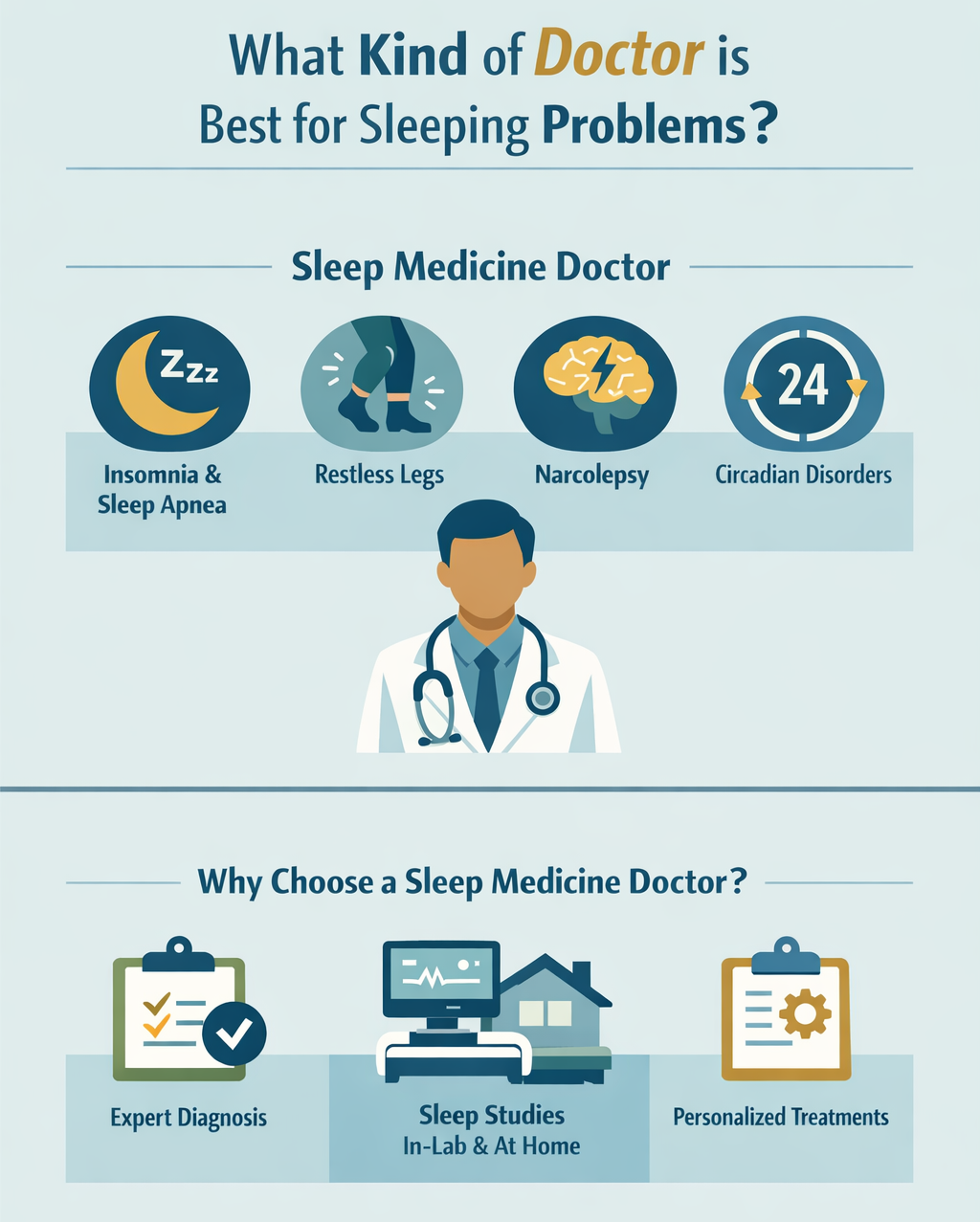
What Kind of Doctor Is Best for Sleeping Problems?
A sleep medicine doctor is the best specialist for sleep problems. These physicians are trained to diagnose and treat conditions like insomnia, sleep apnea, restless legs syndrome, narcolepsy, and circadian rhythm disorders. Many are board-certified in sleep medicine after training in neurology, pulmonology, psychiatry, or internal medicine.
Sleep doctors are trained to diagnose and manage a wide range of conditions beyond snoring or poor sleep. These include obstructive and central sleep apnea, chronic insomnia, circadian rhythm disorders, restless legs syndrome, parasomnias, narcolepsy, and sleep issues related to medical or neurological conditions.
Many patients with insomnia or fatigue actually have overlapping or secondary sleep disorders that require specialist evaluation (1, 2). Proper identification of the underlying condition is essential, as treatment strategies differ significantly depending on the diagnosis.
Why a sleep medicine doctor is the right choice
- They evaluate sleep issues as medical conditions, not just symptoms
- They can order and interpret sleep studies, including in-lab and home testing
- They create treatment plans that address the root cause of poor sleep, not just short-term relief
At The Insomnia and Sleep Institute of Arizona, care is focused on identifying why sleep is disrupted and choosing treatments that improve sleep quality and daytime function.
What to Look for When Choosing a Sleep Doctor
What exactly should you look for in a sleep doctor? A clinic that provides diagnoses and treatments is critical. There are many sleep labs that exclusively offer testing services without diagnosis or treatment. You should also seek out a facility that offers the latest, most innovative management and treatment options.
There are many sleep testing sites around the country and Arizona, but these differ from comprehensive sleep centers, where you will find physicians who focus on sleep medicine. Without a diagnosis first, there is no way to determine whether testing, treatment, or both are needed.
An incorrect diagnosis can be pointless at best and dangerous at worst. Even though some sleep disorders are relatively common, such as obstructive sleep apnea (OSA) and insomnia, that does not mean they are harmless. We need sleep not only to function at our best, but also to maintain our health.
For instance, cognitive behavioral therapy for Insomnia (CBT-I) is often the best approach for insomnia (3). When it comes to treating obstructive sleep apnea (OSA), CPAP therapy remains the standard treatment. There are, however, other options available when you work with a leading sleep doctor.
Your sleep specialist should be board-certified and an expert in their field. That’s exactly what you’ll find at The Insomnia and Sleep Institute. Plus, the “Top Doc” title reflects how a physician’s peers view their expertise, since they are the ones who vote for the recognition.
The Insomnia and Sleep Institute has held this title for six consecutive years, and every year other sleep experts vote on who they think is the best of the best. This is a great and easy way to identify highly regarded sleep physicians in the Phoenix area.
Why Proper Diagnosis Comes Before Testing or Treatment
Sleep disorders and disruptions can negatively affect every facet of your health, including your physical, emotional, mental, and social well-being. Poor quality sleep has been linked to a wide range of other disorders, and improving sleep can often improve other health issues as well (4, 5).
The body is a holistic system, and if one part is not functioning correctly, such as getting the quality sleep you need, everything else can suffer.
Accurate diagnosis of sleep disorders begins with a comprehensive clinical evaluation, including a detailed sleep history, medical history, medications, and assessment of daytime symptoms. Clinical practice guidelines emphasize that diagnostic testing should be guided by this initial evaluation, with tools such as in-lab polysomnography, home sleep apnea testing, or actigraphy (6, 7).
Evaluation for obstructive sleep apnea should combine diagnostic testing with a complete sleep assessment and proper follow-up care. For adults with clinical concern for OSA, polysomnography is the primary method used to confirm the diagnosis. (8)
A structured, physician-led diagnostic approach improves diagnostic precision and treatment selection by ensuring that test results are interpreted within the full clinical context, reducing the risk of misdiagnosis and inappropriate care.
Options Beyond CPAP for Obstructive Sleep Apnea
Dr. Ruchir P. Patel received the Inspire Physician Excellence Award and is part of the exclusive Inspire Excellence Program (2021). This award is given to providers who achieve exceptional outcomes for patients who undergo Inspire implant treatment for OSA. This recognition from Inspire is a rare honor and was awarded to only 19 centers worldwide at the time..
For those struggling with OSA, it’s important to have every available treatment option, including implants.
CPAP treatment is required before a patient becomes eligible for an implant. It is uncommon for CPAP to be ineffective when used correctly and consistently, but in these rare cases an implant can be helpful (9). Both CPAP and implants work to keep the airway open while a person sleeps, reducing the risks associated with interrupted breathing, including cardiovascular complications and other serious health consequences.
Dr. Ruchir P. Patel is an expert on Inspire and gives presentations on the implant around the country. Not every clinic offers the Inspire implant, and you deserve to have every option available. Although all patients must try CPAP therapy first, at The Insomnia and Sleep Institute you may have the option of receiving the Inspire implant if CPAP fails.
Why Seeing the Right Specialist Early Matters
Early evaluation by a qualified sleep specialist can make a meaningful difference in long-term health outcomes. Sleep disorders tend to progress over time, and delayed diagnosis may allow symptoms to worsen or become more complex. Seeing the right specialist early helps identify whether symptoms stem from a primary sleep disorder or are linked to another medical condition.
A sleep specialist is trained to recognize patterns that may not be obvious during a routine medical visit. Early intervention can reduce the need for more intensive treatment later, shorten recovery time, and help prevent complications such as cardiovascular strain, mood disturbances, or chronic fatigue.
Primary care providers are often the first point of contact for sleep complaints, but they typically screen for sleep disorders rather than specialize in them.
Many sleep disorders, including obstructive sleep apnea and chronic insomnia, are often underrecognized in primary care, where sleep symptoms are not routinely screened during visits (10). The National Academies of Sciences report “very little education of health care professionals” in sleep disorders, which contributes to delayed or missed diagnoses and the need for specialist involvement (11).
Sleep specialists receive focused training in diagnosing and managing sleep disorders, including interpreting sleep studies and evaluating complex breathing and neurological sleep conditions (12).
Sleep specialists are recommended for consultation when patients experience significant daytime sleepiness, persistent insomnia, or disturbed sleep behavior, especially when the initial diagnosis is uncertain or treatment fails, because standard primary care management may not clarify the underlying disorder.
Dr. Michael Howell, MD, sleep expert and associate professor in the Department of Neurology at the University of Minnesota, explains the stakes: “This is a critically important study that communicates to decision makers on the costs of sleep problems.” He notes that when sleep disorders are treated properly, people often feel happier, more awake during the day, and more capable at work (13).
When obstructive sleep apnea goes undiagnosed, the risk of serious health complications rises. Mortality increases as the number and severity of associated conditions grow. In the United States, an estimated 23.5 million undiagnosed cases contribute to roughly $149.6 billion in annual costs from higher health care use, workplace and motor vehicle accidents, and lost productivity. (14)
In modern culture, we often quote Thomas Edison, who famously said, “Sleep is an absurdity, a bad habit.” (15) However, science now shows that the most successful individuals don’t sleep less, they sleep better (16). Choosing a doctor who understands the demands of modern work, stress, and lifestyle ensures symptoms are evaluated in context, not in isolation.
How to Prepare for Your First Sleep Appointment With Sleep Doctor
Preparing ahead of time helps your sleep doctor make accurate decisions from the first visit.
What to bring and track before your appointment
- A list of symptoms, including how long they’ve been happening and when they’re worst.
- Current medications, supplements, caffeine use, and alcohol intake.
- Previous sleep studies or relevant medical records, if available.
Helpful habits before your visit
- Keep a short sleep log for one to two weeks, noting bedtimes, wake times, and awakenings.
- Write down specific concerns such as trouble falling asleep, waking too early, snoring, or daytime fatigue.
This preparation allows your doctor to focus on diagnosis and next steps rather than gathering basic information.
What Should I Ask a Sleep Medicine Doctor on the First Visit?
During your first visit, ask clear questions that help you understand your diagnosis, testing needs, and treatment options. Important questions include what may be causing your sleep problem, whether a sleep study is recommended, how treatment will improve both sleep and daytime health, and what changes are realistic to expect.
You should also ask how long treatment typically takes to show results and what follow-up care looks like. These questions help set expectations and ensure your care plan is practical and evidence-based.
Taking Care of Your Sleep Health
Sleep is a critical part of a person’s health and well-being, yet it is often overlooked or neglected. We live in a culture that celebrates lack of sleep, but even one night of poor sleep can have negative effects.
Matthew Walker, PhD, Professor of Neuroscience and Psychology at UC Berkeley and author of “Why We Sleep,” puts it powerfully: “Sleep is not an optional lifestyle luxury. Sleep is a non-negotiable biological necessity. It is your life support system and it is Mother Nature’s best effort yet at immortality.”
His work emphasizes that chronic sleep deprivation can have serious health consequences, including dementia. (17, 18)
Poor quality sleep has been linked to numerous physical, emotional, and mental health consequences, but help is available. Working with a sleep physician is the first step in managing or treating any sleep disorder.
Sleep Health Across All Ages
The Insomnia and Sleep Institute works with patients as young as two years old because sleep disorders can affect even very young individuals. Additionally, lack of sleep in developing bodies (children) can be especially harmful. If you suspect your child has a sleep disorder or have concerns about their sleep patterns, seeing a sleep specialist is essential.
Scheduling Your Consultation with a Sleep Specialist
Sleep disorders are often missed by GPs and pediatricians. In fact, many people with sleep disorders remain undiagnosed or are initially misdiagnosed.
For instance, about 30% of adults are affected by insomnia, with women having a higher lifetime risk than men (19, 20). It is also estimated that up to 38% of people have obstructive sleep apnea, the most common type of sleep apnea (21).
Symptoms of sleep disorders don’t always present in obvious ways. If you are experiencing symptoms such as fatigue or headaches that may be linked to a sleep disorder, it may be time to schedule a consultation with a sleep specialist.
The Insomnia and Sleep Institute is available for in-person or virtual consultations. There are solutions for all sleep disorders, and the sooner you get the support you need, the sooner you can start enjoying uninterrupted quality sleep and all of the benefits it provides.
The Insomnia and Sleep Institute is home to leading sleep experts, and we offer the latest treatments, techniques, and tools to help you regain control of your sleep health. To schedule your consultation, contact The Insomnia and Sleep Institute today by calling the office or, for the fastest response, complete the online form.
We have locations in Scottsdale, Gilbert, and Phoenix for easier access to sleep care.
References
- Yu, Y. (2023). Links between Sleep Apnoea and Insomnia in a British Cohort. Clocks & Sleep, 5(3), 552. https://doi.org/10.3390/clockssleep5030036
- Bjørn Bjorvatn, Jernelöv, S., & Pallesen, S. (2021). Insomnia – A Heterogenic Disorder Often Comorbid With Psychological and Somatic Disorders and Diseases: A Narrative Review With Focus on Diagnostic and Treatment Challenges. Frontiers in Psychology, 12, 639198. https://doi.org/10.3389/fpsyg.2021.639198
- Madari, S., Golebiowski, R., Mansukhani, M. P., & Kolla, B. P. (2021). Pharmacological Management of Insomnia. Neurotherapeutics, 18(1), 44–52. https://doi.org/10.1007/s13311-021-01010-z
- How does inadequate sleep affect health? (2019, April 29). Https://Www.Nichd.Nih.Gov/. https://www.nichd.nih.gov/health/topics/sleep/conditioninfo/inadequate-sleep
- How Sleep Affects Your Health. (2022, June 15). Nhlbi, NIH. https://www.nhlbi.nih.gov/health/sleep-deprivation/health-effects
- Kapur, V. K., Auckley, D. H., Chowdhuri, S., Kuhlmann, D. C., Mehra, R., Ramar, K., & Harrod, C. G. (2017). Clinical Practice Guideline for Diagnostic Testing for Adult Obstructive Sleep Apnea: An American Academy of Sleep Medicine Clinical Practice Guideline. Journal of Clinical Sleep Medicine, 13(03), 479–504. https://doi.org/10.5664/jcsm.6506
- Gupta, R., Das, S., Gujar, K., Mishra, K., Gaur, N., & Majid, A. (2017). Clinical Practice Guidelines for Sleep Disorders. Indian Journal of Psychiatry, 59(5), 116. https://doi.org/10.4103/0019-5545.196978
- Kapur, V. K., Auckley, D. H., Chowdhuri, S., Kuhlmann, D. C., Mehra, R., Ramar, K., & Harrod, C. G. (2017). Clinical Practice Guideline for Diagnostic Testing for Adult Obstructive Sleep Apnea: An American Academy of Sleep Medicine Clinical Practice Guideline. Journal of Clinical Sleep Medicine, 13(3), 479–504. https://doi.org/10.5664/jcsm.6506
- Weaver, T. E., & Grunstein, R. R. (2008). Adherence to Continuous Positive Airway Pressure Therapy: The Challenge to Effective Treatment. Proceedings of the American Thoracic Society, 5(2), 173. https://doi.org/10.1513/pats.200708-119MG
- Egambaram Senthilvel, Auckley, D., & Jaividhya Dasarathy. (2011). Evaluation of Sleep Disorders in the Primary Care Setting: History Taking Compared to Questionnaires. Journal of Clinical Sleep Medicine : JCSM : Official Publication of the American Academy of Sleep Medicine, 7(1), 41. https://pmc.ncbi.nlm.nih.gov/articles/PMC3041630/
- Read. (2026). The National Academies Press. https://www.nationalacademies.org/read/11617/chapter/7#183
- Read. (2026). The National Academies Press. https://www.nationalacademies.org/read/11617/chapter/7
- Obstructive Sleep Apnea: Hidden Health Crisis in America. (2016, August 15). Medical School. https://med.umn.edu/news/obstructive-sleep-apnea-hidden-health-crisis-america
- Celmer, L. (2023, April 4). New national indicator report details importance of prompt sleep apnea diagnosis and treatment. American Academy of Sleep Medicine – Association for Sleep Clinicians and Researchers. https://aasm.org/new-national-indicator-report-details-importance-prompt-sleep-apnea-diagnosis-treatment/
- Wines, N. (2022, October 14). Edison’s Speculations on the Future. Thomas A. Edison Papers | The School of Arts and Sciences, Rutgers, The State University of New Jersey. https://edison.rutgers.edu/digital-exhibits/edison-science-fiction/science-fiction-09
- Olsen OK;Pallesen S;Torsheim T;Espevik R. (2016). The effect of sleep deprivation on leadership behaviour in military officers: an experimental study. Journal of Sleep Research, 25(6). https://doi.org/10.1111/jsr.12431
- Greene, B. (2019, April 20). In Case You Missed It: Highlights from TED2019 | TED Blog. Tedtalks. https://blog.ted.com/in-case-you-missed-it-highlights-from-ted2019/
- Contributors to Wikimedia projects. (2017, September 24). book by Matthew Walker. Wikipedia.Org; Wikimedia Foundation, Inc. https://en.wikipedia.org/wiki/Why_We_Sleep
- Roth, T. (2007). Insomnia: Definition, Prevalence, Etiology, and Consequences. Journal of Clinical Sleep Medicine : JCSM : Official Publication of the American Academy of Sleep Medicine, 3(5 Suppl), S7. https://pmc.ncbi.nlm.nih.gov/articles/PMC1978319/
- Zeng, L.-N., Zong, Q.-Q., Yang, Y., Zhang, L., Xiang, Y.-F., Ng, C. H., Chen, L.-G., & Xiang, Y.-T. (2020). Gender Difference in the Prevalence of Insomnia: A Meta-Analysis of Observational Studies. Frontiers in Psychiatry, 11. https://doi.org/10.3389/fpsyt.2020.577429
- Iannella, G., Pace, A., Bellizzi, M. G., Magliulo, G., Greco, A., De Virgilio, A., Croce, E., Gioacchini, F. M., Re, M., Costantino, A., Casale, M., Moffa, A., Lechien, J. R., Cocuzza, S., Vicini, C., Caranti, A., Marchese Aragona, R., Lentini, M., & Maniaci, A. (2025). The Global Burden of Obstructive Sleep Apnea. Diagnostics, 15(9), 1088. https://doi.org/10.3390/diagnostics15091088
Disclaimer: The information provided in this blog post is for educational and informational purposes only and is not intended as a substitute for professional medical advice, diagnosis, or treatment. Always consult with a licensed healthcare provider for recommendations specific to your individual health needs.