If you struggle with sleep apnea, you may have more options than you think. The Insomnia and Sleep Institute of Arizona is physician-owned and staffed by sleep specialists who focus on sleep medicine.
Our clinic has been recognized as the “Face of Sleep Medicine” in the Phoenix area, and it is where you will find the “Top Doc” for the past five years, as voted by his colleagues and peers.
At The Insomnia and Sleep Institute of Arizona, outcomes drive the process, and a correct diagnosis is always established before the best treatment plan is implemented. Today, that may include one of two implants for sleep apnea.
The Universal Struggle with Sleep
Sleep is something every culture values, yet millions worldwide struggle to achieve it. As renowned neuroscientist and UC Berkeley professor Matthew Walker puts it, “Sleep is your life-support system and Mother Nature’s best effort yet at immortality.” (1) His research has shown that the shorter your sleep, the shorter your life, making sleep disorders not just inconveniences, but serious health threats that demand attention (2).
Sleep exists in every culture, and research confirms that “sleep happens in all cultures,” with some traditions viewing it as meaningful or even spiritual (3). Midday rest is culturally embedded in places like China, where napping is considered a healthy habit, and Spain, known for the traditional siesta (4, 5). Today, digital distractions and screen light that can “suppress melatonin and shift circadian rhythms” reduce sleep time, compounding problems for the estimated 29.4 million U.S. adults with obstructive sleep apnea (6, 7, 8).
Understanding Implant Options for Obstructive and Central Sleep Apnea
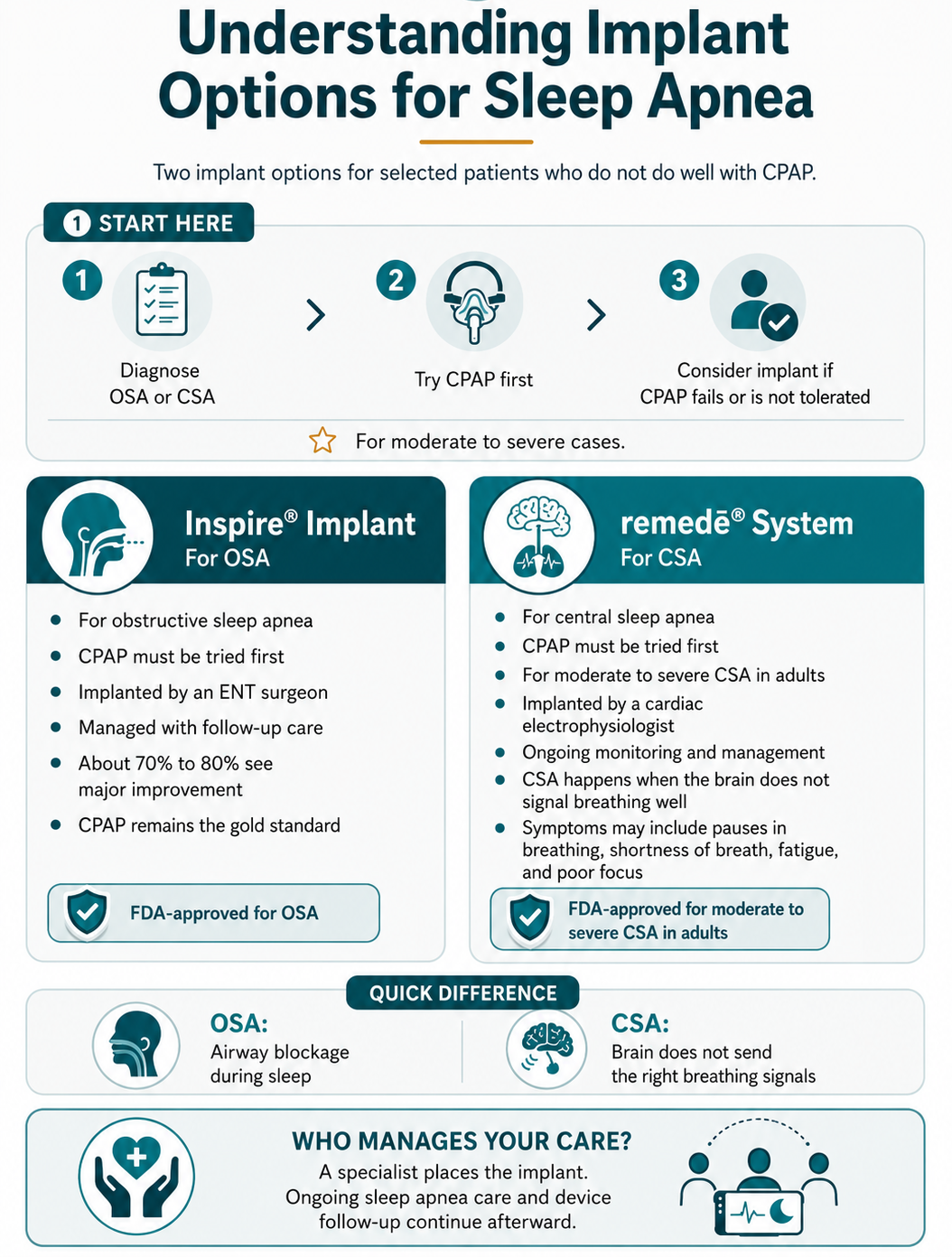
Sleep apnea is generally classified into two primary types: obstructive sleep apnea (OSA) and central sleep apnea (CSA). Implantable therapies are available for carefully selected patients with moderate to severe forms of these conditions who have not been successful with CPAP therapy.
Inspire® Implant for Obstructive Sleep Apnea (OSA)
The Inspire OSA implant is designed for obstructive sleep apnea. Dr. Ruchir P. Patel is the exclusive sleep specialist in the area who consults with the makers of this implant, Inspire Medical Systems, Inc. Before determining whether you are a good candidate for the Inspire OSA implant, you must first be diagnosed with OSA and have undergone CPAP therapy as your primary treatment.
Those who did not respond to CPAP or could not tolerate it may qualify for an Inspire implant. It is important to note that you cannot opt out of CPAP entirely before trying the implant. CPAP therapy must first be tried and deemed ineffective or intolerable. If that is the case, you will be referred to an ENT surgeon to determine if you are a good candidate for the Inspire implant, as airway anatomy plays a critical role in the decision.
The Inspire OSA Implant: How It Is Managed
Once the device is implanted, you will work with The Insomnia and Sleep Institute to manage it. This includes the initial activation of the implant as well as any future adjustments or follow-up needs. The ENT surgeon performs the implantation procedure, but the sleep specialists oversee ongoing management and care of the Inspire implant.
Many patients enjoy great success using the Inspire implant to reduce obstructive sleep apnea events. It has a high satisfaction rating and a strong history of therapy adherence. If you have OSA, you likely already know it is a serious condition that can significantly reduce quality of life and is associated with numerous comorbidities.
On average, Inspire therapy significantly reduces apnea severity in about 70% to 80% of eligible patients with moderate to severe OSA. (9), though CPAP therapy remains the gold standard. The Inspire implant is FDA-approved specifically to treat OSA as an implantable device.
Expert Insight on Inspire Therapy
Dr. Katherine Green, Assistant Professor in the Department of Otolaryngology at the University of Colorado, explains the benefit-to-risk ratio: “I think if we have a 70% to 80% chance of treating those events significantly, then the risks of surgery and the risk of having an implant that comes along with it are outweighed by the benefits.” (9)
She also emphasizes that “on the spectrum of surgeries, I think Inspire is a relatively easier surgery to recover from, especially compared to the more traditional upper-airway surgeries, such as palate or tongue surgery.” Most patients go home the same day and use over-the-counter pain medication like Tylenol or ibuprofen.
Dr. Glen Nelson, Inspire’s first chairman of the board, established a guiding principle for the company: “If we put the patient first, we will never lose our way.” (10). This patient-centered philosophy continues to drive innovation in sleep apnea treatment
The remedē® System for Central Sleep Apnea (CSA)
The other primary type of sleep apnea, central sleep apnea (CSA), may be treated with the CSA implant from remedē System. Like the OSA implant, patients must first try CPAP therapy and find it ineffective, intolerable, or both.
Those with CSA often report grogginess during the day, and moderate or severe CSA can dramatically affect quality of life. CSA causes low oxygen levels, which have also been linked to high blood pressure and cardiac arrest. Common symptoms of CSA include brief pauses in breathing during sleep and shortness of breath.
The remedē® System is an implantable device approved by the U.S. Food and Drug Administration to treat moderate to severe central sleep apnea in adult patients (10).
Central sleep apnea develops when the brain does not properly signal the body to breathe, causing repeated breathing pauses, drops in oxygen levels, sudden awakenings, and symptoms such as shortness of breath, daytime fatigue, and poor concentration. (11). Research also suggests that central sleep apnea may influence the onset and progression of cardiovascular disease (12).
Who Performs the CSA Implant Procedure?
Qualifying for a CSA implant is similar to qualifying for an OSA implant. It begins with a correct diagnosis and an attempt at CPAP therapy first.
However, a cardiac electrophysiologist implants the device rather than an ENT surgeon (13). We will refer you to the best specialist for this part of the process. Once the implant is in place, we will continue to monitor and manage it.
How Much Does a Sleep Apnea Implant Cost in Arizona?
Sleep apnea implants such as Inspire® and the remedē® System are advanced surgical treatments for patients who cannot tolerate CPAP therapy. Because they involve a device, surgery, anesthesia, and follow-up care, overall costs vary significantly depending on the hospital, surgeon, and insurance coverage.
Most major insurers, including Medicare and many commercial plans, cover these implants for patients who meet medical necessity criteria and have documented CPAP intolerance (14). Out-of-pocket expenses depend on your specific plan, deductible, and authorization status. Early insurance verification with your sleep specialist can help clarify coverage and expected costs before surgery.
What Is the Recovery Time After Central Sleep Apnea Implant Surgery?
Recovery after a central sleep apnea implant, such as the remedē® System, varies, but official patient materials note that many patients “can return to most of your normal routine within a week” (15). Implantation is described as “typically an outpatient procedure performed under light sedation,” though some patients may stay overnight (16).
Temporary “pain or discomfort” and “bruising or swelling” at the incision site can occur (17), and patients are commonly instructed not to lift the arm above shoulder height for a period after surgery (15). Therapy is generally started or enabled about one month after implantation to allow healing (15).
How Long Does a Central Sleep Apnea Implant Last?
A central sleep apnea implant such as the remedē® System is intended for long-term therapy, but battery longevity depends on the device model and energy settings. On average, the battery functions for three to four years, though lifespan can vary from person to person (15). ZOLL’s FAQ for newer models states batteries generally last about four to six years (18).
When the battery is depleted, the device is surgically replaced. The existing leads are disconnected from the old unit and attached to the new one, and the replacement procedure is typically shorter than the original implantation. (15).
Considerations Before Choosing a Sleep Apnea Implant
Implanting the remedē® System requires certain precautions. FDA labeling states that diathermy and heat therapies must not be used in patients with the remedē implant due to the risk of serious injury (15). MRI access depends on the device model. Earlier FDA labelling advised against use in patients needing MRI scans (15), while current manufacturer guidance classifies the system as MR Conditional under specific requirements (19). The device may also be used with a pacemaker or defibrillator, but special testing is required to ensure the devices do not interfere with one another (20).
No matter what type of sleep apnea you have, both forms can be dangerous and even life-threatening if not properly treated. CSA is especially connected to heart health, making it hard to find the treatment that is best for you. Those with a history of stroke, atrial fibrillation, and heart failure have increased odds of having CSA.
Sleep Apnea Implant Evaluation in Phoenix, Scottsdale, and Gilbert
If you live in Phoenix, Scottsdale, or Gilbert and would like to learn more about sleep apnea implant options, contact The Insomnia and Sleep Institute of Arizona today. Our team offers evaluations across all three locations and can help determine whether an implant is appropriate for your condition. Complete the online form to get started.
References
- Walker, M. (2019, May 10). Sleep is your superpower. Ted.com; TED. https://www.ted.com/talks/matt_walker_sleep_is_your_superpower
- Cooke, R. (2017, September 24). “Sleep should be prescribed”: what those late nights out could be costing you. The Guardian; The Guardian. https://www.theguardian.com/lifeandstyle/2017/sep/24/why-lack-of-sleep-health-worst-enemy-matthew-walker-why-we-sleep
- Andersen, M. L., Pires, G. N., & Tufik, S. (2024). The Impact of Sleep: From Ancient Rituals to Modern Challenges. Sleep Science, 17(02), e203–e207. https://doi.org/10.1055/s-0043-1777785
- Liu, Y., Peng, T., Zhang, S., & Tang, K. (2018). The relationship between depression, daytime napping, daytime dysfunction, and snoring in 0.5 million Chinese populations: exploring the effects of socio-economic status and age. BMC Public Health, 18(1). https://doi.org/10.1186/s12889-018-5629-9
- Siesta | period of sleep | Britannica. (2026). Encyclopedia Britannica. https://www.britannica.com/topic/siesta
- Celmer, L. (2023, December 4). Over three-fourths of Americans lose sleep due to digital distractions. American Academy of Sleep Medicine – Association for Sleep Clinicians and Researchers. https://aasm.org/over-three-fourths-of-americans-lose-sleep-due-to-digital-distractions-sleep-experts-urge-a-change/
- Module 2. The Color of the Light Affects Circadian Rhythms | NIOSH | CDC. (2025, May). Cdc.gov. https://www.cdc.gov/niosh/work-hour-training-for-nurses/longhours/mod2/20.html
- In an Age of Constant Activity, the Solution to Improving the Nation’s Health May Lie in Helping it Sleep Better What Benefits Do Patients Experience in Treating their Obstructive Sleep Apnea? (n.d.). https://aasm.org/resources/pdf/sleep-apnea-patient-experience.pdf
- Melani, D. (2023, August 28). What Is Inspire for Sleep Apnea and Will It Work for Me? Cuanschutz.edu; University of Colorado Anschutz Medical Campus. https://news.cuanschutz.edu/news-stories/what-is-inspire-for-sleep-apnea-and-will-it-work-for-me
- About Inspire Medical Systems, Inc. | Inspire Sleep Apnea Innovation. (2016). Inspiresleep.com. https://www.inspiresleep.com/en-us/about-inspire/
- Rana, A. M., & Abdulghani Sankari. (2023, June 11). Central Sleep Apnea. Nih.gov; StatPearls Publishing. https://www.ncbi.nlm.nih.gov/books/NBK578199/
- Florés, M., de Batlle, J., Sánchez-de-la-Torre, A., Sánchez-de-la-Torre, M., Aldomá, A., Worner, F., Galera, E., Seminario, A., Torres, G., Dalmases, M., Montserrat, J. M., Garmendia, O., & Barbé, F. (2016). Central Sleep Apnoea Is Related to the Severity and Short-Term Prognosis of Acute Coronary Syndrome. PLOS ONE, 11(11), e0167031. https://doi.org/10.1371/journal.pone.0167031
- remedē Implant Procedure | remedē® System. (2025, September 23). Remedē® System. https://remede.zoll.com/clinicians/patient-pathway/remede-implant-procedure/
- Prior Authorization & Reimbursement | remedē® System. (2026, February 6). Remedē® System. https://remede.zoll.com/clinicians/patient-pathway/prior-authorization-reimbursement/
- remedē ® System Patient Manual. (n.d.). https://www.accessdata.fda.gov/cdrh_docs/pdf16/P160039d.pdf
- Innovative treatment for Central Sleep Apnea | remedē® System. (2025, November 11). Remedē® System. https://remede.zoll.com/remede-system/
- MORE INFORMATION IMPLANT PROCEDURE remedē ® SYSTEM Understanding the remedē ® system FOR CENTRAL SLEEP APNEA remedē ® System CENTRAL SLEEP APNEA. (n.d.). https://remede.zoll.com/wp-content/uploads/366-Patient-Flip-Book-EN_r2a.pdf
- Patient Manuals | remedē® System. (2025). Remedē® System. https://remede.zoll.com/patient-manuals/
- Clinicians Important Safety Information | remedē® System. (2025, October 8). Remedē® System. https://remede.zoll.com/clinicians/important-safety-information-for-clinicians/
Disclaimer: The information provided in this blog post is for educational and informational purposes only and is not intended as a substitute for professional medical advice, diagnosis, or treatment. Always consult with a licensed healthcare provider for recommendations specific to your individual health needs.