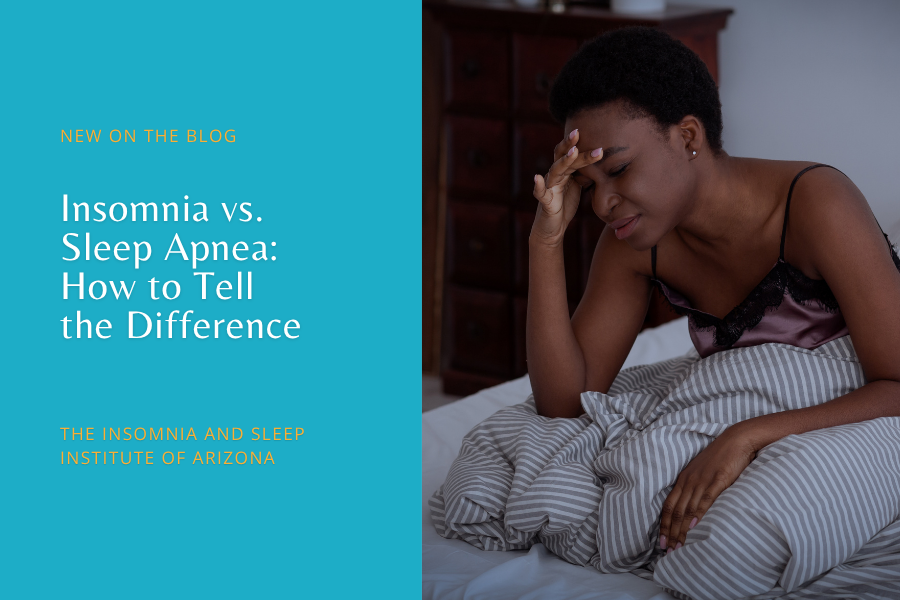
The difference between insomnia and sleep apnea is that insomnia is a sleep-initiation or maintenance problem, whereas sleep apnea is a breathing disorder during sleep. Insomnia causes difficulty falling asleep, staying asleep, waking up prematurely, or suffering from overall poor sleep quality despite having plenty of time to rest (1).
At The Insomnia and Sleep Institute of Arizona, our sleep physicians routinely educate patients that while both conditions leave you feeling completely depleted during the day, insomnia stems from a hyperaroused nervous system while you are conscious, whereas sleep apnea is caused by a physical obstruction or breakdown in your breathing while you are unconscious.
What Is Insomnia?
Chronic insomnia is formally diagnosed when sleep difficulty occurs at least three nights per week for three months or longer, causing significant daytime problems like severe fatigue, poor concentration, mood disturbances, and reduced daily function despite an adequate opportunity to sleep (2).
In our clinical practice, patients with insomnia are aware of their struggle. They remember staring at the ceiling, watching the clock tick by, and calculating how few hours of sleep remain before their alarm sounds.
This condition is far more common than many realize and frequently affects high-performing individuals. For example, actress Jennifer Aniston has publicly spoken about her decades-long struggle with chronic insomnia, describing how dreading bedtime created a vicious cycle of nighttime anxiety and daytime exhaustion. Her experience highlights a key clinical aspect of insomnia: it is not a voluntary choice to stay up late (such as revenge bedtime procrastination or night-shift work), but rather an involuntary inability of the body’s sleep mechanisms to engage (2).
What Is Sleep Apnea?
Unlike insomnia, sleep apnea is fundamentally a respiratory issue where breathing repeatedly stops and restarts throughout the night. These pauses drop blood oxygen levels and repeatedly shatter sleep architecture, preventing the brain from reaching deep, restorative stages (3).
Common sleep apnea symptoms include loud or irregular snoring, gasping for air, witnessed breathing pauses, morning dry mouth, morning headaches, daytime sleepiness, and waking up frequently during the night to urinate (4).
Loud snoring alone does not automatically prove sleep apnea, as many non-apneic individuals snore. However, when loud snoring is accompanied by choking, gasping, or noticeable breathing pauses, an evaluation is essential (5).
The vast majority of cases we treat involve Obstructive Sleep Apnea (OSA). OSA occurs when the muscles in the back of the throat relax, causing the upper airway to collapse or become blocked (6). While OSA is a major global health concern, affecting an estimated 936 million adults aged 30 to 69 worldwide (7), it frequently goes undiagnosed for years because the sufferer is asleep when the symptoms occur.
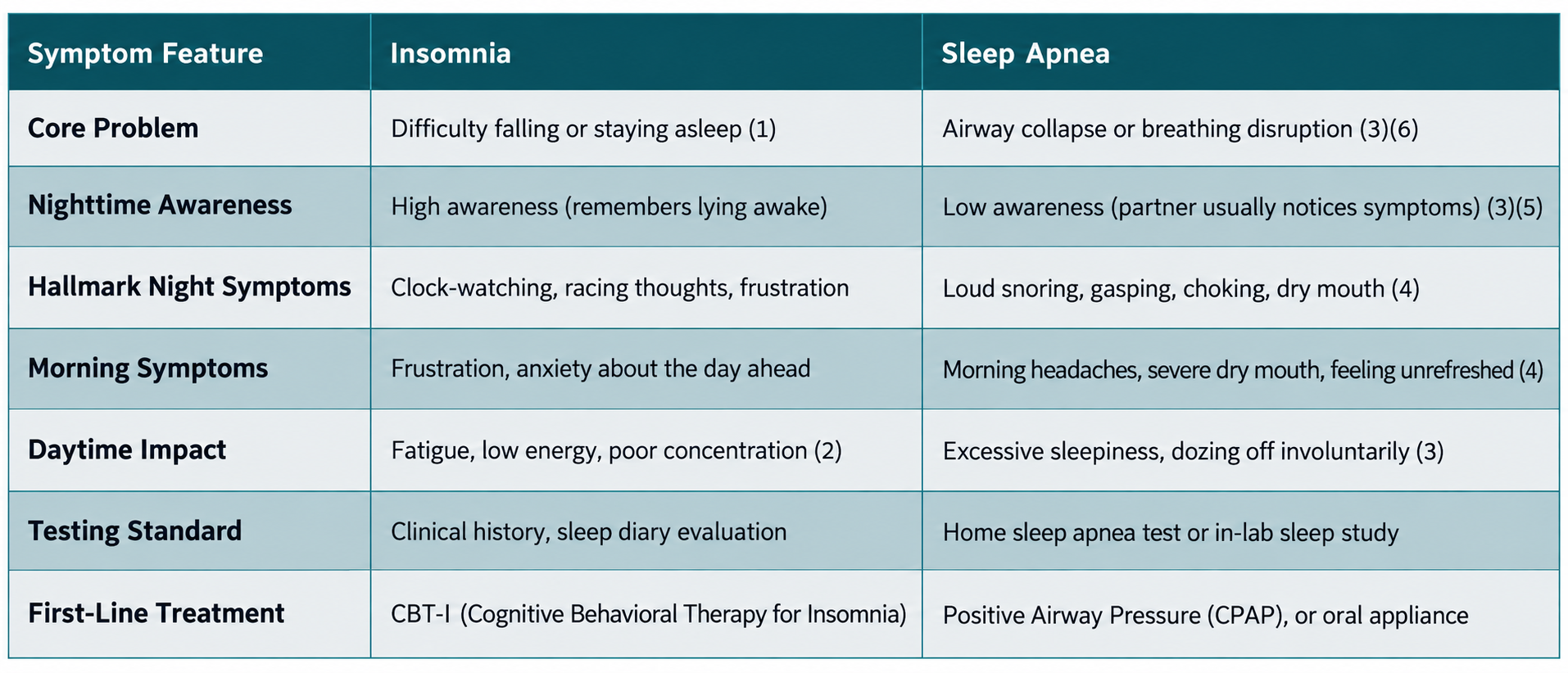
Insomnia vs. Sleep Apnea: Quick Comparison
To help distinguish between these two conditions, we created this symptom matrix:
Why Insomnia and Sleep Apnea Symptoms Are Frequently Confused
The confusion arises because both disorders ultimately lead to the same daytime outcome: nonrestorative sleep, brain fog, fatigue, memory issues, and emotional irritability (2)(6).
Furthermore, a significant portion of the population suffers from both conditions simultaneously, a complex clinical state known as COMISA (Comorbid Insomnia and Sleep Apnea). Research indicates that roughly 39% to 58% of patients diagnosed with obstructive sleep apnea also report chronic insomnia symptoms (8).
COMISA creates a challenging snowball effect (not necessarily always in this order):
- Sleep apnea causes an upper airway collapse, dropping oxygen levels and jolting the brain awake.
- The brain experiences an adrenaline surge, causing the patient to awaken in a hyperaroused state.
- The patient misinterprets this as insomnia, struggling to fall back asleep due to heightened bedtime anxiety (9).
This interplay demonstrates why self-diagnosis based on generic online checklists is rarely sufficient. A symptom as simple as “waking up multiple times a night” can stem from insomnia, sleep apnea, restless legs syndrome, chronic pain, or stress.
How We Evaluate and Diagnose Sleep Symptoms
When symptoms suggest a potential sleep-breathing disorder, unexplained daytime somnolence, or persistent unrefreshing sleep, our sleep physicians recommend a formal diagnostic sleep study (3)(4).
Our diagnostic pathway generally follows two approaches:
- Home Sleep Apnea Testing (HSAT): A portable monitor worn in the comfort of your home to track breathing effort, airflow, and blood oxygen levels. If a home test is negative or inconclusive, but clinical symptoms remain strong, an in-lab study is the necessary next step (10).
- In-Lab Polysomnography (PSG): The gold standard in sleep diagnostics. An overnight stay at one of our specialized sleep facilities allows us to continuously measure brain waves (EEG), eye movements, muscle activity, heart rate, oxygen levels, and breathing patterns (11).
Modern Treatment for Insomnia and Sleep Apnea
Because the underlying mechanisms of these conditions are entirely different, their treatment protocols require distinct medical strategies.
Evidence-Based Insomnia Care
For chronic insomnia, AASM guidelines recommend Cognitive Behavioral Therapy for Insomnia (CBT-I) as the gold-standard first-line treatment (12). CBT-I is a structured, non-pharmacological therapy that targets the cognitive thoughts and behavioral habits that perpetuate sleep anxiety. It incorporates stimulus control, sleep restriction protocols, cognitive restructuring, and sleep hygiene education to re-train the brain’s sleep drive.
Targeted Sleep Apnea Care
For obstructive sleep apnea, the primary goal is physically securing an open airway during sleep:
- PAP / CPAP Therapy: Continuous Positive Airway Pressure remains the gold standard treatment for moderate to severe OSA, utilizing mild air pressure to keep the airway open (13).
- Oral Appliance Therapy: Custom-fitted dental devices designed to gently advance the lower jaw forward, keeping the airway open for patients who cannot tolerate CPAP or have mild-to-moderate OSA (14).
- Advanced Surgical Solutions: Advanced options such as the Inspire® Upper Airway Stimulation implant for obstructive sleep apnea or remedē® System for complex central sleep apnea cases.
What to Track Before Your Medical Appointment
If you are preparing for a consultation with a sleep specialist, keeping a comprehensive sleep diary for 1 to 2 weeks prior to your visit provides valuable clinical data (15).
Recording the following details is helpful:
- Bedtime and wake-up time
- Estimated time required to fall asleep
- Number of nighttime awakenings and what caused them (e.g., gasping, pain, worry)
- Daily caffeine and alcohol consumption timing
- Morning symptoms (headaches, parched throat, feeling unrefreshed)
- Daytime sleepiness ratings and unintentional naps
- Observations from your bed partner regarding snoring, gasping, or breathing pauses (3)(5)
The Insomnia and Sleep Institute of Arizona
If you are tired of waking up exhausted, struggling to fall asleep, or being told that you snore loudly, The Insomnia and Sleep Institute of Arizona is here to deliver clear answers and personalized clinical care.
Our board-certified sleep physicians specialize in diagnosing and treating the full spectrum of sleep disorders, including complex comorbid cases of insomnia and sleep apnea. With our diagnostic facilities across Phoenix, Scottsdale, and Gilbert, our team will help you find the exact root cause of your sleep issues and build the right treatment plan for you.
Contact our team to request your comprehensive sleep evaluation.
References
- Substance Abuse and Mental Health Services Administration. (2016, June). Table 3.36, DSM-IV to DSM-5 Insomnia Disorder Comparison. Nih.Gov; Substance Abuse and Mental Health Services Administration (US). https://www.ncbi.nlm.nih.gov/books/NBK519704/table/ch3.t36/
- McNamara, S., Spurling, B. C., & Bollu, P. C. (2025, March 28). Chronic Insomnia. Ncbibooks; StatPearls Publishing. https://www.ncbi.nlm.nih.gov/books/NBK526136/
- What Is Sleep Apnea? (2025, January 9). Nhlbi, NIH. https://www.nhlbi.nih.gov/health/sleep-apnea
- Symptoms. (2025, January 9). Nhlbi, NIH. https://www.nhlbi.nih.gov/health/sleep-apnea/symptoms
- Sleep Apnea. (2025). Medlineplus; National Library of Medicine. https://medlineplus.gov/sleepapnea.html
- Slowik, J. M., Abdulghani Sankari, & Collen, J. F. (2025, March 4). Obstructive Sleep Apnea. Ncbibooks; StatPearls Publishing. https://www.ncbi.nlm.nih.gov/books/NBK459252/
- Benjafield, A. V., Ayas, N. T., Eastwood, P. R., et al. (2019). Estimation of the global prevalence and burden of obstructive sleep apnoea: a literature-based analysis. The Lancet Respiratory Medicine, 7(8), 687-698. https://pubmed.ncbi.nlm.nih.gov/31300334/
- Luyster, F. S., Buysse, D. J., & Strollo, P. J. J. (2010). Comorbid Insomnia and Obstructive Sleep Apnea: Challenges for Clinical Practice and Research. Journal of Clinical Sleep Medicine : JCSM : Official Publication of the American Academy of Sleep Medicine, 6(2), 196. https://pmc.ncbi.nlm.nih.gov/articles/PMC2854710/
- Ong, J. C., Crawford, M. R., & Wallace, D. M. (2021). Sleep Apnea and Insomnia. Chest, 159(5), 2020–2028. https://doi.org/10.1016/j.chest.2020.12.002
- Kapur, V. K., Auckley, D. H., Chowdhuri, S., Kuhlmann, D. C., Mehra, R., Ramar, K., & Harrod, C. G. (2017). Clinical Practice Guideline for Diagnostic Testing for Adult Obstructive Sleep Apnea: An American Academy of Sleep Medicine Clinical Practice Guideline. Journal of Clinical Sleep Medicine, 13(3), 479–504. https://doi.org/10.5664/jcsm.6506
- Sleep Study. (2024). Medlineplus. https://medlineplus.gov/lab-tests/sleep-study/
- Edinger, J. D., Arnedt, J. T., Bertisch, S. M., Carney, C. E., Harrington, J. J., Lichstein, K. L., Sateia, M. J., Troxel, W. M., Zhou, E. S., Kazmi, U., Heald, J. L., & Martin, J. L. (2021). Behavioral and psychological treatments for chronic insomnia disorder in adults: an American Academy of Sleep Medicine clinical practice guideline. Journal of Clinical Sleep Medicine, 17(2), 255–262. https://doi.org/10.5664/jcsm.8986
- Patil SP;Ayappa IA;Caples SM;Kimoff RJ;Patel SR;Harrod CG. (2019). Treatment of Adult Obstructive Sleep Apnea with Positive Airway Pressure: An American Academy of Sleep Medicine Clinical Practice Guideline. Journal of Clinical Sleep Medicine : JCSM : Official Publication of the American Academy of Sleep Medicine, 15(2). https://doi.org/10.5664/jcsm.7640
- Ramar K;Dort LC;Katz SG;Lettieri CJ;Harrod CG;Thomas SM;Chervin RD. (2015). Clinical Practice Guideline for the Treatment of Obstructive Sleep Apnea and Snoring with Oral Appliance Therapy: An Update for 2015. Journal of Clinical Sleep Medicine : JCSM : Official Publication of the American Academy of Sleep Medicine, 11(7). https://doi.org/10.5664/jcsm.4858
- Diagnosis. (2022, March 24). Nhlbi, NIH. https://www.nhlbi.nih.gov/health/insomnia/diagnosis
Disclaimer: The information provided in this blog post is for educational and informational purposes only and is not intended as a substitute for professional medical advice, diagnosis, or treatment. Always consult with a licensed healthcare provider for recommendations specific to your individual health needs.