There are many types of circadian rhythm disorders, and all are treated at The Insomnia and Sleep Institute of Arizona. We offer exceptional staffing levels at an outcome-driven facility that is home to the “Top Doc” of the area in sleep disorders for the past six years straight.
As the Face of Sleep Medicine in Phoenix, we set the standard in sleep care, treating patients as young as two years old. Although circadian rhythm disorders are not the most common type of sleep disorder, many people struggle with disruptions of their circadian rhythm. This rhythm is another term for the body’s internal clock, which is in charge of regulating all kinds of biological processes like hormone production, brain wave activity, and cell generation within a 24-hour period.
Dr. Matthew Walker, Professor of Neuroscience and Psychology at UC Berkeley and Director of the Center for Human Sleep Science, describes the circadian rhythm with remarkable clarity in his book Why We Sleep: “Everyone generates a circadian rhythm (circa, meaning ‘around,’ and dian, derivative of diam, meaning ‘day’) (1). Indeed, every living creature on the planet with a life span of more than several days generates this natural cycle. The internal twenty-four-hour clock within your brain communicates its daily circadian rhythm signal to every other region of your brain and every organ in your body”
This internal conductor orchestrates everything from hunger to peak body temperature. When this delicate system falls out of sync, whether from a parasitic infection in Africa or working the night shift in Phoenix, the consequences ripple through every aspect of our health and daily functioning.
A Rare and Little-Known Circadian Rhythm Disorder: Sleeping Sickness
“Sleeping sickness” has recently been identified as a circadian rhythm disorder, following an international study from the O’Donnell Brain Institute (2). Although many people have not heard of it e, sleeping sickness is one of the deadliest diseases in parts of Africa. It occurs when the biological clock speeds up, disrupting vital functions, including sleep.
Researchers hope that studying the side effects of this parasitic disease will reveal which genes are affected and lead to safer treatments. Currently, the standard therapy is toxic and can sometimes be fatal. As one researcher explained, “Sleeping sickness is really a misnomer. Our work shows that the underlying mechanism of altered sleep in this disease is caused by a circadian disorder.” (3)
A Sleep Disorder Caused By Parasites
The technical term for sleeping sickness is trypanosomiasis (4, 5). It is transmitted via tsetse fly bites and is a threat to tens of millions of people throughout the sub-Saharan countries.
After infection, symptoms soon begin with fever, itching, muscle weakness, and an inverted sleep cycle. Eventually, the parasite reaches the central nervous system where the infection can become fatal. This might happen in just a few months or after many years.
The Human Impact: A Disease That Shaped African Communities
For communities across sub-Saharan Africa, sleeping sickness represents more than just a medical challenge—it’s been a devastating reality that has shaped entire regions. During epidemic periods in parts of the Democratic Republic of Congo, Angola, and South Sudan, prevalence reached 50%, making African trypanosomiasis the first or second leading cause of death in some villages. (6).
The disease disproportionately affects rural populations whose livelihoods depend on agriculture, fishing, animal husbandry, or hunting—activities that increase exposure to tsetse flies. Limited healthcare access has historically made diagnosis and treatment difficult.
There is hope, however. Coordinated global public health efforts over the past 25 years have reduced cases dramatically, from more than 38,000 in 1998 to fewer than 600 cases of the T.b. gambiense strain in 2024. (7). This represents one of global health’s most remarkable success stories, achieved through persistent screening programs and improved treatments.
The Treatment Challenge
For decades, treatment options were nearly as dangerous as the disease. Melarsoprol, an arsenic-derived drug developed in the 1940s, was the primary therapy and killed about 5% of patients due to post-treatment reactive encephalopathy. Patients faced a disease where the cure carried a 1-in-20 chance of death. (8). Imagine facing a disease where the cure itself carried a 1-in-20 chance of death.
What Research Reveals About Circadian Disruption and Infection
A study in Nature Communications that involved mice revealed that sleeping sickness symptoms develop quickly (9). They often happen prior to mass parasitic accumulation in the brain. Once parasites entered the bloodstream, the biological clocks of infected mice sped up, triggering inverted sleep cycles, fever, and hormone changes similar to human symptoms.
Interestingly, not all parasitic diseases disrupt circadian rhythm. Mice infected with malaria showed no change in their biological clocks.
The researchers say, “How the clocks are changing remains a mystery. We need to study further whether the host is producing a molecule in response to the infection, or if there is a secretion from the parasite.” (9) This particular study is the second in a collaborative work including Luisa Figueiredo, PhD, whose published work revealed parasites also have biological clocks.
The researchers hope that these findings can be helpful to patients who cannot handle arsenic-based toxic treatments that are currently the only cure for sleeping sickness. Currently, there is no vaccine for this disease.
Circadian Rhythm Disorders in the United States
Sleeping sickness is just one of many circadian rhythm disorders, and most people in the United States will never encounter it. However, circadian rhythm disruptions are also common found domestically as well as abroad.
If you or your child seems to struggle with sleep-related issues, the sooner you seek help from a sleep expert the faster you can improve your quality of life. Sustained, untreated sleep disorders of any kind are linked to comorbidities because sleep is essential to function.
How Circadian Rhythm Disorders Are Diagnosed
Circadian rhythm disorders are diagnosed through a detailed sleep history and objective tracking of sleep timing over days to weeks. Sleep specialists look for consistent patterns of misalignment between a patient’s internal clock and their required sleep schedule.
Diagnosis may include:
- Sleep diaries or actigraphy to track sleep-wake timing
- Review of work schedules, light exposure, and daily routines
- Sleep studies when another sleep disorder is suspected
Can Circadian Rhythm Disorders Be Misdiagnosed as Insomnia or Fatigue?
Yex. These disorders are often mistaken for insomnia because the symptoms look similar. The key difference: the ability to sleep is intact, but occurs at the wrong biological time. (10).
Common signs of misdiagnosis include:
- Difficulty falling asleep at conventional bedtime
- Daytime sleepiness despite adequate total sleep
- Temporary improvement during weekends or vacations
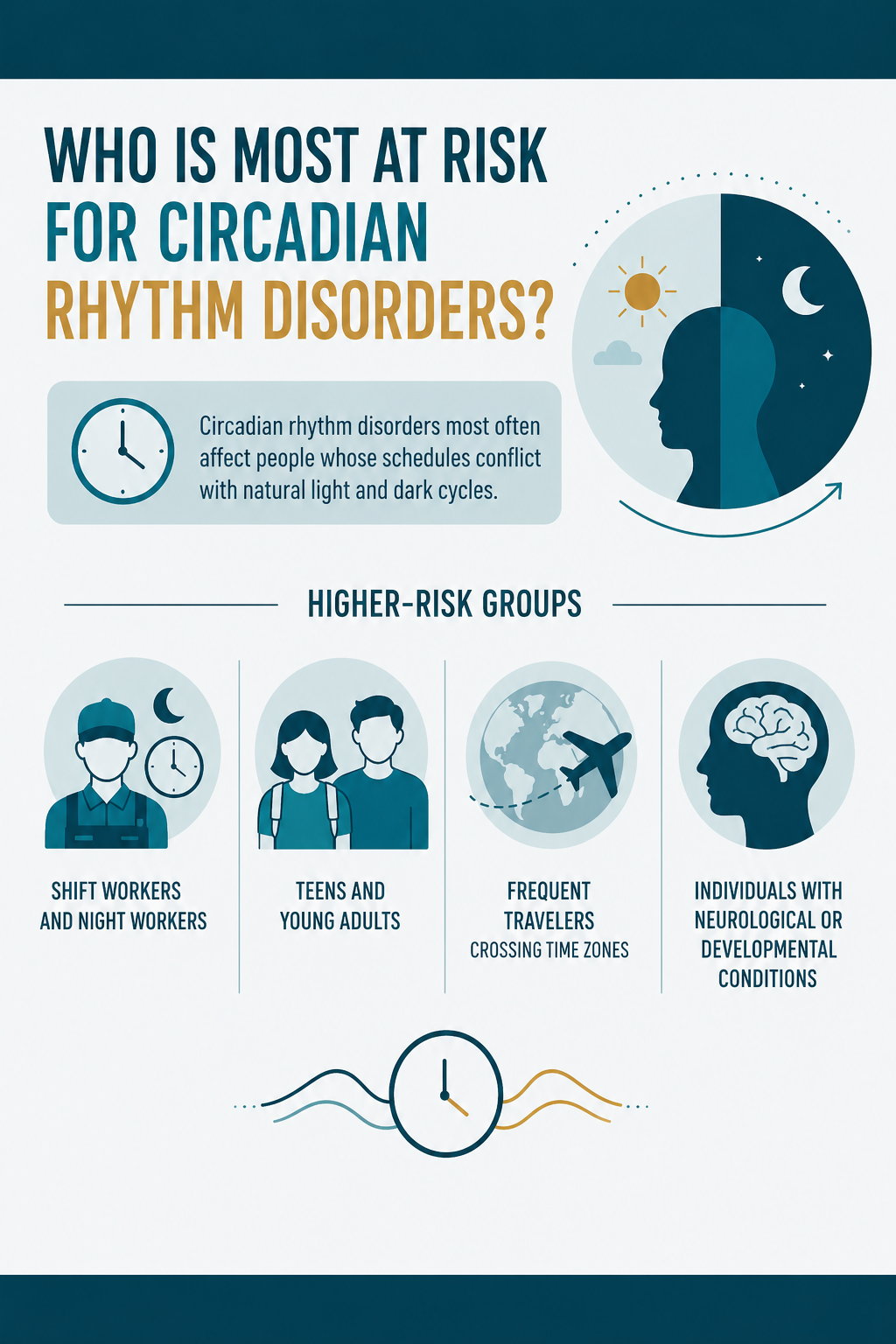
Who Is Most at Risk for Circadian Rhythm Disorders?
Circadian rhythm disorders most often affect people whose schedules conflict with natural light and dark cycles (11).
Higher-risk groups include (11):
- Shift workers and night workers
- Teens and young adults
- Frequent travelers crossing time zones
- Individuals with neurological or developmental conditions
Over 22 million Americans work evening, overnight, rotating, or on-call schedules. More than half of night-shift healthcare workers sleep six hours or less per day, which is well below the recommended 7–9 hours. Dr. Daniel Barone, Associate Medical Director of the Center for Sleep Medicine at Weill Cornell Medicine, notes that “overnight shifts are especially common in the health care field,” where the people caring for our health are often fighting against their own biological clocks (12).
Why Early Evaluation Matters for Circadian Rhythm Disorders
Early evaluation helps prevent long-term sleep deprivation and its effects on mental, metabolic, and cardiovascular health. When circadian disruption goes untreated, symptoms often worsen and affect mood, performance, and daily functioning.
Identifying the problem early allows for targeted treatment rather than years of ineffective sleep advice or misdirected therapy.
Over 22 million people in the United States are employed in jobs that require evening, overnight, rotating, or on-call work schedules.
When to See a Sleep Specialist for Circadian Rhythm Disorders
You do not need a referral from your GP to schedule a consultation with The Insomnia and Sleep Institute of Arizona.
Work with leaders in sleep medicine who are committed to providing an accurate diagnosis and effective treatment. Call the office or complete the online form for a faster response.
References
- Why We Sleep Important Quotes with Page Numbers | SuperSummary. (2017). SuperSummary. https://www.supersummary.com/why-we-sleep/important-quotes/
- Scientists use parasite’s internal clock to attack sleeping sickness. (2017). ScienceDaily. https://www.sciencedaily.com/releases/2017/03/170323105838.htm
- Roy, S. (2018, January 24). “Sleeping Sickness” Is a Circadian Rhythm Disorder. Sleep Review. https://sleepreviewmag.com/sleep-disorders/circadian-rhythm-disorders/sleeping-sickness-circadian-rhythm-disorder-2/
- World. (2023, May 2). Trypanosomiasis, human African (sleeping sickness). Who.int; World Health Organization: WHO. https://www.who.int/news-room/fact-sheets/detail/trypanosomiasis-human-african-%28sleeping-sickness%29
- CDC. (2024, December 2). Symptoms of Sleeping Sickness. Sleeping Sickness (African Trypanosomiasis). https://www.cdc.gov/sleeping-sickness/symptoms/index.html
- Trypanosomiasis, human African (sleeping sickness). (2023, May 2). Who.int; World Health Organization: WHO. https://www.who.int/news-room/fact-sheets/detail/trypanosomiasis-human-african-(sleeping-sickness)
- Symptoms, transmission, and current treatments for sleeping sickness | DNDi. (2020, March 17). Drugs for Neglected Diseases Initiative (DNDi). https://dndi.org/diseases/sleeping-sickness/facts/
- Kennedy, P. G. (2012). Clinical features, diagnosis, and treatment of human African trypanosomiasis (sleeping sickness). The Lancet Neurology, 12(2), 186–194. https://doi.org/10.1016/s1474-4422(12)70296-x
- Study: Sleeping sickness not just a sleeping disorder. (2018, January 4). EurekAlert! https://www.eurekalert.org/news-releases/836872
- family of sleep disorders which affect the timing of sleep. (2006, May 29). Wikipedia.org; Wikimedia Foundation, Inc. https://en.wikipedia.org/wiki/Circadian_rhythm_sleep_disorder
- Causes and Risk Factors. (2022, March 24). NHLBI, NIH. https://www.nhlbi.nih.gov/health/circadian-rhythm-disorders/causes
- Shift Work Sleep Disorder: A Condition with Wide-Ranging Effects on Health, Job Performance and Daily Life | Patient Care. (2023). Weillcornell.org; Weill Cornell Medicine. https://weillcornell.org/news/shift-work-sleep-disorder-a-condition-with-wide-ranging-effects-on-health-job-performance-and
Disclaimer: The information provided in this blog post is for educational and informational purposes only and is not intended as a substitute for professional medical advice, diagnosis, or treatment. Always consult with a licensed healthcare provider for recommendations specific to your individual health needs.