CPAP is the first-line treatment for obstructive sleep apnea, but some people find it difficult to use consistently. If CPAP isn’t working for you, choosing between the Inspire implant and an oral appliance may be the next step. Inspire works inside the body, using gentle stimulation to keep your airway open, while oral appliances reposition the jaw to prevent airway collapse. The best choice is the one that effectively maintains an open airway without causing discomfort or hassle.
How Do These Treatments Work?
Both Inspire therapy and oral appliances aim to keep the airway open during sleep, but they use very different mechanisms.
Inspire Therapy: A Fully Implanted Device That Works with Natural Breathing
Inspire is an implantable device that works inside the body rather than relying on external air pressure or a mouthpiece. Here’s how it functions:
- A small sensor, positioned behind the implant against the superficial rib muscle, monitors natural breathing patterns.
- When inhalation is detected, the device sends an impulse through a stimulation lead wrapped around a specific section of the hypoglossal nerve, which controls tongue movement.
- This gentle electrical impulse activates two muscles beneath the tongue, moving the base of the tongue and soft palate forward.
- By preventing airway collapse, Inspire keeps the throat open without requiring a mask or mouthpiece.
- Instead of detecting sleep, the device synchronizes with breathing patterns, delivering stimulation in a 4-second on, 1-second off cycle to maintain an open airway.
This real-time response to breathing effort is what makes Inspire a proactive treatment rather than a reactive one. It prevents blockages before they happen rather than treating them as they occur.
Oral Appliances: Repositioning the Jaw and Tongue to Open the Airway
Oral appliances, including mandibular advancement devices (MADs), are custom-made mouthpieces designed to physically reposition the jaw and tongue.
- Oral appliances prevent the tongue from falling back and obstructing the airway by slightly pushing the lower jaw forward.
- Some devices also stabilize the throat’s soft tissues, reducing snoring and mild airway collapse.
- Unlike Inspire, oral appliances do not actively respond to breathing effort. They simply hold the airway in a more open position throughout the night.
They are non-invasive and removable, but their effectiveness depends on consistent nightly use and proper fit.
Effectiveness: Which One Treats OSA Better?
Inspire is far more effective than oral appliances for moderate to severe OSA. If the jaw structure allows proper airway support, an oral appliance may be sufficient for mild OSA.
Inspire: Clinically Proven to Reduce AHI by 79%
- In a five-year follow-up study, Inspire therapy reduced AHI by an average of 79% (1).
- Many users drop from severe to mild or no sleep apnea after implantation.
- Inspire also improved oxygen saturation levels, reducing cardiovascular risk factors associated with OSA.
Oral Appliances: Limited Effectiveness for Moderate to Severe OSA
- Studies show oral appliances reduce AHI by about 30-50%—significantly less than Inspire (2).
- Works best for mild to moderate OSA, but often not enough for severe cases.
- Less predictable than Inspire. Some users experience minimal improvement depending on airway anatomy and jaw structure.
Comfort & Compliance: Which Is Easier to Use?
Inspire is hands-free and requires no daily maintenance—ideal for those who struggle with CPAP or hate wearing devices. Oral appliances are non-invasive but require consistent use and can cause discomfort.
Inspire: A Set-and-Forget Solution with High Compliance
- No mask, no mouthpiece, no daily setup—just a small remote to turn it on before bed.
- Patients don’t feel the stimulation when asleep.
Oral Appliances: Non-Invasive but Can Be Uncomfortable
- Requires consistent nightly wear, which can be difficult for some.
- Common issues: Jaw pain, teeth shifting, excessive salivation, or dry mouth.
- Long-term adherence rates drop to around 55%, often due to discomfort,pain, or effectiveness concerns (3).
Side Effects & Risks: What Should You Expect?
Inspire has a short recovery period but minimal long-term side effects. Oral appliances don’t require surgery, but long-term jaw changes are a concern.
Inspire: Minor Surgery with a Short Recovery
Since Inspire is an implanted device, there is a short surgical procedure and a brief recovery period:
- Surgery lasts about 90 minutes and is performed under general anesthesia.
- Most patients resume normal activities within days and fully heal within 4-6 weeks.
- Possible temporary side effects: Mild swelling, soreness, or tongue tingling as the body adjusts.
- Long-term risks are low—no major complications have been reported in large-scale studies.
Oral Appliances: Non-Surgical but Potential Long-Term Issues
- Common side effects: Jaw pain, teeth shifting, temporomandibular joint (TMJ) issues.
- Long-term use can permanently alter bite alignment.
- Some users find breathing resistance increases when using an oral appliance, worsening oxygen desaturation levels.
Cost & Insurance Coverage: Which One Is More Affordable?
If insurance covers Inspire, it’s a better financial investment. No ongoing costs or replacements. If a patient has mild sleep apnea and insurance covers an oral appliance, it may be a lower-cost option. Inspire delivers better results for moderate to severe OSA, making the cost worth it in the long run.
Inspire: Higher Upfront Cost, Often Covered by Insurance
- The cost of Inspire therapy ranges from $30,000 to $50,000, including the device, surgical implantation, and follow-up care.
- Most major insurance providers, including Medicare, Tricare, and the VA, cover Inspire for eligible patients.
- Why does insurance cover Inspire? Because it’s an FDA-approved medical device for moderate to severe sleep apnea, and studies show it effectively reduces apnea events and improves health outcomes.
- Inspire is a one-time investment. Once implanted, it does not require regular replacements or adjustments like CPAP masks or oral appliances.
Oral Appliances: Lower Initial Cost, Less Insurance Coverage
- The cost of a custom-fitted oral appliance ranges from $2,000 to $4,000.
- Insurance coverage is inconsistent. Some plans cover them under durable medical equipment (DME), while others classify them as dental devices and deny coverage.
- Many patients pay out of pocket for device fittings, adjustments, and replacements every 3-5 years. Over time, costs can add up.
- If the oral appliance is ineffective, patients often end up needing another treatment, increasing long-term costs.

Who Qualifies? Eligibility Criteria for Inspire vs. Oral Appliances
Inspire has a highly selective process to ensure it only goes to patients who will benefit from it. Oral appliances are easier to access, but their effectiveness varies based on airway anatomy and OSA severity.
Inspire: Strict Medical Criteria for Moderate to Severe OSA
To qualify for Inspire, patients must meet specific medical requirements:
- Moderate to severe OSA (AHI 15-100): Inspire is FDA-approved for patients within this range.
- CPAP Intolerance: Patients must have documented struggles with CPAP therapy—either due to discomfort or non-compliance.
- BMI Restriction (Typically 40 kg/m² or lower): A higher BMI may reduce Inspire’s effectiveness.
- No complete concentric collapse of the airway: This is confirmed through drug-induced sleep endoscopy (DISE) before implantation.
- No significant central sleep apnea (CSA): Central events must make up less than 25% of the total apnea-hypopnea index (AHI).
Who is NOT a candidate for Inspire?
- Patients with central sleep apnea (CSA)—which is a neurological condition, not an airway blockage issue.
- People with severe anatomical obstructions beyond tongue collapse.
- Pregnant individuals or those with severe neuromuscular disorders affecting breathing.
Oral Appliances: A Broader Candidate Pool, But Limited Effectiveness
- Best for mild to moderate OSA. If AHI is above 30, an oral appliance may not be effective enough.
- Patients with CPAP intolerance who don’t want surgery.
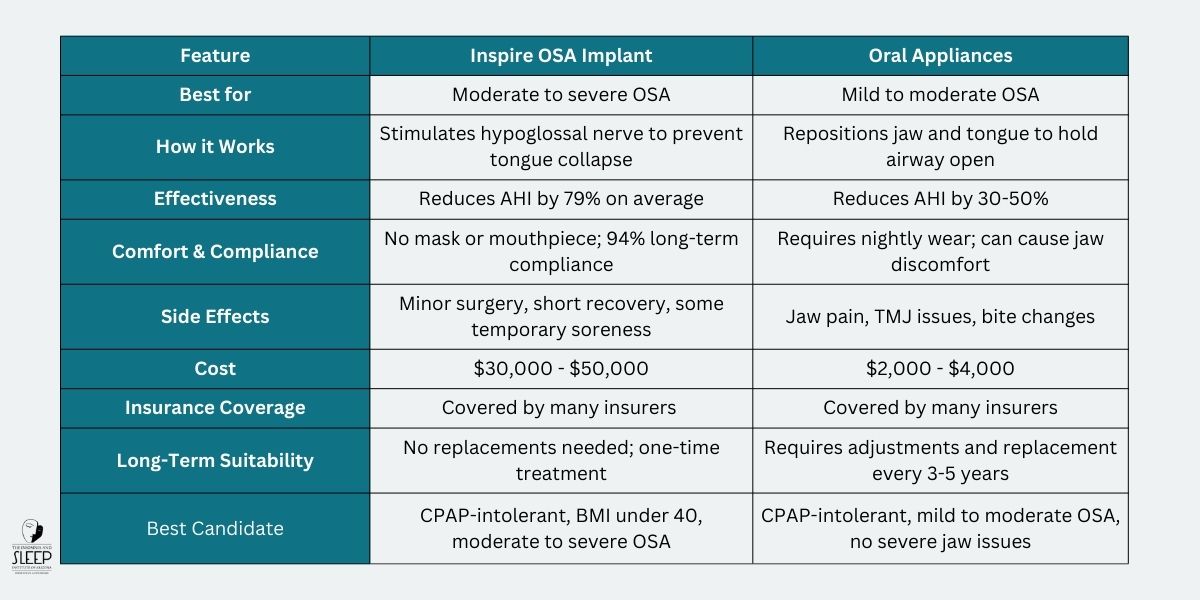
Inspire vs. Oral Appliances: A Quick Comparison
Find Out What Works—Because Sleep Matters.
The Insomnia and Sleep Institute of Arizona is home to Dr. Patel, a trusted leader in sleep medicine, and a team dedicated to helping people breathe easier and sleep better. We don’t just diagnose sleep apnea—we find real solutions that fit your needs, whether that’s Inspire therapy or an oral appliance.
With three convenient locations in Scottsdale, Phoenix, and Gilbert, expert care is always within reach. Our board-certified sleep specialists take the time to understand your sleep study, airway function, and health history to ensure you receive the most effective treatment.
Why People Trust Us:
- Dr. Patel and our expert team provide compassionate, patient-focused care.
- Inspire therapy is available.
- Care built around your sleep study and medical history.
- Insurance support, including Tricare.
- Three locations in Scottsdale, Phoenix, and Gilbert for easier access to care.
Better sleep starts with the right team. Contact The Insomnia and Sleep Institute of Arizona today.
Disclaimer: The information provided in this blog post is for educational and informational purposes only and is not intended as a substitute for professional medical advice, diagnosis, or treatment. Always consult with a licensed healthcare provider for recommendations specific to your individual health needs.