You reset your sleep schedule by syncing your internal clock to consistent sleep and wake times, anchored by light exposure, activity, and daily habits. Circadian rhythms are biologically programmed to follow a 24-hour cycle, slightly longer in most people,but they’re highly sensitive to timing cues, called zeitgebers. When these cues go missing or shift, your sleep cycle does too.
Resetting your clock isn’t just about sleep, it’s about re-establishing the rhythm that regulates hormones, mood, energy, and metabolism.
Why Do Sleep Schedules Get Off Track?
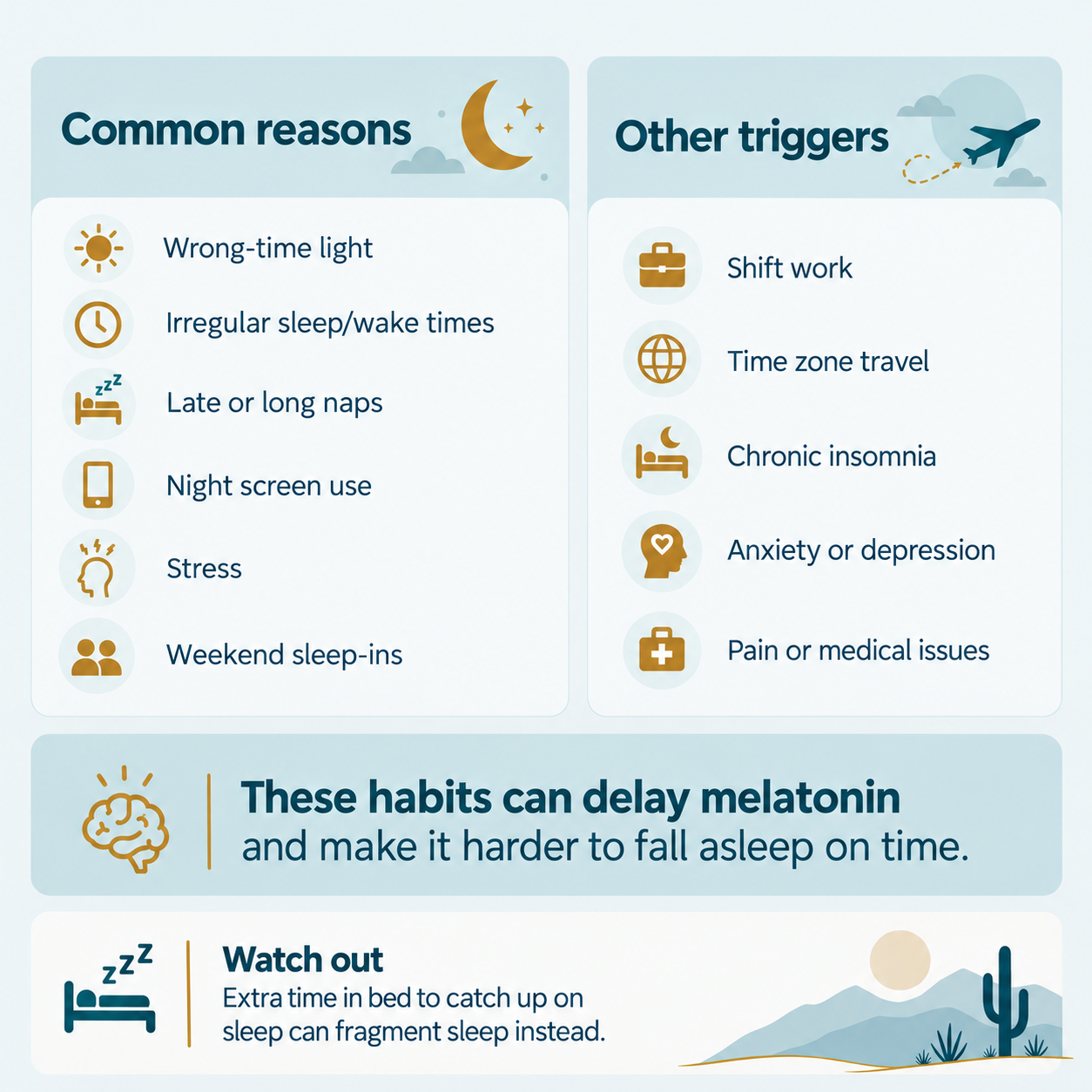
Common reasons include:
- Light exposure at the wrong times
- Inconsistent sleep and wake times
- Naps that are too long or too late
- Nighttime screen use
- High stress levels
- “Social jet lag” (staying up late and sleeping in on weekends)
These behaviors can delay melatonin release, making it harder to fall asleep on time.
Other triggers:
- Shift work
- Travel across time zones
- Chronic insomnia
- Anxiety or depression
- Pain or medical conditions
Another pitfall: spending extra time in bed to “make up” for poor sleep. This often fragments sleep further instead of repairing it.
How Long Does It Take to Fix a Sleep Schedule?
Most people can reset a disrupted sleep schedule in a few days or weeks with consistent effort. But that timeline depends on how far your internal clock has drifted and whether there are underlying issues like insomnia or delayed sleep phase syndrome (DSPS).
A practical approach is to adjust your bedtime and wake time gradually, by 15 to 30 minutes every 2 to 3 days. Too fast, and your brain won’t adapt. Too slow, and progress stalls.
If sleep hasn’t improved after two weeks, it may be more than bad habits. Circadian rhythm disorders or clinical insomnia may require medical evaluation.
What’s the First Step in Resetting a Sleep Routine?
Set a consistent wake-up time and stick to it, even after poor sleep. One study found that consistent sleep timing, not just sleep duration, was strongly linked to improved sleep quality and better mental health (1). Waking up at the same time every day sends a clear signal to your circadian system. Wake-up time anchors your circadian rhythm. In the reset process, it matters more than bedtime.
Can Melatonin Help Fix Your Sleep Schedule?
Melatonin may help shift circadian timing, but its usefulness depends on dose, timing, and the underlying problem.
- For jet lag or DSPS: Low doses (0.3–1 mg) taken about 90 minutes before the desired bedtime may help shift the clock.
- For general insomnia: Melatonin alone is usually insufficient. Lasting improvements typically require behavioral strategies, light exposure, and consistent routines.
A meta-analysis found that melatonin provided minimal benefit (<2 minutes faster sleep onset) for secondary sleep disorders or sleep restriction, though it was safe for short-term use up to three months (2).
Should You Force Yourself to Sleep Early?
Forcing yourself to sleep before you’re naturally tired rarely works. Instead of falling asleep, you may lie in bed awake, which can increase frustration and create a negative association with bedtime.
Going to bed too early can actually delay sleep further. The brain may begin to associate your bed with wakefulness rather than rest. If you’re not sleepy, do something quiet and relaxing in low light until drowsiness builds, and then return to bed. This method retrains your brain to fall asleep more easily without creating pressure or anxiety around sleep.
What’s the Role of Light Exposure at Night?
Light exposure at night directly affects melatonin production, the hormone that signals your body to prepare for sleep. Research from the Lighting Research Center found that just two hours of exposure to light from phones, tablets, or laptops can suppress melatonin levels by 23% in adults. This suppression can delay sleep onset and reduce overall sleep quality.
Adolescents are even more affected. In a 2015 follow-up study, one hour of screen use cut melatonin by 23%, while two hours dropped it by 38%. This makes falling asleep more difficult, particularly for teens who use screens before bed (3).
Your environment matters. Managing nighttime light is one of the most powerful tools you can control to support healthy sleep.
Does What You Eat or Drink Matter?
Yes.
- Caffeine: Blocks adenosine and lasts 6–8 hours. Stop by 2 p.m.
- Alcohol: Fragments sleep, especially REM.
- Heavy/spicy meals: Raise body temperature and delay melatonin release.
Tips:
- Avoid eating within 2–3 hours of bedtime.
- Choose light snacks with tryptophan, magnesium, or complex carbs.
- Limit fluids at night to avoid bathroom trips.
Examples:
- Oatmeal with almond milk
- Banana with peanut butter
- Tart cherry juice (contains natural melatonin)
Should You Use Naps While Resetting?
Naps can help, but only if used strategically. When you’re running on sleep debt, a short nap might improve alertness, focus, and mood. But if you nap too long or too late in the day, you reduce your natural sleep drive at night. This can delay your bedtime and slow your progress.
Use naps carefully:
- Keep naps under 30 minutes
- Schedule them before 2 p.m.
- Avoid napping at all if you’re struggling with insomnia
Naps after 3 p.m. can push your body clock later, especially if you already have delayed sleep phase tendencies. If your main goal is to reset your sleep schedule, prioritize nighttime sleep and only nap when absolutely needed.
What About Sleep Aids or Sleeping Pills?
Sleep medications may offer short-term relief, but they do not correct a broken sleep schedule. Most over-the-counter sleep aids contain diphenhydramine or doxylamine, antihistamines that cause next-day grogginess, cognitive impairment, and rapid tolerance (4). These pills may help you fall asleep but reduce deep and REM sleep, which are essential for recovery.
The American Academy of Sleep Medicine recommends CBT-I (Cognitive Behavioral Therapy for Insomnia) as the first-line treatment for chronic sleep issues like insomnia (5). It retrains the brain to fall asleep without pills. It’s more effective than medication, with longer-lasting results.
What’s the Role of Exercise?
Regular exercise helps reset your biological clock and improve sleep quality. Physical activity increases adenosine levels in the brain, which builds sleep pressure. It also reduces stress hormones like cortisol and promotes deeper sleep cycles.
Key benefits of regular movement:
- Shorter sleep onset latency (you fall asleep faster)
- Increased slow-wave (deep) sleep
- Lower risk of insomnia and depression
For best results:
- Exercise early in the day, ideally in the morning
- Avoid vigorous workouts within 2 hours of bedtime
- Aim for 150 minutes of moderate-intensity exercise per week as recommended by the CDC (6)
Can Stress and Anxiety Keep You Stuck?
Psychological arousal is a leading cause of delayed sleep. When you’re anxious, your nervous system stays alert. Your heart rate is elevated. Cortisol stays high and melatonin production is suppressed. This makes it nearly impossible to fall asleep on time, no matter how tired you are.
Common signs of anxiety-related sleep disruption:
- Racing thoughts in bed
- Waking up frequently during the night
- Feeling more awake the moment you lie down
Techniques that help:
- Mindfulness-based stress reduction
- Diaphragmatic breathing
- Guided imagery
- Progressive muscle relaxation
If you’ve tried these and still can’t sleep, it’s time to talk to a professional. Anxiety disorders are highly treatable. Addressing mental health is often the missing piece in resetting sleep.
Get Expert Help from the Sleep Specialists Who Listen
If home strategies don’t help, a sleep specialist can rule out medical or psychiatric causes. Clinics like the Insomnia and Sleep Institute of Arizona offer physician-led care that combines behavioral, medical, and environmental approaches tailored to your specific needs.
Why people come to us:
- Your care is led by experienced sleep doctors
- We match treatment to your sleep phase, stress levels, and health history
- We serve patients in Scottsdale, Phoenix, and Gilbert areas
- You get answers based on sleep science
Medical decisions come from our physicians, because you deserve better sleep and better care.
Reach out today. You’ve waited long enough to get the sleep you need and deserve.
References
- Scott, A. J., Webb, T. L., Martyn-St James, M., Rowse, G., & Weich, S. (2021). Improving sleep quality leads to better mental health: A meta-analysis of randomised controlled trials. Sleep Medicine Reviews, 60, 101556. https://doi.org/10.1016/j.smrv.2021.101556
- Buscemi, N., Vandermeer, B., Hooton, N., Pandya, R., Tjosvold, L., Hartling, L., Vohra, S., Klassen, T. P., & Baker, G. (2006). Efficacy and safety of exogenous melatonin for secondary sleep disorders and sleep disorders accompanying sleep restriction: meta-analysis. BMJ, 332(7538), 385–393. https://doi.org/10.1136/bmj.38731.532766.f6
- Light at Night | Light and Health | Research Programs | LRC. (2017). Rpi.edu. https://www.lrc.rpi.edu/programs/lighthealth/LightatNight.asp
- Pigeon, W. R., Bishop, T. M., & Marcus, J. A. (2014). Advances in the management of insomnia. F1000Prime Reports, 6, 48–48. https://doi.org/10.12703/p6-48
- Celmer, L. (2024, March 6). Digital cognitive behavioral therapy for insomnia. American Academy of Sleep Medicine – Association for Sleep Clinicians and Researchers. https://aasm.org/digital-cognitive-behavioral-therapy-for-insomnia-platforms-and-characteristics/
- CDC. (2024, July 19). Adult Activity: An Overview. Physical Activity Basics. https://www.cdc.gov/physical-activity-basics/guidelines/adults.html
Disclaimer: The information provided in this blog post is for educational and informational purposes only and is not intended as a substitute for professional medical advice, diagnosis, or treatment. Always consult with a licensed healthcare provider for recommendations specific to your individual health needs.