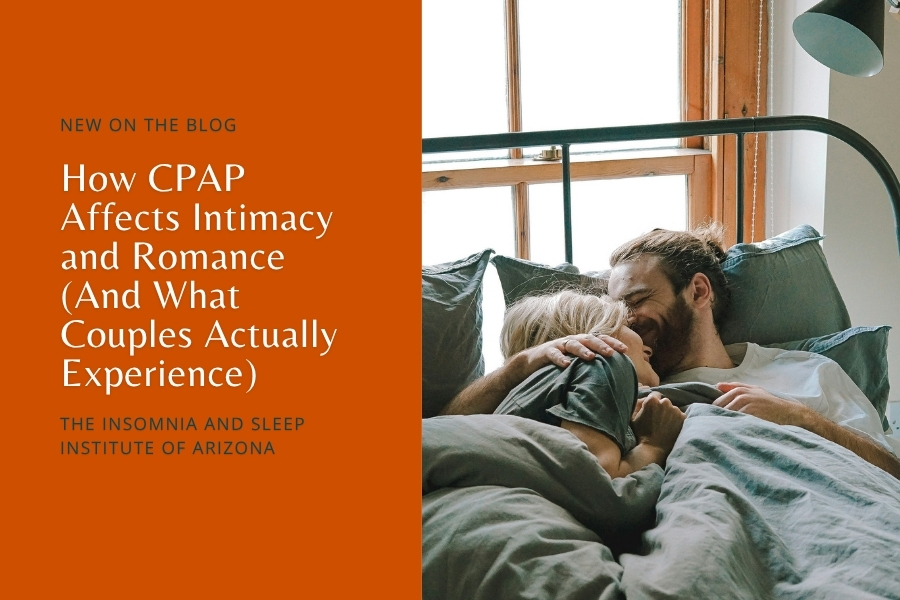
When patients ask our sleep specialists if wearing a CPAP mask will ruin intimacy and romance, the short answer is no. While the initial adjustment phase can feel awkward or cumbersome, the clinical reality is that CPAP therapy frequently restores relationship quality and physical closeness.
CPAP treatment helps get rid of the constant exhaustion, grumpiness, and snoring that drive partners into separate rooms. It’s all about helping couples reconnect and finally getting a good night’s sleep together.
The Initial Adjustment Phase
Sleep apnea shapes the night for both people sharing the room. When our sleep physicians prescribe CPAP, the primary medical goal is clear: keep the upper airway open, prevent apneas, and restore oxygen levels. However, we understand that adding a medical device to the bedroom requires adaptation.
During the first few weeks, adjustments to mask fit and airflow settings are standard. Some people find the mask uncomfortable or loud in the beginning, though practice helps most individuals obtain a secure and comfortable fit (1).
In a qualitative study on couple dynamics during CPAP initiation, bed partners were actively involved during the first few weeks by assisting with device setup, adjusting mask straps, and encouraging consistent use (2).
That same study revealed that concerns about interference with intimacy acted as an initial barrier to treatment, with some patients feeling self-conscious in front of their partner (2). At our clinic, we view this phase as a predictable period of adjustment rather than a permanent hurdle to romantic connection.
What Actually Changes in the Relationship
The broader transformation occurs once CPAP treatment is used consistently. Obstructive sleep apnea causes repeated night awakenings, loud gasping, daytime fatigue, and emotional strain. Loud snoring can keep anyone sleeping nearby from getting adequate rest (3).
When breathing stabilizes, both partners experience tangible relief. A randomized controlled trial demonstrated that real CPAP therapy significantly reduces subjective sleepiness and improves the overall quality of life for both patients and their bed partners (4).
Research evaluating couples found that starting treatment positively influenced marital quality, with a statistically significant proportion of couples choosing to sleep in the same bed again (5). Long-term clinical data also indicates that after three months of consistent CPAP use, patients report decreased marital conflict (6).
When researchers surveyed bed partners directly about physical closeness, 86 percent reported that the appearance of the mask did not affect their perception negatively, and 64 percent stated there were no negative effects on intimacy (7). Furthermore, 71 percent of partners reported improved sleep quality, while 41 percent noted increased relationship satisfaction (7).
Sleep apnea is rarely an isolated health issue because a partner is often the first person to notice gasping, pauses in breathing, or severe snoring. Television host Regis Philbin underwent an overnight sleep evaluation during a 2009 episode of Live with Regis and Kelly and was subsequently reported to have sleep apnea.
His wife, Joy, had encouraged him to seek treatment for his sleep problems. Her concern reflects an issue many couples face: snoring and other symptoms of sleep-disordered breathing can disturb a bed partner’s sleep as well as the sleep of the person with apnea. (8).
When a loved one encourages sleep testing out of genuine care, it builds deep emotional trust. Accepting CPAP therapy is a powerful act of devotion that directly protects your partner’s health and rest alongside your own.
Work With a Sleep Specialist Who Understands Real-Life Concerns
CPAP works best when it fits into your life, not when your life revolves around it.
Discomfort, noise concerns, and mask fit issues are common early on. These are not reasons to stop therapy. They are signals that something needs adjustment.
A properly fitted mask should feel secure without pressure points. Airflow settings should support breathing without causing dryness or leaks. These details make a difference in how the device feels during the night and how confident you feel using it.
At The Insomnia and Sleep Institute of Arizona, care is centered on real outcomes. Patients are seen by sleep specialists from the beginning, so concerns are addressed early. That includes mask fitting, pressure adjustments, and follow-up based on how you are actually sleeping, not just what the data shows.
We work with patients across Phoenix, Scottsdale, and Gilbert. No referral is needed.
If CPAP feels uncomfortable, if it is affecting your routine, or if you have questions about how it fits into your relationship, it can be refined. Small changes often solve what feels like a major issue.
Schedule a consultation and get support that makes CPAP easier to live with and easier to keep using.
References
- Chou, M. S. H., Ting, N. C. H., El-Turk, N., Harrington, Z., & Dobler, C. C. (2021). Treatment burden experienced by patients with obstructive sleep apnoea using continuous positive airway pressure therapy. PLOS ONE, 16(6), e0252915. https://doi.org/10.1371/journal.pone.0252915
- Luyster, F. S., Dunbar-Jacob, J., Aloia, M. S., Martire, L. M., Buysse, D. J., & Strollo, P. J. (2014). Patient and Partner Experiences With Obstructive Sleep Apnea and CPAP Treatment: A Qualitative Analysis. Behavioral Sleep Medicine, 14(1), 67–84. https://doi.org/10.1080/15402002.2014.946597
- Beninati, W., Harris, C. D, Herold, D. L., & Shepard, J. W. (1999, October). The effect of snoring and obstructive sleep apnea on the sleep quality of bed partners. Mayo Clinic Proceedings; PubMed. https://doi.org/10.4065/74.10.955
- Siccoli, M. M., Pepperell, J. C. T., Kohler, M., Craig, S. E., Davies, R. J. O., & Stradling, J. R. (2008). Effects of Continuous Positive Airway Pressure on Quality of Life in Patients With Moderate to Severe Obstructive Sleep Apnea: Data From a Randomized Controlled Trial. Sleep, 31(11), 1551–1558. https://doi.org/10.1093/sleep/31.11.1551
- Cascais Costa, C., Afreixo, V., & Cravo, J. (2023). Impact of Obstructive Sleep Apnea Treatment on Marital Relationships: Sleeping Together Again? Cureus. https://doi.org/10.7759/cureus.46513
- Baron, K. G., Smith, T. W., Czajkowski, L. A., Gunn, H. E., & Jones, C. R. (2009). Relationship Quality and CPAP Adherence in Patients With Obstructive Sleep Apnea. Behavioral Sleep Medicine, 7(1), 22–36. https://doi.org/10.1080/15402000802577751
- Laharnar, N., Bailly, S., Basoglu, O. K., Buskova, J., Drummond, M., Fanfulla, F., Mihaicuta, S., Pataka, A., Riha, R. L., Bouloukaki, I., Testelmans, D., Trakada, G., Verbraecken, J., Zimmermann, S., Penzel, T., & Fietze, I. (2024, August). Bed partner perception of CPAP therapy on relationship satisfaction and intimacy-A European perspective from the ESADA network. Journal of Sleep Research; PubMed. https://doi.org/10.1111/jsr.14125
- July 9, 2009. (2009, July 9). Live with Kelly and Mark. https://livewithkellyandmark.com/guide/july-9-2009/
Disclaimer: The information provided in this blog post is for educational and informational purposes only and is not intended as a substitute for professional medical advice, diagnosis, or treatment. Always consult with a licensed healthcare provider for recommendations specific to your individual health needs.