Living in Arizona presents unique challenges for continuous positive airway pressure (CPAP) users. When high particulate desert dust and seasonal pollen irritate the upper airway, positive pressure feels like pushing air against a swollen, resistant passage. This irritation triggers nasal congestion, mouth breathing, air leaks, and severe dryness, causing patients to pull off their masks mid-night.
Fortunately, optimizing heated humidification, controlling indoor air quality, and treating underlying allergic rhinitis can restore consistent, comfortable therapy even during peak dust season.
Understanding CPAP Compliance in the Desert
Consistency is the absolute foundation of successful sleep apnea treatment. However, staying consistent is often much harder for residents living in dry desert environments.
In clinical practice, standard CPAP compliance is defined as using the device for at least four hours per night on 70 percent of nights within a 30-day window (1). While insurance providers use this threshold for coverage, our sleep physicians emphasize that optimal health benefits occur when patients achieve six or more hours of uninterrupted sleep every night (2). When airborne dust and arid air strike, reaching that benchmark becomes a daily battle for many of our patients.
How Desert Dust Triggers the CPAP Abandonment Cycle
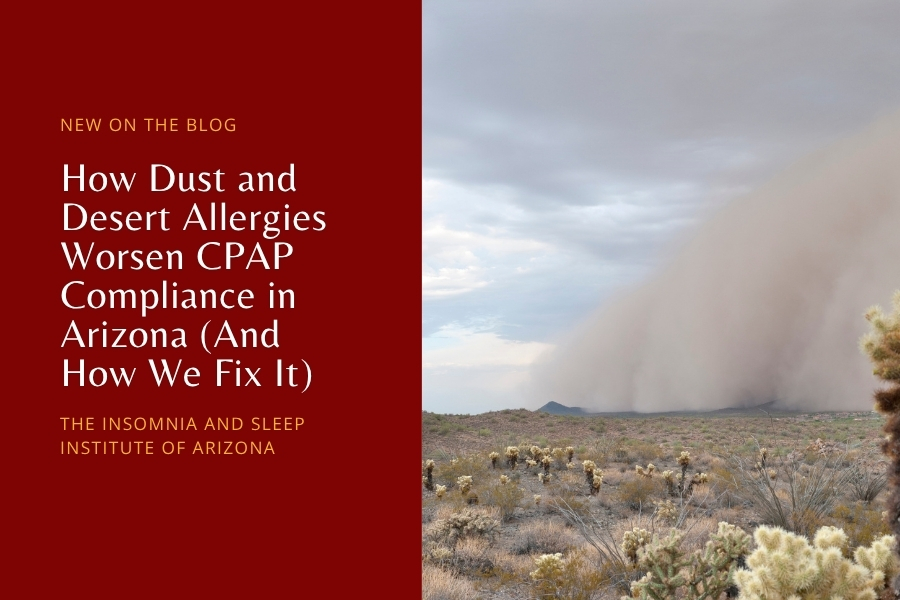
During Arizona monsoon season, massive dust storms known as haboobs regularly sweep through Maricopa County and the Greater Phoenix area, as documented in recent news reports on Arizona dust storms. These intense storms kick up high concentrations of coarse and fine particulate matter, specifically PM10, which easily slips past initial nasal filtration defenses (3).
When patients inhale PM10 particles, these microscopic grains cause acute inflammation across the nasal and paranasal mucosal tissue (4). Because CPAP therapy relies on steady airflow through the nose, even mild tissue swelling amplifies airway resistance, making incoming air feel overwhelmingly harsh and uncomfortably strong (5).
For patients who also suffer from seasonal desert allergies, the situation becomes even more complicated. Allergic rhinitis increases nasal tissue resistance, triggers excess mucus production, and causes persistent postnasal drip (6). Clinical research confirms that developing nasal congestion after starting CPAP is directly associated with lower overall adherence rates (7).
This creates a predictable physical cycle that our sleep team routinely sees in our clinic:
- Airborne dust or local pollen inflames sensitive nasal tissue (8).
- Swelling increases upper airway resistance, making nasal breathing difficult (9).
- The patient instinctively opens their mouth to breathe, causing mouth dryness and air leaks around the mask seal (10).
- Noise from mask leaks and facial irritation repeatedly interrupt deep sleep (11).
- Overwhelmed by discomfort, the patient removes their mask earlier each night (12).
Without targeted clinical intervention, this cycle continues, leaving patients exhausted and vulnerable to untreated sleep apnea.
Evidence-Based Clinical Strategies to Restore CPAP Comfort
Rather than simply telling patients to endure the discomfort or arbitrarily raising pressure settings, our sleep specialists focus on restoring airway comfort and environmental control.
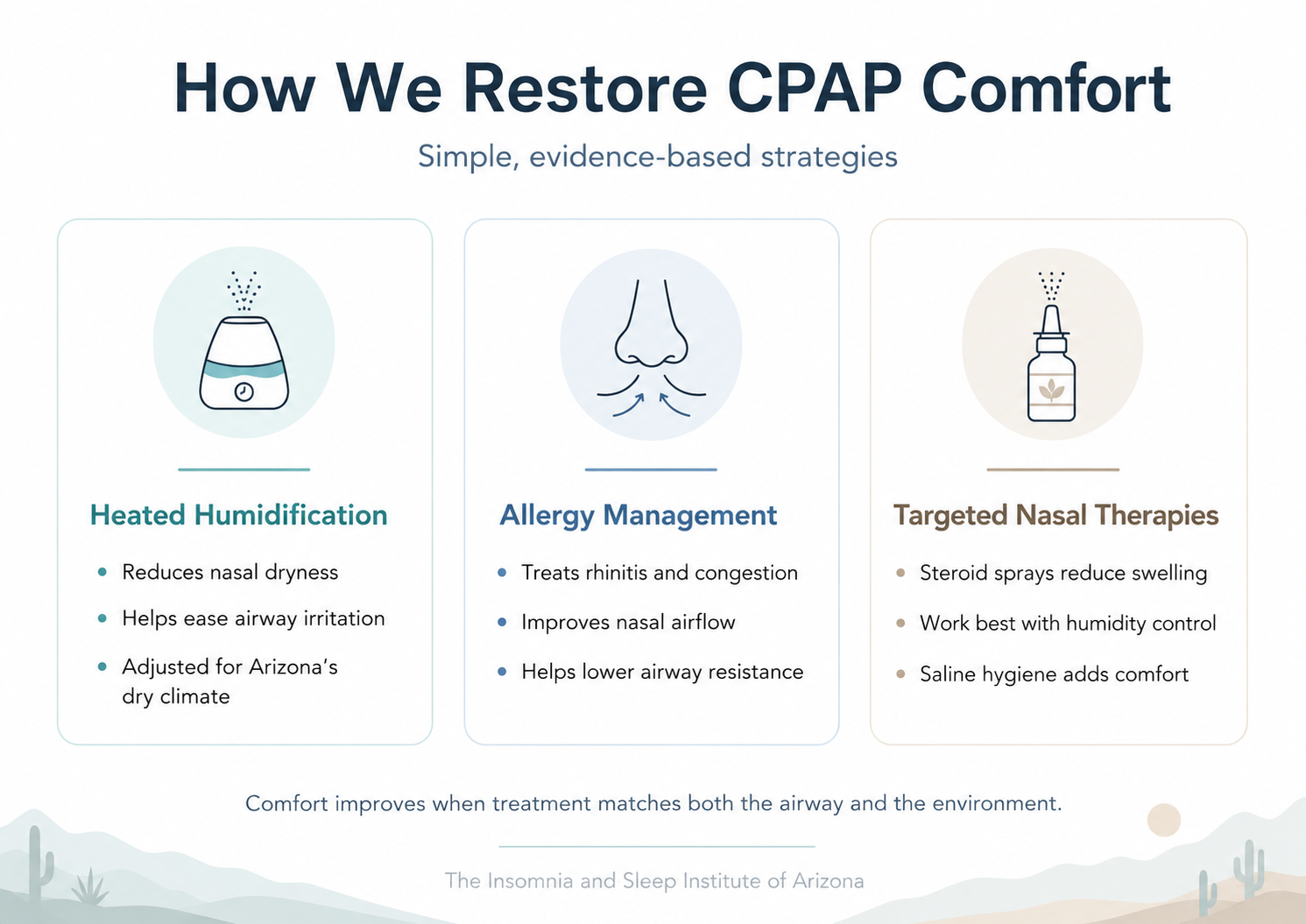
- Heated Humidification: In Arizona’s dry climate, heated humidification is an essential component of care. Studies show heated humidification significantly reduces nasal dryness and airway irritation during CPAP use (13). We routinely adjust temperature and humidity settings to match seasonal desert shifts.
- Comprehensive Allergy Management: Uncontrolled rhinitis actively undermines therapy. By managing underlying allergies, we stabilize nasal airflow and lower upper airway resistance (14).
- Targeted Nasal Therapies: While nasal steroid sprays help reduce chronic swelling, medical research demonstrates that steroid sprays alone do not consistently resolve CPAP compliance issues for every patient (15). They work best when combined with aggressive humidity control and saline hygiene.
Real-World Environmental Tactics for High-Dust Months
When American Lung Association dust storm advisories highlight elevated particulate levels outdoors, our sleep team advises patients to adopt these proactive daily habits:
- Hydrate and Rinse Before Bed: Rinsing nasal passages with sterile saline removes trapped dust particles and pollen before you put on your mask (16). Starting therapy with clear, hydrated nasal passages dramatically improves breathing comfort.
- Fortify Your Indoor Environment: Keep house windows closed during windy weather, replace HVAC filters on schedule, and run a HEPA air purifier in your bedroom. Filtering indoor air minimizes airborne irritants and protects sleep quality (17).
- Maintain Equipment Hygiene: Dust particles readily cling to silicone mask cushions, tubing walls, and intake filters. Wipe your mask seal daily, wash tubing weekly, and replace disposable filters as soon as they show discoloration.
- Address Mask Leak and Fit Early: If nasal swelling forces mouth breathing, tightening your mask straps will only create painful pressure sores. Our sleep team can evaluate whether switching to a full-face mask or adding a chin strap is appropriate during peak dust months.
When to Consult Our Sleep Specialists
You do not have to struggle through therapy alone. We encourage you to schedule an evaluation with our sleep clinic if you experience any of the following:
- Inability to tolerate your CPAP mask past two or three hours
- Persistent nasal burning, nosebleeds, or severe tissue dryness
- Ongoing mask leaks that wake you or your bed partner
- Daily reliance on over-the-counter decongestant nasal sprays
- Residual daytime fatigue despite using your machine
Breathing Comfortably Means Better Sleep
At The Insomnia and Sleep Institute of Arizona, we specialize in helping patients adapt their therapy to real environmental conditions. We evaluate nasal health, airflow dynamics, equipment performance, and symptom patterns together. Our goal is to help you sleep comfortably and consistently, not to push you to tolerate discomfort.
If CPAP has felt difficult or unpredictable, we can help identify why and guide you with solutions that fit your body and your environment. Message us. Our clinics provide care for patients across Gilbert, Phoenix, and Scottsdale.
References
- Weaver, T. (2025). UpToDate. Uptodate.com. https://www.uptodate.com/contents/assessing-and-managing-nonadherence-with-continuous-positive-airway-pressure-cpap-for-adults-with-obstructive-sleep-apnea
- Weaver, T. E., & Grunstein, R. R. (2008). Adherence to Continuous Positive Airway Pressure Therapy: The Challenge to Effective Treatment. Proceedings of the American Thoracic Society, 5(2), 173–178. https://doi.org/10.1513/pats.200708-119mg
- Sandhu, H. S., et al. (2024). Times Matter, the Impact of Convective Dust Events on Air Quality in the Greater Phoenix Area, Arizona. PMC / National Library of Medicine. https://pmc.ncbi.nlm.nih.gov/articles/PMC11880626/
- Kwak, H.-H., Park, J.-H., Kim, H.-S., Lee, H. M., Kim, S.-D., Mun, S. J., & Cho, K.-S. (2025). Inflammatory Effects of Particulate Matter Exposure on the Nasal and Paranasal Sinus Mucosa in Rats. International Journal of Molecular Sciences, 26(12), 5885–5885. https://doi.org/10.3390/ijms26125885
- Mack, S. M., Madl, A. K., & Pinkerton, K. E. (2019). Respiratory Health Effects of Exposure to Ambient Particulate Matter and Bioaerosols. Comprehensive Physiology, 10(1), 1–20. https://doi.org/10.1002/cphy.c180040
- Skirko, J. R., James, K. T., Shusterman, D. J., & Weaver, E. M. (2020). Association of Allergic Rhinitis With Change in Nasal Congestion in New Continuous Positive Airway Pressure Users. JAMA Otolaryngology–Head & Neck Surgery, 146(6), 523–523. https://doi.org/10.1001/jamaoto.2020.0261
- Inoue, A., Chiba, S., Matsuura, K., Osafune, H., Capasso, R., & Wada, K. (2019). Nasal function and CPAP compliance. Auris Nasus Larynx, 46(4), 548–558. https://doi.org/10.1016/j.anl.2018.11.006
- Rosario, C. S., Urrutia-Pereira, M., Murrieta-Aguttes, M., D’Amato, G., Chong-Silva, D. C., Godoi, R. H. M., & Rosario Filho, N. A. (2024). Air pollution and rhinitis. Frontiers in Allergy, 5. https://doi.org/10.3389/falgy.2024.1387525
- Magliulo, G., Iannella, G., Ciofalo, A., Polimeni, A., De Vincentiis, M., Pasquariello, B., Montevecchi, F., & Vicini, C. (2019). Nasal pathologies in patients with obstructive sleep apnoea. Acta Otorhinolaryngologica Italica, 39(4), 250–256. https://doi.org/10.14639/0392-100x-2173
- Pinto, V. L., Abdulghani Sankari, & Sharma, S. (2025, July 7). Continuous Positive Airway Pressure. Nih.gov; StatPearls Publishing. https://www.ncbi.nlm.nih.gov/books/NBK482178/
- Genta, P. R., Kaminska, M., Edwards, B. A., Ebben, M. R., Krieger, A. C., Renaud Tamisier, Ye, L., Weaver, T. E., Vanderveken, O. M., Lorenzi-Filho, G., DeYoung, P., Hevener, W., & Strollo, P. (2020). The Importance of Mask Selection on Continuous Positive Airway Pressure Outcomes for Obstructive Sleep Apnea. An Official American Thoracic Society Workshop Report. Annals of the American Thoracic Society, 17(10), 1177–1185. https://doi.org/10.1513/annalsats.202007-864st
- Maliheh Ghadiri, & Grunstein, R. R. (2020). Clinical side effects of continuous positive airway pressure in patients with obstructive sleep apnoea. Respirology, 25(6), 593–602. https://doi.org/10.1111/resp.13808
- Massie, C. A., Hart, R. W., Peralez, K., & Richards, G. N. (1999). Effects of Humidification on Nasal Symptoms and Compliance in Sleep Apnea Patients Using Continuous Positive Airway Pressure. CHEST Journal, 116(2), 403–408. https://doi.org/10.1378/chest.116.2.403
- Ali, M. M., Ellison, M., Iweala, O. I., & Spector, A. R. (2023). A sleep clinician’s guide to runny noses: evaluation and management of chronic rhinosinusitis to improve sleep apnea care in adults. Journal of Clinical Sleep Medicine, 19(8), 1545–1552. https://doi.org/10.5664/jcsm.10608
- Charnsiri Segsarnviriya, Mantana Prakassajjatham, Naricha Chirakalwasan, Prakobkiat Hirunwiwatkul, Busarakum Chaitusaney, & Natamon Charakorn. (2023). The use of topical nasal steroids to improve continuous positive airway pressure compliance in patients with obstructive sleep apnea: An updated systematic review and meta-analysis of randomized control trials. Asian Pacific Journal of Allergy and Immunology, 43(2), 206–213. https://doi.org/10.12932/ap-081122-1498
- Office of the Commissioner. (2025, April 28). Is Rinsing Your Sinuses With Neti Pots Safe? U.S. Food and Drug Administration; FDA. https://www.fda.gov/consumers/consumer-updates/rinsing-your-sinuses-neti-pots-safe
- Using Indoor Air Quality Tactics To Sleep Better At Night, Perform Well The Next Day | ashrae.org. (2025). Ashrae.org. https://www.ashrae.org/news/ashraejournal/using-indoor-air-quality-tactics-to-sleep-better-at-night-perform-well-the-next-day
Disclaimer: The information provided in this blog post is for educational and informational purposes only and is not intended as a substitute for professional medical advice, diagnosis, or treatment. Always consult with a licensed healthcare provider for recommendations specific to your individual health needs.