Your insomnia is considered mild if sleep trouble happens occasionally without significantly impairing your daytime function, moderate if poor sleep occurs several nights a week with noticeable fatigue and irritability, and severe if night after night is spent awake, causing severe daytime distress, brain fog, or safety risks. When sleep difficulty happens at least 3 nights per week and persists for 3 months or longer, we classify it as chronic insomnia. (1)(2)
At our sleep clinic, we regularly see patients who wonder if their sleeplessness is just a rough patch or a clinical medical issue. Insomnia is not just an individual struggle—it is a cultural phenomenon depicted in films like Fight Club and experienced by public figures like actress Jennifer Aniston, who spoke publicly with NBC News about her own battle with insomnia that left her dreading her bed.
Measuring Severity: The Insomnia Severity Index (ISI)
When evaluating sleep health, our sleep physicians often start with a validated clinical screening tool called the Insomnia Severity Index (ISI). (3) This seven-question tool assesses trouble falling asleep, staying asleep, early morning awakenings, sleep dissatisfaction, and daytime interference.
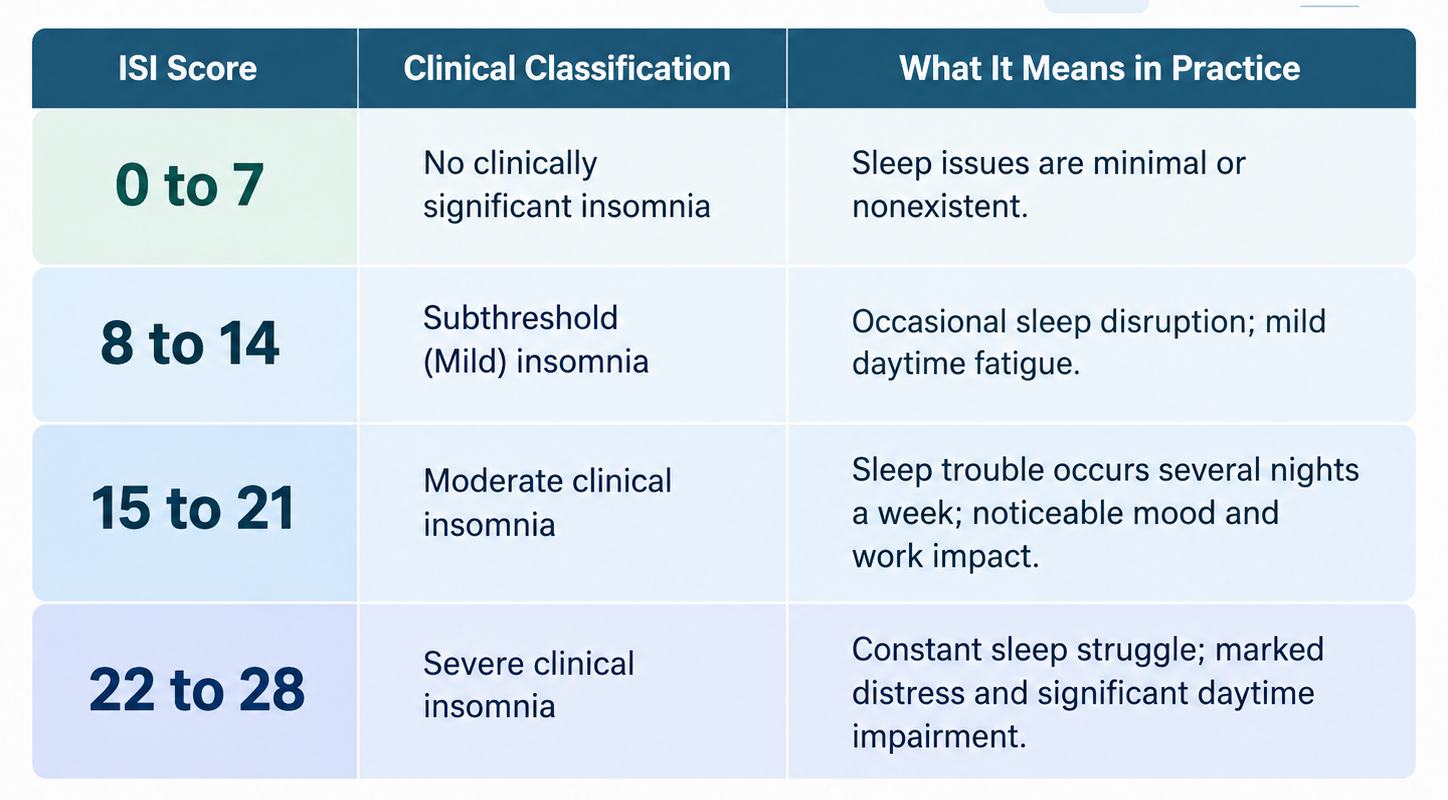
While an ISI score provides a clear baseline, a low score may still require clinical evaluation if you experience loud snoring, gasping for air, or extreme daytime sleepiness.
When Sleeplessness Turns Chronic
Short-term insomnia usually triggers after acute stress, travel, illness, or schedule changes. However, when sleep loss repeats week after week, the brain begins to form a conditioned pattern: the bed becomes associated with frustration rather than rest.
When sleep anxiety sets in, trying harder to sleep backfires by increasing central nervous system arousal. This hyperarousal cycle is why chronic insomnia rarely resolves on its own without targeted behavioral interventions.
Key Indicators Your Insomnia Is Worsening
- Taking longer than 30 minutes to fall asleep most nights.
- Waking up repeatedly during the night and struggling to drift back off.
- Experiencing “tired but wired” physical agitation when getting into bed.
- Dreading bedtime hours before it arrives.
- Relying heavily on caffeine to function during the day or alcohol/sedatives to sleep at night.
Could Your Insomnia Be Another Sleep Disorder?
At our practice, we frequently evaluate patients who believe they have primary insomnia, only to find an underlying sleep condition driving their symptoms.
Disorders such as obstructive sleep apnea (4), restless legs syndrome (5), circadian rhythm shifts (6), or narcolepsy (7) can cause fragmented sleep that looks identical to insomnia. Additionally, health factors like chronic pain, medication side effects (8), and hormonal changes during perimenopause or menopause (9) can severely interrupt sleep continuity. If breathing interruptions, leg discomfort, or hot flashes are keeping you awake, standard insomnia tips alone will not resolve the issue. In these cases, our sleep physicians order a sleep study (polysomnography) to identify the true root cause. (10)
The Health Risks of Unmanaged Insomnia
Chronic sleep loss is far more serious than feeling groggy. When severe insomnia goes untreated, we see it manifest across multiple areas of physical and mental health:
- Mental Health: Research tracking patients over time shows that persistent insomnia increases the risk of developing clinical depression by 2.6 times. (12)
- Cardiovascular Health: Chronic insomnia paired with short sleep duration significantly elevates the risk of high blood pressure, coronary heart disease, and heart failure. (13)
- Daytime Safety: The National Highway Traffic Safety Administration (NHTSA) links drowsy driving to over 91,000 police-reported crashes annually, resulting in roughly 50,000 injuries and 800 deaths. (14)
How We Treat Insomnia at Our Sleep Clinic
If you are struggling with chronic sleep loss, relying on over-the-counter sleep aids or alcohol provides only temporary, poor-quality sedation.
Our clinic utilizes Cognitive Behavioral Therapy for Insomnia (CBT-I) as the first-line, evidence-based medical treatment. (15) CBT-I restructures the behavioral habits, sleep scheduling, and anxiety patterns surrounding sleep, restoring your body’s natural sleep drive without dependence on medication.
Before your appointment, we recommend keeping a 1- to 2-week sleep diary (11) tracking your bedtimes, wake times, caffeine intake, and nighttime awakenings to help our specialists create your care plan.
Visit The Insomnia and Sleep Institute of Arizona for an Insomnia Evaluation
The Insomnia and Sleep Institute of Arizona helps people understand how severe their insomnia may be, what may be driving it, and what treatment fits the real sleep problem. We are a physician-owned sleep medicine center with locations in Phoenix, Scottsdale, and Gilbert. Our care model gives people access to trained sleep medicine professionals.
We evaluate insomnia, sleep apnea, restless legs syndrome, periodic limb movement disorder, narcolepsy, hypersomnia, circadian rhythm problems, and other sleep conditions that can look like “bad sleep” from the outside. Our team includes fellowship-trained and board-certified sleep medicine physicians, clinical psychologists, physician assistants trained in sleep medicine, respiratory therapists, sleep technologists, and medical assistants.
If your sleep feels unpredictable, exhausting, or harder to manage each week, our team can help you get clearer answers.Message us for a consultation with The Insomnia and Sleep Institute of Arizona, and let us help you review your symptoms, sleep pattern, insomnia score, and daytime struggles.
References
- CDC. (2025, February 12). About Sleep. Sleep. https://www.cdc.gov/sleep/about/index.html
- McNamara, S., Spurling, B. C., & Bollu, P. C. (2025, March 28). Chronic Insomnia. Ncbibooks; StatPearls Publishing. https://www.ncbi.nlm.nih.gov/books/NBK526136/
- Morin, C. M., Belleville, G., Bélanger, L., & Ivers, H. (2011). The Insomnia Severity Index: Psychometric Indicators to Detect Insomnia Cases and Evaluate Treatment Response. Sleep, 34(5), 601. https://doi.org/10.1093/sleep/34.5.601
- What Is Sleep Apnea? (2025, January 9). Nhlbi, NIH. https://www.nhlbi.nih.gov/health/sleep-apnea
- Restless Legs Syndrome. (2026). National Institute of Neurological Disorders and Stroke. https://www.ninds.nih.gov/health-information/disorders/restless-legs-syndrome
- What Are Circadian Rhythm Disorders? (2022, March 24). Nhlbi, NIH. https://www.nhlbi.nih.gov/health/circadian-rhythm-disorders
- Narcolepsy. (2019). National Institute of Neurological Disorders and Stroke. https://www.ninds.nih.gov/health-information/disorders/narcolepsy
- Insomnia: MedlinePlus Medical Encyclopedia. (2018). Medlineplus.Gov. https://medlineplus.gov/ency/article/000805.htm
- Menopause symptoms and relief | Office on Women’s Health. (2025). OASH | Office on Women’s Health. https://womenshealth.gov/menopause/menopause-symptoms-and-relief
- Sleep Study. (2024). Medlineplus. https://medlineplus.gov/lab-tests/sleep-study/
- Diagnosis. (2022, March 24). Nhlbi, NIH. https://www.nhlbi.nih.gov/health/insomnia/diagnosis
- Baglioni, C., Battagliese, G., Feige, B., Spiegelhalder, K., Nissen, C., Voderholzer, U., Lombardo, C., & Riemann, D. (2011). Insomnia as a predictor of depression: A meta-analytic evaluation of longitudinal epidemiological studies. Journal of Affective Disorders, 135(1–3), 10–19. https://doi.org/10.1016/j.jad.2011.01.011
- Javaheri, S., & Redline, S. (2017). Insomnia and Risk of Cardiovascular Disease. Chest, 152(2), 435–444. https://doi.org/10.1016/j.chest.2017.01.026
- NHTSA. (2024). Nhtsa. https://www.nhtsa.gov/risky-driving/drowsy-driving
- Qaseem, A., Kansagara, D., Forciea, M. A., Cooke, M., & Denberg, T. D. (2016). Management of Chronic Insomnia Disorder in Adults: A Clinical Practice Guideline From the American College of Physicians. Annals of Internal Medicine, 165(2), 125–133. https://doi.org/10.7326/m15-2175
Disclaimer: The information provided in this blog post is for educational and informational purposes only and is not intended as a substitute for professional medical advice, diagnosis, or treatment. Always consult with a licensed healthcare provider for recommendations specific to your individual health needs.