Sleep apnea does not directly cause gastroesophageal reflux disease (GERD), but the two conditions frequently trigger each other in a frustrating nighttime cycle. While research does not prove that airway blockages mechanically create reflux, treating sleep apnea often provides substantial relief from nighttime heartburn.
A 2026 systematic review and meta-analysis found that people with obstructive sleep apnea have nearly double the odds of suffering from GERD compared to those who breathe easily throughout the night (1). However, a larger review published in 2025 examined 49 clinical studies and failed to determine whether sleep apnea and reflux are linked: the association it found was not statistically significant (2).
What Happens During Nighttime Acid Reflux?
Acid reflux occurs when stomach acid travels backward into the esophagus. When this happens repeatedly and produces chronic discomfort, doctors classify it as GERD. The condition affects roughly 20% of adults in the United States and can lead to esophageal inflammation over time if left untreated (3).
The most familiar symptom is heartburn, which creates a burning pain behind the breastbone. Regurgitation can also push sour fluid or food into the throat. This backflow happens when the lower esophageal sphincter, the muscular valve between the stomach and esophagus, relaxes at the wrong moment (4). At night, this feels especially alarming because acid can reach the throat while lying flat, provoking coughing, choking, and sudden awakenings.
The Airway Connection and Shared Risk Factors
Obstructive sleep apnea (OSA) happens when the soft tissues in the back of the throat collapse during sleep, partially or completely blocking airflow. These events lower blood oxygen levels and force the brain to wake up briefly to resume breathing, often accompanied by loud snoring or gasping (5).
One clear reason sleep apnea and acid reflux appear together so often is that they share common risk factors. Excess body weight places physical pressure on the stomach while simultaneously narrowing the upper airway with fatty tissue around the neck. Smoking and alcohol use can contribute to both conditions. Smoking may increase OSA risk and contribute to GERD, and alcohol can worsen airway obstruction during sleep and trigger reflux symptoms in some people. (3,6,13).
Does Sleep Apnea Physically Pull Acid Upward?
A long-standing theory suggested that breathing hard against a closed throat creates negative suction inside the chest, physically pulling stomach contents upward like liquid through a straw. Clinical research indicates the process is slightly different.
When researchers monitored esophageal pressures and pH levels during sleep testing, nighttime reflux was mainly linked to the temporary relaxation of the lower esophageal valve rather than suction created during apneas (7). These valve relaxations occurred most frequently during brief awakenings and lighter stages of sleep. Sleep apnea does not literally vacuum acid from the stomach, but the physical stress and frequent awakenings it causes alter normal nighttime physiology.
The Cycle of Nighttime Awakenings
In a clinical study tracking sleep alongside esophageal acid monitoring, researchers recorded 69 nighttime reflux events. An arousal occurred with 68 of those 69 events (8). A person may wake up coughing with an acidic taste in their mouth and assume reflux woke them. A breathing pause may also have jolted them awake first, causing the stomach valve to relax and let acid escape into the throat.
The reverse problem is just as damaging. Acid reflux independently degrades sleep quality even without breathing pauses. In a prospective study of patients evaluated for daytime sleepiness, two-thirds had reflux symptoms. Those with reflux experienced an average of 43 sleep disruptions per hour, compared to only 20 disruptions per hour in patients without reflux (9).
A related study using 24-hour pH monitoring found abnormal nighttime acid exposure in 22% of participants with sleep dysfunction, compared to just 5.7% of those without sleep issues (10). Acid irritates the esophagus, triggering awakenings that fragment sleep, while fragmented sleep gives reflux more opportunities to travel upward.
Can CPAP Therapy Help Nighttime Reflux?
Continuous positive airway pressure (CPAP) is the primary medical treatment for obstructive sleep apnea. While CPAP is designed to keep the airway open rather than treat the stomach directly, keeping airflow steady can reduce nighttime reflux.
A meta-analysis of ten studies found that CPAP therapy led to significant improvements in reflux frequency, overall acid exposure time, and symptom scores (11). Consistent use makes a measurable difference. In a six-month study of patients with sleep apnea and heartburn, individuals who used CPAP consistently saw their heartburn scores drop by 62%, compared to a 29% decrease in those who rarely wore their equipment (12).
By delivering gentle air pressure to keep the airway open, CPAP prevents the repetitive choking events and awakenings that give stomach acid an opportunity to rise.
Practical Steps for Nighttime Relief
Managing both conditions requires addressing sleep habits and digestive habits together:
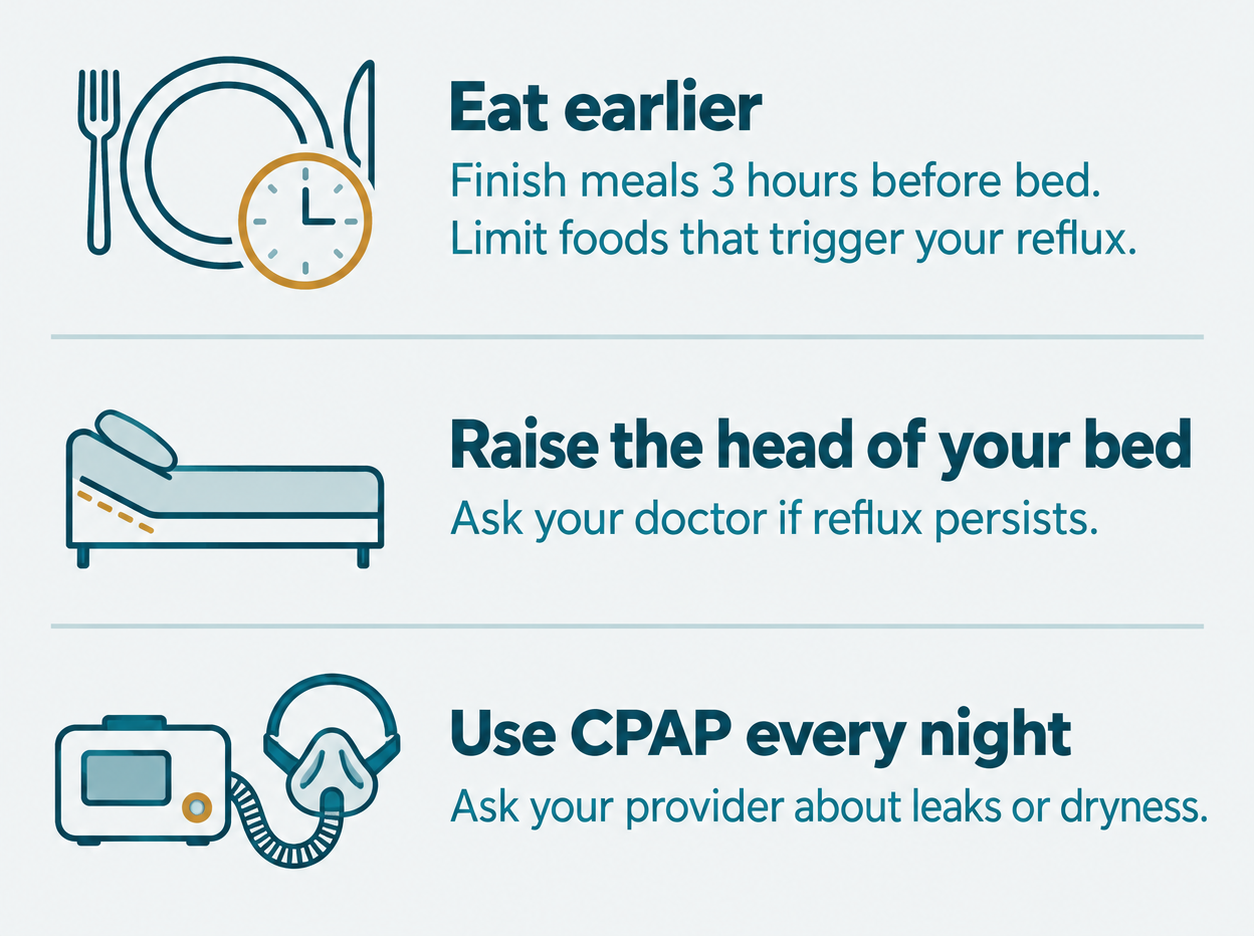
- Adjust your dinner timing: Finish meals at least three hours before bed so your stomach has time to empty. Moderating personal food triggers like caffeine, alcohol, chocolate, mint, citrus, and fatty foods may reduce symptoms for some people (13).
- Use gravity to your advantage: Elevate the head of your bed. If symptoms persist, consult your doctor about acid-reducing medications or further diagnostic testing (14).
- Stay consistent with sleep therapy: If you have diagnosed sleep apnea, use your CPAP machine every night. If mask leaks or dryness bother you, work with your provider to adjust the fit rather than stopping therapy.
Finding Lasting Relief
Waking up coughing, gasping, or burning should never be accepted as normal sleep. At The Insomnia and Sleep Institute of Arizona, our team evaluates sleep disorders across Phoenix, Scottsdale, and Gilbert. If nighttime reflux and broken rest are disturbing your life, a comprehensive sleep evaluation can determine whether sleep apnea is driving the problem so you can get back to restful, uninterrupted nights. Contact us today.
References
- Vega Sanchez, M., Córdova, F., Mosquera Cisneros, V., Rodríguez Tates, M., Chauca Bajaña, L., Quiguango Farias, D., Flores Araque, M., & Velasquez Ron, B. (2026). Obstructive Sleep Apnea and Gastroesophageal Reflux Disease: A Systematic Review and Meta-Analysis of Observational Studies. Journal of Clinical Medicine, 15(7), 2518. https://doi.org/10.3390/jcm15072518
- Zeng, X., Wang, S., & Zhang, P. (2025). Association Between Obstructive Sleep Apnea and Reflux Disease: A Systematic Review and Meta-Analysis. Nature and Science of Sleep, Volume 17, 2165–2183. https://doi.org/10.2147/nss.s535962
- Definition & Facts for GER & GERD. (2025, October 3). National Institute of Diabetes and Digestive and Kidney Diseases; NIDDK – National Institute of Diabetes and Digestive and Kidney Diseases. https://www.niddk.nih.gov/health-information/digestive-diseases/acid-reflux-ger-gerd-adults/definition-facts
- Symptoms & Causes of GER & GERD. (2025, October 3). National Institute of Diabetes and Digestive and Kidney Diseases; NIDDK – National Institute of Diabetes and Digestive and Kidney Diseases. https://www.niddk.nih.gov/health-information/digestive-diseases/acid-reflux-ger-gerd-adults/symptoms-causes
- What Is Sleep Apnea? (2025, January 9). Nhlbi, NIH. https://www.nhlbi.nih.gov/health/sleep-apnea
- Causes and Risk Factors. (2025, January 9). Nhlbi, NIH. https://www.nhlbi.nih.gov/health/sleep-apnea/causes
- Kuribayashi, S., Kusano, M., Kawamura, O., Shimoyama, Y., Maeda, M., Hisada, T., Ishizuka, T., Dobashi, K., & Mori, M. (2010). Mechanism of gastroesophageal reflux in patients with obstructive sleep apnea syndrome. Neurogastroenterology & Motility, 22(6), 611-e172. https://doi.org/10.1111/j.1365-2982.2010.01485.x
- Penzel, T., Becker, H. F., Brandenburg, U., Labunski, T., Pankow, W., & Peter, J. H. (1999, December). Arousal in patients with gastro-oesophageal reflux and sleep apnoea. The European Respiratory Journal; PubMed. https://doi.org/10.1183/09031936.99.14612669
- Guda, N., Partington, S., & Vakil, N. (2004). Symptomatic gastro‐oesophageal reflux, arousals and sleep quality in patients undergoing polysomnography for possible obstructive sleep apnoea. Alimentary Pharmacology & Therapeutics, 20(10), 1153–1159. https://doi.org/10.1111/j.1365-2036.2004.02263.x
- Hung, J.-S., Lei, W.-Y., Yi, C.-H., Liu, T.-T., & Chen, C.-L. (2016). Association Between Nocturnal Acid Reflux and Sleep Disturbance in Patients With Gastroesophageal Reflux Disease. The American Journal of the Medical Sciences, 352(2), 141–145. https://doi.org/10.1016/j.amjms.2016.05.017
- Li, C., Wu, Z., Pan, X., & Yuan, K. (2020). Effect of continuous positive airway pressure on gastroesophageal reflux in patients with obstructive sleep apnea: a meta-analysis. Sleep and Breathing, 25(3), 1203–1210. https://doi.org/10.1007/s11325-020-02224-9
- Tamanna, S., Campbell, D., Warren, R., & Ullah, M. I. (2016). Effect of CPAP Therapy on Symptoms of Nocturnal Gastroesophageal Reflux among Patients with Obstructive Sleep Apnea. Journal of Clinical Sleep Medicine, 12(9), 1257–1261. https://doi.org/10.5664/jcsm.6126
- Eating, Diet, & Nutrition for GER & GERD. (2025, October 3). National Institute of Diabetes and Digestive and Kidney Diseases; NIDDK – National Institute of Diabetes and Digestive and Kidney Diseases. https://www.niddk.nih.gov/health-information/digestive-diseases/acid-reflux-ger-gerd-adults/eating-diet-nutrition
- Katz, P. O., Dunbar, K. B., Schnoll-Sussman, F. H., Greer, K. B., Yadlapati, R., & Spechler, S. J. (2021). ACG Clinical Guideline for the Diagnosis and Management of Gastroesophageal Reflux Disease. American Journal of Gastroenterology, 117(1), 27–56. https://doi.org/10.14309/ajg.0000000000001538
Disclaimer: The information provided in this blog post is for educational and informational purposes only and is not intended as a substitute for professional medical advice, diagnosis, or treatment. Always consult with a licensed healthcare provider for recommendations specific to your individual health needs.