You can use purified water in your CPAP humidifier in a pinch, but it is not the best choice for everyday use. Purified water may still contain trace minerals that can build up inside the humidifier chamber and shorten the lifespan of your machine.
What Does “Purified Water” Actually Mean on a Label?
When you see “purified water” on a label, it means the water has undergone treatment processes to remove many contaminants and make it safer for drinking or household use. Purification can involve processes such as reverse osmosis, carbon filtration, microfiltration, ultraviolet (UV) oxidation, electrodeionization, or combinations of these methods. These treatments remove chemicals, organic compounds, and microorganisms (1, 2).
Purified water, however, may still contain small amounts of minerals or dissolved solids, depending on the process used. Unlike distilled water, which is produced by boiling and recondensing steam so that nearly all impurities and minerals are left behind (3), purified water does not have a single standardized definition covering every possible contaminant level.
In everyday language, bottled purified water is perfectly safe to drink.But for medical devices like CPAP humidifiers, even small differences in mineral content can matter over time.
Can You Use Purified Water in a CPAP Humidifier?
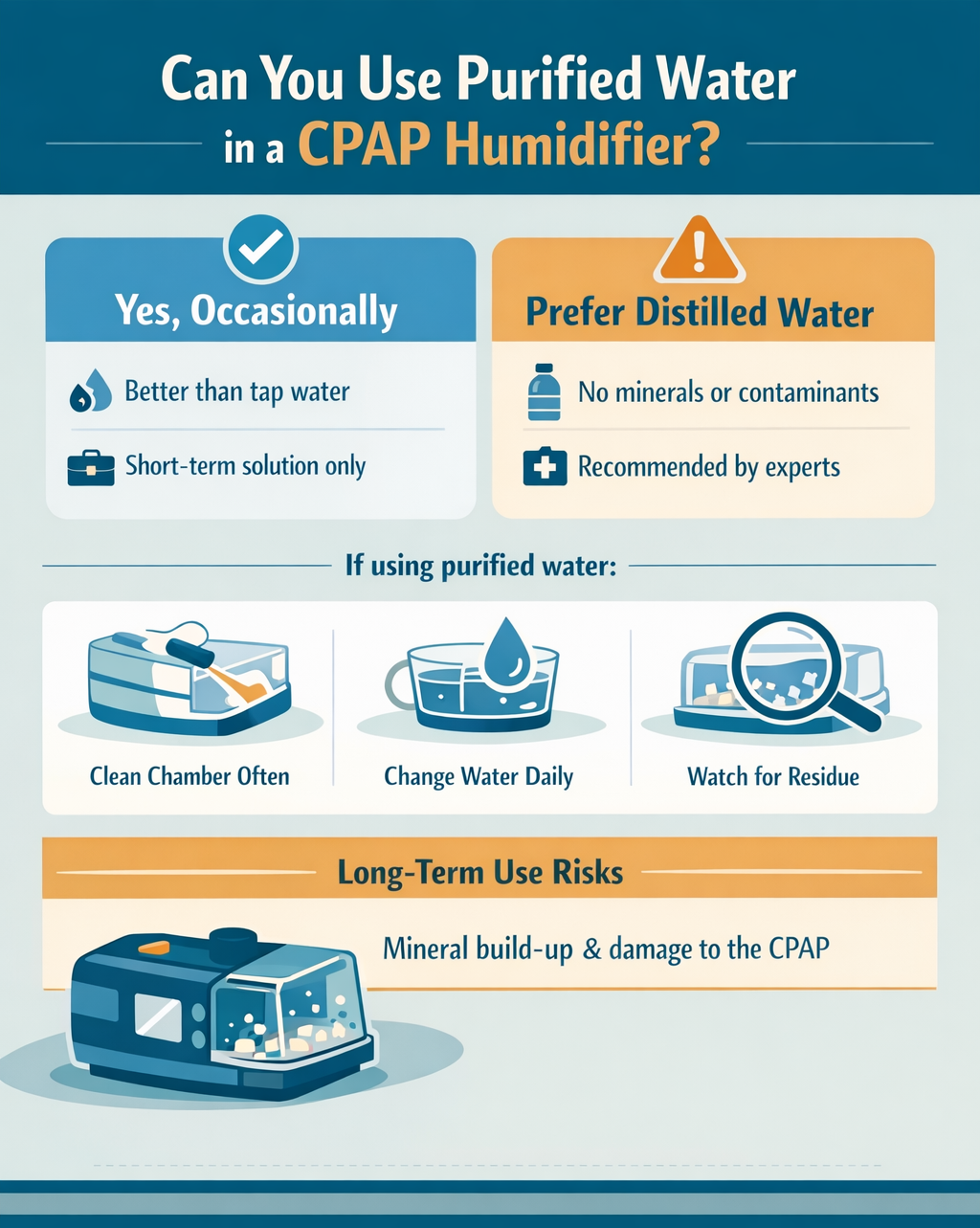
Yes, purified water can be used occasionally or temporarily in a CPAP humidifier if distilled water is unavailable. It is generally a better option than regular tap water because it has been processed to remove many impurities.
However, most sleep therapy providers, manufacturers, and sleep specialists recommend using distilled water whenever possible. Distilled water contains virtually no minerals or contaminants that could accumulate in the machine (4, 5).
If you must use purified water for a night or two, for example when traveling, you should:
- Clean your humidifier chamber more often
- Empty and refill the water daily
- Monitor for mineral residue or build-up
Using purified water for a short time rarely causes immediate harm, but if used regularly it can leave mineral scale and nodules that interfere with efficient humidification and require more cleaning and maintenance.
Is Distilled Water Better Than Purified Water for CPAP?
Distilled water is the best type of water for a CPAP humidifier because it contains virtually no minerals or dissolved solids at all. This greatly reduces buildup inside the machine’s water chamber (6).
Distilled water offers several advantages (3):
- Mineral free: Distillation removes minerals like calcium and magnesium completely.
- Fewer contaminants: Steam-condensed distilled water has fewer impurities that can harbor microbes or leave residue.
- Machine longevity: Less mineral buildup means less cleaning, lower risk of mechanical wear, and longer CPAP life.
While purified water can work temporarily, distilled water remains the preferred choice because it minimizes the risks associated with mineral deposits.
If “Purified Water” Is Not Mineral Free, What Can Go Wrong?
When water contains minerals, even in trace amounts, those minerals can be left behind as the water warms and evaporates inside the humidifier. Over time, they can form a chalky white residue in the chamber.
This buildup can cause:
- Reduced humidification performance because deposits can coat the heating plate.
- Increased cleaning needs due to scale buildup.
- Shortened equipment lifespan from mineral stress on components.
- Potential bacterial harboring because residue can trap moisture and organic material that invites microbial growth if not cleaned.
In simple terms, mineral scale interferes with how your humidifier heats and vaporizes water. That can make CPAP therapy less comfortable and cause the machine to wear out faster.
When Is Purified Water a Reasonable Choice??
Purified water is a reasonable temporary option in situations such as:
- Traveling abroad where distilled water is unavailable
- Hotel stays where distilled water is hard to find
- Short supply shortages at local stores
- Emergency situations when your distilled supply runs out
In these cases purified water is usually preferable to tap water because it contains fewer contaminants and particulates.
If you use purified water temporarily:
- Refill the CPAP with fresh water each night
- Empty leftover water every morning
- Clean the chamber at least weekly
- Switch back to distilled water as soon as possible
The key takeaway is simple: distilled water protects both your CPAP device and your respiratory comfort. Purified water can serve as a backup, but it should not be your everyday choice.
Is It Dangerous To Use Tap Water Or Purified Water In CPAP?
Using tap water or purified water in a CPAP humidifier is not immediately dangerous, but it does carry avoidable risks over time. Tap water contains dissolved minerals, trace metals, and microorganisms that are safe to drink but not ideal for heated medical devices. When heated inside a humidifier chamber, minerals such as calcium and magnesium remain behind as residue, and microbes can multiply in standing water.
Purified water reduces many contaminants, but purification methods vary. Some purified water still contains measurable dissolved solids that can accumulate inside the humidifier tub and heating plate.
The concern is not acute toxicity. Instead, the risks include:
- Mineral buildup that damages equipment
- Inconsistent humidification performance
- Increased infection risk if cleaning is neglected
For these reasons, tap and purified water should be considered fallback options rather than daily choices.
How Do You Clean Mineral Buildup From a CPAP Humidifier Tub Safely?
Mineral buildup should be removed gently to avoid damaging the humidifier chamber. Abrasive cleaners can scratch the plastic surface, making residue harder to remove and shortening the life of the component.
To clean the humidifier safely:
- Empty the water chamber completely after use
- Wash the chamber with warm water and mild soap
- Rinse thoroughly to remove any soap residue
- Allow the chamber to air dry completely before refilling
Avoid bleach, alcohol, scented cleaners, or abrasive tools. These products can damage seals and plastic components and may leave residues that irritate the airway during therapy.
Regular cleaning helps maintain consistent humidification and prevents mineral buildup from affecting machine performance.
CPAP Use for People With Allergies, Asthma, or Sinus Issues
People with asthma, allergies, or other respiratory conditions may be more sensitive to contaminants that develop in CPAP humidifier water.
Research and clinical guidance indicate that bacteria or mold growing in humidifier chambers can be inhaled during CPAP therapy. Heated humidification may increase respiratory exposure if water becomes contaminated. (7, 8).
For individuals with airway conditions, keeping the humidifier clean and using fresh water daily is especially important.
How Can You Reduce Dry Mouth And Rainout Without Constantly Changing Your Water Type?
Dry mouth and rainout are usually settings issues, not water issues. Changing water types does not correct airflow physics.
To reduce dry mouth:
- Increase humidifier level gradually
- Check for mouth breathing and consider a chin strap or full face mask
- Confirm mask fit to prevent leaks
To reduce rainout:
- Lower humidity slightly
- Use heated tubing
- Keep the machine lower than the bed
- Avoid cold bedroom temperatures
Rainout occurs when warm humid air cools inside the tubing and condenses into water droplets. Heated hoses help stabilize temperature and reduce condensation.
Water choice supports cleanliness. Settings control comfort.
Can You Run CPAP Without Water If You Do Not Want Humidification?
Yes. Most modern CPAP machines allow humidification to be turned off, allowing the device to run in dry airflow mode.
However, running CPAP without humidification increases the risk of:
- Nasal dryness
- Throat irritation
- Congestion
- Nosebleeds, expecially in dry climates
Dry environments, such as those common in Arizona, can make these issues more noticeable. Many patients tolerate CPAP therapy better with at least a low level of humidification.
Skipping water occasionally is acceptable, but long-term dryness can reduce comfort and lead to lower CPAP use.
Get CPAP Support That Actually Solves The Problem
If CPAP discomfort, dryness, congestion, or equipment issues keep recurring, guessing at solutions is rarely effective. A proper evaluation can identify the root cause.
At Insomnia and Sleep Institute of Arizona, patients receive physician-led sleep care that focuses on solving CPAP challenges and not just managing symptoms.
Our clinics serve patients across the Valley, including:
Our sleep specialists evaluate humidification needs, mask fit, airflow settings, and alternative treatments when CPAP therapy is difficult to tolerate. Effective treatment restores comfort and protects long-term health.
If CPAP feels harder than it should, contact us.
References
- water treated to remove dissolved solutes or suspended impurities. (2004, December 12). Wikipedia.org; Wikimedia Foundation, Inc. https://en.wikipedia.org/wiki/Purified_water
- Bottled Water Everywhere: Keeping it Safe. (2025). U.S. Food and Drug Administration. https://www.fda.gov/consumers/consumer-updates/bottled-water-everywhere-keeping-it-safe
- water that has had many of its impurities removed through distillation. (2002, October 17). Wikipedia.org; Wikimedia Foundation, Inc. https://en.wikipedia.org/wiki/Distilled_water
- theffron. (2020, March 17). Coronavirus FAQs: CPAP tips for sleep apnea patients | AASM. American Academy of Sleep Medicine – Association for Sleep Clinicians and Researchers. https://aasm.org/coronavirus-covid-19-faqs-cpap-sleep-apnea-patients/
- Consumer information for our Sleep apnea products specific to COVID-19 | Philips. (2026). Philips. https://www.usa.philips.com/c-e/hs/sleep-and-respiratory-care/covid-19-response/sleep-apnea-faqs.html
- Resmed. (2023, August 16). A beginner’s guide to CPAP therapy: Humidification. Resmed.com.au; ResMed ANZ. https://www.resmed.com.au/blog/a-beginners-guide-to-cpap-therapy-humidification
- Godman, H. (2019, October 8). Can your CPAP make you sick? – Harvard Health. Harvard Health. https://www.health.harvard.edu/blog/can-your-cpap-make-you-sick-2019100818005
- Ortolano, G. A., Schaffer, J., McAlister, M. B., Stanchfield, I., Hill, E., Vandenburgh, L., Lewis, M., John, S., Canonica, F. P., & Cervia, J. S. (2007). Filters Reduce the Risk of Bacterial Transmission from Contaminated Heated Humidifiers Used with CPAP for Obstructive Sleep Apnea. Journal of Clinical Sleep Medicine : JCSM : Official Publication of the American Academy of Sleep Medicine, 3(7), 700. https://pmc.ncbi.nlm.nih.gov/articles/PMC2556912/
Disclaimer: The information provided in this blog post is for educational and informational purposes only and is not intended as a substitute for professional medical advice, diagnosis, or treatment. Always consult with a licensed healthcare provider for recommendations specific to your individual health needs.