If your partner refuses to acknowledge or seek help for obstructive sleep apnea (OSA), the most effective approach is clear medical information, calm communication, and genuine concern for their long-term health.
Why Some People Refuse to Admit They Have Sleep Apnea
Denial and delayed treatment are common with obstructive sleep apnea because many of the key symptoms occur during sleep. As a result, the person experiencing the disorder may not realize what is happening. For example, breathing pauses are often first noticed by a partner. (1) The American Academy of Sleep Medicine estimates that nearly 30 million Americans have sleep apnea, yet about 80% remain undiagnosed. (2)
Psychological barriers also delayed care. Research shows that the perception of stigma and negative expectations about sleep testing or Continuous Positive Airway Pressure (CPAP) therapy can discourage people from seeking evaluation. (3)
There may also be a biological factor. Studies suggest that oxygen saturation during sleep may influence decision-making ability, and untreated OSA patients may be at risk of disadvantageous decision-making. (4) After all, repeated drops in oxygen levels and disrupted sleep can even affect insight, judgment, and cognitive clarity. (4)
As National Institute of Health sleep expert Dr. Michael Twery explains, “Sleep affects almost every tissue in our body” (5). When someone refuses evaluation, the cause may be fear, misunderstanding, or reduced awareness rather than simple stubbornness.
Signs Your Partner’s Snoring Is Actually Sleep Apnea
Habitual snoring should not be ingnored. Yale Medicine defines obstructive sleep apnea as repetitive episodes of complete or partial upper airway obstruction during sleep. (6)
Red flags include (1):
• Loud, habiutual snoring
• Observed pauses in breathing
• Gasping or choking awakenings
• Morning headaches
• Excessive daytime sleepiness
• High blood pressure
Untreated moderate to severe OSA carries significant cardiovascular risks. The American Heart Association recognizes obstructive sleep apnea as a risk factor for multiple conditions, including hypertension, atrial fibrillation, stroke, coronary artery disease, and heart failure (7).
How to Talk to Your Partner About Sleep Apnea Without Triggering Defensiveness
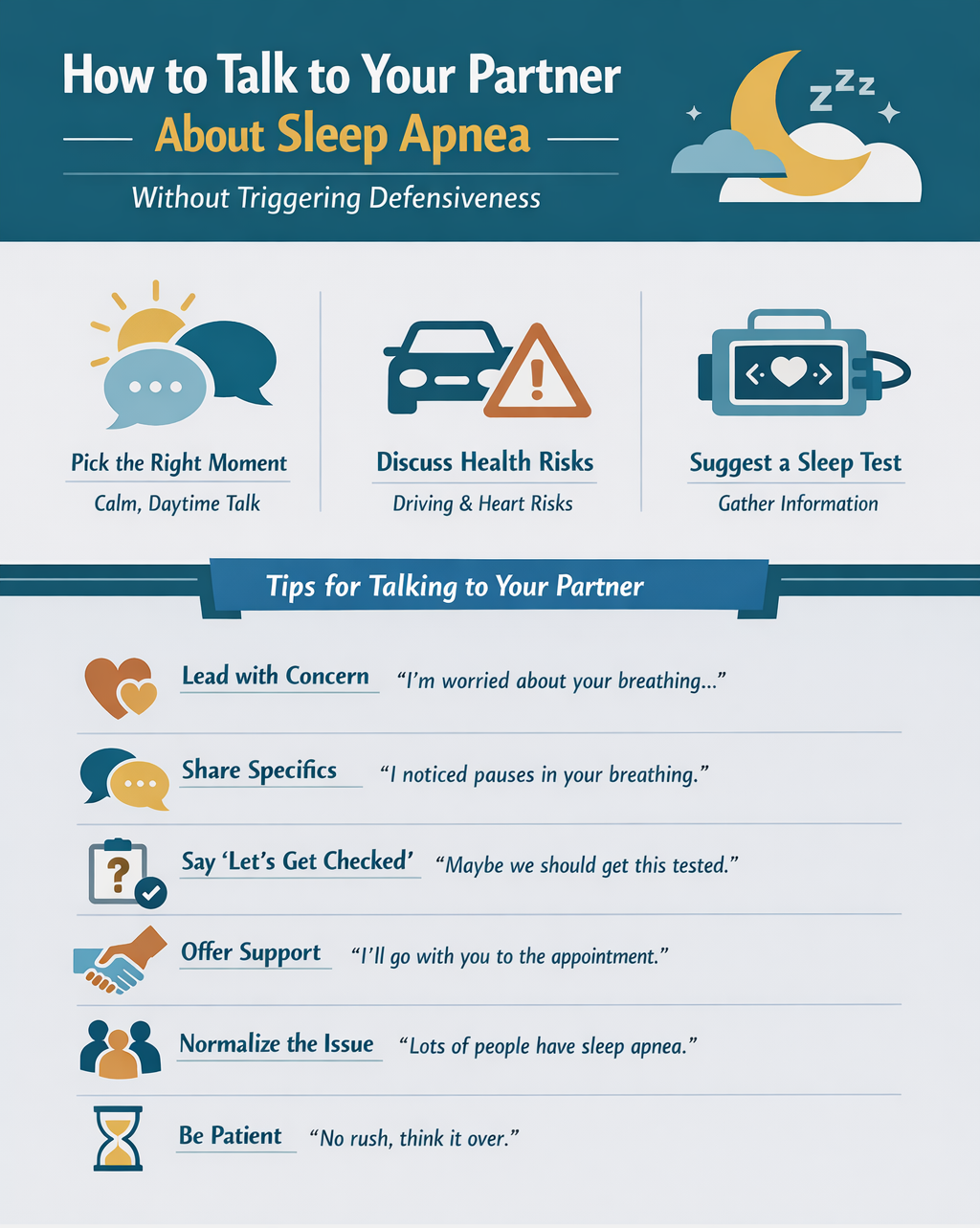
Timing and tone strongly influence how health concerns are received. Discuss symptoms during calm daytime hours rather than in moments of frustration, such as after a sleepless nigh. Focus on specific observations, such as witnessed breathing pauses or choking sounds, rather than the annoyance of snoring. This shifts the conversation from irritation to safety.
Framing the issue around risk can also increase receptiveness. Federal safety experts report that individuals with untreated OSA are at increased risk for motor vehicle crashes. (8) In fact, the National Highway Traffic Safety Administration reports that in 2017 alone, nearly 800 fatalities involved drowsy drivers. (9)
In addition, present sleep testing as information gathering rather than labeling. The American Academy of Sleep Medicine recommends either home sleep apnea testing or in-lab polysomnography for diagnosis in appropriate adults. (10) Objective data can often reduce emotional resistance.
If hesitation continues, returning to well-established medical evidence can help keep the conversation focused on health rather than criticism. Obstructive sleep apnea is strongly associated with both cardiovascular and cerebrovascular disease (11)
More Tips for Talking to a Partner About Sleep Apnea
Every relationship is different. What works for one couple may not work for another. These approaches tend to lower defensiveness and encourage cooperation:
- Lead with concern, not correction. Start with “I’m worried about your breathing at night” rather than “You need to fix your snoring.” Concern feels supportive. Criticism feels attacking.
- Choose the right moment. Avoid bringing it up immediately after a sleepless night. A neutral afternoon conversation prevents emotional escalation.
- Commly share how it affects you. Explain that you feel concerned or scared when breathing pauses happen. Keep the focus on safety, not inconvenience.
- Use specific examples. Mention witnessed pauses, choking sounds, or daytime fatigue. Specific observations feel more credible than general complaints.
- Suggest evaluation, not diagnosis. Instead of saying “You have sleep apnea,” say “Maybe it’s worth getting checked.” Testing is information gathering, not labeling.
- Offer support. Volunteer to attend the appointment or help schedule a consultation. Partnership reduces isolation.
- Normalize the condition. Millions of adults live with sleep apnea, and effective treatments are widely available.
- Be patient. Change rarely happens after one conversation. Sometimes planting the seed is enough for now.
What If They Refuse CPAP Because of Fear?
Fear of CPAP therapy is often based on outdated perceptions of loud, bulky machines and uncomfortable masks. Modern CPAP devices are significantly quieter and more compact than earlier models.
Today’s machines typically include comfort features such as auto-adjusting pressure, which can change breath-by-breath based on the patient’s needs. The American Academy of Sleep Medicine describes auto-titrating devices as systems that automatically adjust pressure in response to breathing events (12).
Adherence can improve when patients get hands-on education, proper mask fitting, and structured follow-up care. Clinically, CPAP therapy has been shown to lower blood pressure and hypertension (13). Many patients also experience improved sleep quality and reduced daytime sleepiness after starting treatment (14).
Can You Force Someone to Get Tested?
No. In most cases, you cannot force someone to get tested for sleep apnea. Medical evaluations require informed consent, and adults have the right to refuse care even when symptoms are concerning. There may be limited exceptions in certain safety-regulated professions.
If someone continues to refuse testing, focus on calm discussions, documented symptoms such as witnessed breathing pauses, and safety concerns such as drowsy driving. Offering to attend an appointment together and framing testing as a way to gather information often improves willingness more than pressure does.
Why Sleep Apnea Affects Relationships
Sleep apnea affects relationships because it disrupts shared sleep, alters mood and cognition, and increases stress for both partners. Snoring alone can significantly affect a partner’s sleep (15). Chronic sleep loss is associated with greater next-day conflict between couples. (16) Over time, repeated sleep disruption may also increase stress hormone levels, including elevated evening cortisol. (17)
Sleep apnea is also associated with daytime sleepiness, poor concentration, and memory problems. (18) Depressive symptoms are common among patients with OSA. (19) Fatigue and mood changes may strain communication and patience.
Over time, many couples may begin sleeping separately just to get some decent rest . While this may help in the short term, it can reduce physical closeness and spontaneous connection. It is also common for partners to feel anxious or helpless while listening for breathing pauses. Addressing sleep apnea often restores not only sleep quality but also patience, emotional stability, and a sense of teamwork within the relationship.
Supporting a Partner Through Sleep Apnea Treatment
Treatment success improves when patients have strong social support. Research shows that greater partner involvement is associated with better CPAP adherence. In one study, “level of spousal involvement was associated with increased CPAP adherence at 6 months.” (20) Other research found that patients reporting higher overall social support used CPAP more regularly. (21)
Encouragement during the first weeks of therapy is particularly important, as early experiences of support often determine long-term use.
Practical ways to support a partner include:
- Attending the sleep consultation
- Encouraging consistent nightly use
- Helping troubleshoot mask discomfort
- Celebrating improvements in energy and mood
Improved oxygen levels during sleep can support better cognitive clarity, blood pressure control, and mood stability.
Schedule a Sleep Apnea Consultation at The Insomnia and Sleep Institute of Arizona
At The Insomnia and Sleep Institute of Arizona, we provide comprehensive evaluation and evidence-based treatment for obstructive sleep apnea in both adults and children throughout the Phoenix metropolitan area. Our sleep clinics are conveniently located in Gilbert, Scottsdale, and Phoenix, Arizona, allowing families to access specialized care close to home.
Because our team focuses exclusively on sleep medicine, we deliver precise diagnosis using home sleep apnea testing and in-lab polysomnography when medically indicated. Our physician-led team develops personalized treatment plans based on each patient’s airway structure, medical history, and lifestyle factors that influence long-term outcomes.
Early diagnosis reduces cardiovascular strain, improves blood pressure control, enhances daytime alertness, and protects long-term brain and heart health.
Contact us today to schedule your consultation at one of our Arizona locations. We are committed to helping local families breathe better, sleep deeper, and protect their long-term health.
References
- Obstructive sleep apnea – Symptoms and causes. (2025). Mayo Clinic; https://www.mayoclinic.org/diseases-conditions/obstructive-sleep-apnea/symptoms-causes/syc-20352090
- Celmer, L. (2023, April 4). National indicator report details importance of OSA diagnosis, treatment. American Academy of Sleep Medicine – Association for Sleep Clinicians and Researchers. https://aasm.org/new-national-indicator-report-details-importance-prompt-sleep-apnea-diagnosis-treatment/
- Ye, L., Li, W., & Willis, D. G. (2022). Facilitators and barriers to getting obstructive sleep apnea diagnosed: perspectives from patients and their partners. Journal of Clinical Sleep Medicine, 18(3), 835–841. https://doi.org/10.5664/jcsm.9738
- Delazer, M., Zamarian, L., Frauscher, B., Mitterling, T., Stefani, A., Heidbreder, A., & Högl, B. (2016). Oxygen desaturation during night sleep affects decision‐making in patients with obstructive sleep apnea. Journal of Sleep Research, 25(4), 395–403. https://doi.org/10.1111/jsr.12396
- The Benefits of Slumber. (2024, June 17). NIH News in Health. https://newsinhealth.nih.gov/2013/04/benefits-slumber
- Obstructive Sleep Apnea (OSA). (2026). Yale Medicine. https://www.yalemedicine.org/clinical-keywords/obstructive-sleep-apnea
- Yeghiazarians, Y., Jneid, H., Tietjens, J. R., Redline, S., Brown, D. L., El-Sherif, N., Mehra, R., Bozkurt, B., Ndumele, C. E., & Somers, V. K. (2021). Obstructive Sleep Apnea and Cardiovascular Disease: A Scientific Statement From the American Heart Association. Circulation, 144(3). https://doi.org/10.1161/cir.0000000000000988
- Ancoli-Israel, S., Czeisler, C., George, C., Guilleminault, C., Pack, A., & Chb. (n.d.). Expert Panel Recommendations Obstructive Sleep Apnea and Commercial Motor Vehicle Driver Safety Medical Expert Panel Members. https://www.fmcsa.dot.gov/sites/fmcsa.dot.gov/files/docs/Sleep-MEP-Panel-Recommendations-508.pdf
- NHTSA. (2023). NHTSA. https://www.nhtsa.gov/risky-driving/drowsy-driving
- Kapur, V. K., Auckley, D. H., Chowdhuri, S., Kuhlmann, D. C., Mehra, R., Ramar, K., & Harrod, C. G. (2017). Clinical Practice Guideline for Diagnostic Testing for Adult Obstructive Sleep Apnea: An American Academy of Sleep Medicine Clinical Practice Guideline. Journal of Clinical Sleep Medicine, 13(3), 479–504. https://doi.org/10.5664/jcsm.6506
- Girardin Jean-Louis, Zizi, F., Clark, L. T., Brown, C. D., & McFarlane, S. I. (2008). Obstructive Sleep Apnea and Cardiovascular Disease: Role of the Metabolic Syndrome and Its Components. Journal of Clinical Sleep Medicine : JCSM : Official Publication of the American Academy of Sleep Medicine, 4(3), 261. https://pmc.ncbi.nlm.nih.gov/articles/PMC2546461/
- Littner, M., Hirshkowitz, M., Davila, D., Anderson, W. M., Kushida, C. A., Woodson, B. T., Johnson, S. F., & Wise, M. S. (2002). Practice parameters for the use of auto-titrating continuous positive airway pressure devices for titrating pressures and treating adult patients with obstructive sleep apnea syndrome. An American Academy of Sleep Medicine report.
- Hu, X., Fan, J., Chen, S., Yin, Y., & Zrenner, B. (2015). The Role of Continuous Positive Airway Pressure in Blood Pressure Control for Patients With Obstructive Sleep Apnea and Hypertension: A Meta‐Analysis of Randomized Controlled Trials. The Journal of Clinical Hypertension, 17(3), 215–222. https://doi.org/10.1111/jch.12472
- CPAP. (2022, March 24). NHLBI, NIH. https://www.nhlbi.nih.gov/health/cpap
- UHBlog. (2022, October 11). Sleeping with a Snorer: Are Both Doomed to Bad Sleep? Uhhospitals.org; University Hospitals. https://www.uhhospitals.org/blog/articles/2022/10/sleeping-next-to-a-snorer
- What doctors wish patients knew about snoring. (2024, April 12). American Medical Association. https://www.ama-assn.org/public-health/prevention-wellness/what-doctors-wish-patients-knew-about-snoring
- Wright, K. P., Drake, A. L., Frey, D. J., Fleshner, M., Desouza, C. A., Gronfier, C., & Czeisler, C. A. (2015). Influence of sleep deprivation and circadian misalignment on cortisol, inflammatory markers, and cytokine balance. Brain, Behavior, and Immunity, 47, 24–34. https://doi.org/10.1016/j.bbi.2015.01.004
- Lal, C., Weaver, T. E., Bae, C. J., & Strohl, K. P. (2021). Excessive Daytime Sleepiness in Obstructive Sleep Apnea. Mechanisms and Clinical Management. Annals of the American Thoracic Society, 18(5), 757–768. https://doi.org/10.1513/annalsats.202006-696fr
- Lee, S.-A., Im, K., Seo, J. Y., & Jung, M. (2023). Association between sleep apnea severity and symptoms of depression and anxiety among individuals with obstructive sleep apnea. Sleep Medicine, 101, 11–18. https://doi.org/10.1016/j.sleep.2022.09.023
- Batool-Anwar, S., Baldwin, C., Fass, S., & Quan, S. (2017). Role of spousal involvement in continuous positive airway pressure (CPAP) adherence in patients with obstructive sleep apnea (OSA). Southwest Journal of Pulmonary and Critical Care, 14(5), 213–227. https://doi.org/10.13175/swjpcc034-17
- Williams, N. J., Grant, A. B., Butler, M., Ebben, M., Belisova-Gyure, Z., Bubu, O. M., Jean-Louis, G., & Wallace, D. M. (2024). The effects of social support and support types on continuous positive airway pressure use after 1 month of therapy among adults with obstructive sleep apnea. Sleep Health, 10(1), 69–74. https://doi.org/10.1016/j.sleh.2023.10.013
Disclaimer: The information provided in this blog post is for educational and informational purposes only and is not intended as a substitute for professional medical advice, diagnosis, or treatment. Always consult with a licensed healthcare provider for recommendations specific to your individual health needs.