Many people can sleep on their side with an Inspire implant after the surgical areas have healed and their doctor has cleared them to return to normal sleep habits. The timing matters because the first few weeks after surgery are different from long-term sleep comfort.
Inspire surgery usually involves incisions in the upper neck and upper chest, and some procedures also involve an incision along the side of the chest between two ribs (1)(2). These areas can feel sore, swollen, or sensitive while the body heals, so direct pressure on the implant side may feel uncomfortable early on.
This is why many side sleepers need a temporary sleep setup after surgery. Sleeping slightly elevated for the first few days can help reduce swelling, and limiting heavy lifting, strenuous activity, and major arm or shoulder movement on the surgical side helps protect the healing area (1)(2).
That does not mean your preferred sleep position is gone forever. The first few weeks are simply about healing safely.
The good news is that Inspire therapy works inside the body. There is no CPAP mask pressed against your face, no tubing to keep aligned, and no hose getting dragged around when you turn over. The system includes an implanted generator, a stimulation lead, a sensing lead, and a remote that turns therapy on before sleep and off after waking (3).
What Is the Inspire Implant for Sleep Apnea?
The Inspire implant is a hypoglossal nerve stimulation device used for certain people with obstructive sleep apnea. Obstructive sleep apnea happens when the upper airway repeatedly narrows or closes during sleep, which can interrupt breathing, lower oxygen levels, and fragment sleep.
Inspire works differently from CPAP. CPAP uses pressurized air to keep the airway open. Inspire senses breathing and sends small electrical impulses to help move the tongue and open the airway during sleep (3)(4).
The word “hypoglossal” refers to the area under the tongue, which is important because the therapy targets the nerve pathway involved in tongue movement (4). In short, the device helps move the tongue forward while you sleep. That forward movement can help reduce airway blockage in properly selected patients.
Inspire is not for every person who snores. It is generally used for adults with moderate to severe obstructive sleep apnea, an AHI from 15 to 100, difficulty using or tolerating PAP therapy, and no complete concentric collapse of the soft palate (3).
A sleep study helps confirm the type and severity of sleep apnea. An airway evaluation also helps determine whether the pattern of airway collapse fits Inspire therapy (4). This is why Inspire treatment starts with careful screening, not a quick yes or no based on snoring alone.
Can You Sleep on Your Side After Inspire Implant Surgery?
Most patients should avoid direct pressure on the surgical side early in recovery and gradually return to their normal sleep positions as healing progresses. This is especially important if the generator and incisions are on the same side where you normally sleep.
The implant system includes parts in the neck and chest, with a breathing sensor near the ribs, a pulse generator below the collarbone, and a stimulation lead connected near the hypoglossal nerve (3)(4). The implanted components need time to heal after surgery, which is why temporary positioning adjustments are often recommended during recovery.
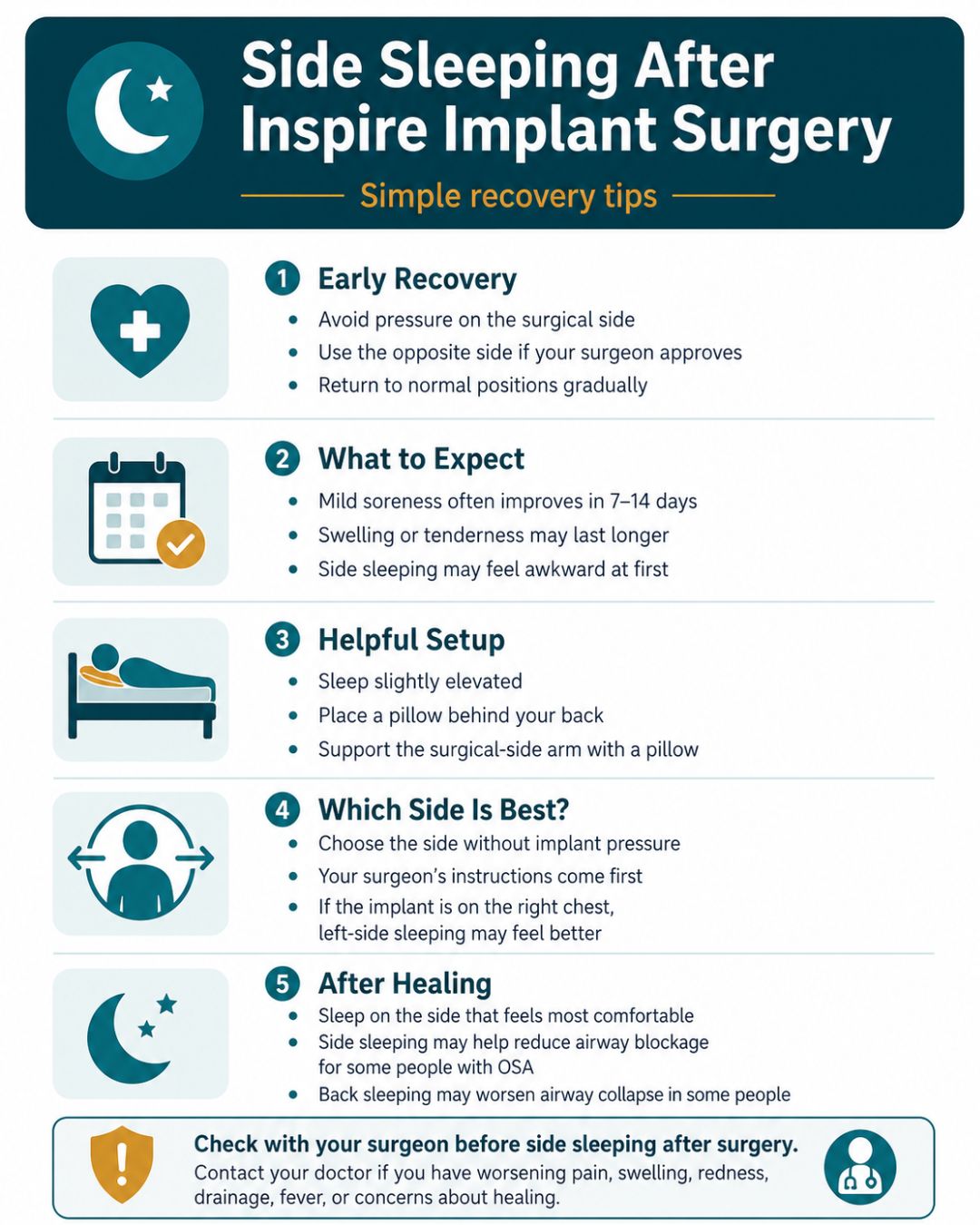
Pain is often mild to moderate and usually improves within 7 to 14 days, though swelling and tenderness can last longer for some patients (1)(5). During this early window, side sleeping may feel awkward or irritating, especially if you roll onto the implant side without thinking.
A better setup may be sleeping slightly elevated, placing a pillow behind your back to stop yourself from rolling onto the surgery side, or supporting the arm on the surgical side with a pillow. These are small changes, but they can make the first few weeks easier for natural side sleepers.
Which Side Should You Sleep on With an Inspire Implant?
During early recovery, the safer side is the one that does not place pressure on the implant or pull across the healing incisions. If the generator was placed on the right upper chest, left-side sleeping may feel more comfortable once your surgeon allows side positioning.
Many Inspire procedures place the incisions on the right side, though left-sided placement can happen (2). This is why your own surgical instructions matter more than a general rule online.
After healing, the best side is usually the side where you can sleep comfortably and use the device consistently. For many people with obstructive sleep apnea, side sleeping may help because airway obstruction often occurs more frequently when lying on the back (6).
When you sleep on your back, gravity can allow the tongue and soft palate to fall backward toward the airway. Side sleeping may reduce that backward collapse in some patients, especially those with positional obstructive sleep apnea (6).
A simple way to think about it: Inspire helps move the tongue forward with breathing, while a side-sleeping position may reduce backward airway collapse in some patients. Those two things can work together, but only follow-up testing can show how your breathing responds in real sleep.
Does Side Sleeping Make Inspire Therapy Work Better?
A side-sleeping position may benefit some patients, especially if their sleep apnea is worse on their back. However, it is not a substitute for proper Inspire activation, programming, and follow-up sleep testing.
In clinical research, Inspire therapy has shown meaningful improvements in selected patients. In the STAR trial, the median AHI decreased by 68 percent at 12 months, from 29.3 events per hour to 9.0 events per hour. The oxygen desaturation index decreased by 70 percent, from 25.4 events per hour to 7.4 events per hour (7).
Long-term results also highlight the importance of follow-up care. At five years, the reported responder rate was 63 percent, and serious device-related events requiring lead or device adjustments were reported in 6 percent of patients (8).
These results are encouraging, but they do not mean every person experiences the same outcome in every sleep position. One patient may do well on their left side but still have more breathing events on their back. Another may need a different stimulation setting. Others may benefit from combining positional therapy with Inspire treatment.
That is why Inspire care typically involves more than surgery alone. Successful treatment includes recovery, device activation, gradual setting adjustments, and follow-up sleep testing to evaluate how the device performs during real sleep.
When Is the Inspire Implant Activated?
The Inspire implant is usually not activated after surgery. The body needs time to heal before stimulation begins.
Activation commonly occurs about four to six weeks after surgery, although some post-operative instructions provide a broader four-to-eight-week timeframe (1)(2). During this appointment, the device is checked, activated, and paired with the patient remote.
Once activated, patients use the remote each time they sleep, including naps (5). The remote turns the device on before sleep and off after waking. It also includes a delay feature that allows simulation to begin after you have had time to fall asleep (4)(5).
A follow-up sleep study is typically performed later to evaluate how well the implant is controlling sleep apnea and whether the settings need adjustment. Some post-operative protocols schedule this study around two to three months after surgery, while others recommend testing at approximately 12 to 16 weeks (1)(2)(5).
This follow-up stage is often where sleep position becomes important. If your breathing appears well controlled on your side but worse on your back, your sleep team may recommend positional strategies. If stimulation feels uncomfortable in one position, your device settings may need adjustment.
What Side Sleepers Should Expect During Recovery
Side sleepers may need to change their sleep setup for a short time after Inspire surgery. The goal is to reduce pressure over the chest incision, avoid pulling near the neck incision, and protect the shoulder and rib area on the surgical side.
For the first few days, sleeping slightly elevated may help reduce swelling (1). For the first couple of weeks, heavy lifting and strenuous activity are usually restricted, and major arm or shoulder movements on the surgical side may be limited for approximately three weeks (1)(2).
Helpful recovery options may include:
- Sleeping slightly elevated during the first few nights.
- Using a pillow behind your back so you do not roll onto the surgery side.
- Hugging a pillow to keep the surgery-side shoulder from falling forward.
- Placing a pillow under the arm on the surgery side for support.
- Calling your surgical team if pain, swelling, drainage, or breathing symptoms worsen.
These strategies are intended to improve comfort and support healing. They should not replace your surgeon’s specific instructions. Your restrictions may vary depending on your incision sites, anatomy, medications, and overall recovery.
The early recovery period can feel frustrating for people who naturally prefer sleeping on their side. A few nights of awkward positioning can feel much longer when you are already tired. Fortunately, these adjustments are usually temporary and intended to protect healing tissues rather than permanently change how you sleep.
Can Sleeping on the Implant Damage the Device?
After proper healing, normal sleep-position pressure is not usually the primary concern. The more practical concern is whether lying on the implant side causes pain, pulling, swelling, unusual stimulation, or ongoing discomfort.
Early after surgery, the healing tissues surrounding the implant need protection. This is why post-op instructions commonly restrict heavy lifting, strenuous activity, and significant arm or shoulder movement on the surgery side (1)(2).
Once the device is healed and activated, comfort becomes the guide. Some people can lie on both sides without a problem. Others prefer the opposite side because direct pressure over the generator feels tender. Sometimes the discomfort is not caused by the implant itself. Shoulder pressure, pillow height, mattress firmness, or twisting across the chest can also affect comfort during sleep.
Soreness and swelling should gradually improve as the body heals, often within a couple of weeks. If tenderness persists, worsens, or is accompanied by swelling, drainage, fever, or shortness of breath, the implant site should be evaluated by your healthcare team.
Does Inspire Work If You Roll Around at Night?
Yes, Inspire is designed to work during sleep, including natural movement and position changes throughout the night. The implanted system senses breathing and delivers stimulation that is timed with each breath to help open the airway (3)(4).
Still, body position can change airway behavior. Back sleeping may worsen obstruction in many people with obstructive sleep apnea, while side sleeping may reduce airway collapse in some patients (6).
This is one reason follow-up sleep testing is valuable. You may think you stay on your side all night, but many people spend more time on their back than they realize. A sleep study can measure body position, oxygen levels, breathing events, arousals, and device performance.
If your bed partner notices increased snoring when you roll onto your back, or if you wake up dry-mouthed even with the implant on, share those details with your provider. It may help them decide whether settings need adjustment or whether positional strategies could help.
What If Side Sleeping Feels Uncomfortable With Inspire?
Sleeping on your side can feel uncomfortable early in recovery because of incision tenderness, swelling, bruising, or pressure over the chest generator. Pain commonly improves within 7 to 14 days, although swelling and sensitivity may take longer to resolve (1)(5).
If discomfort continues beyond the expected healing period, the implant site should be evaluated. Do not ignore new swelling, drainage, fever, shortness of breath, rapid neck or mouth swelling, uncontrolled pain, slurred speech, or difficulty swallowing (2)(5).
The most important factor is timing. Pain during the first week after surgery is very different from pain that develops months later. Tenderness that steadily improves is also different from symptoms that worsen, spread, or are accompanied by signs of infection.
If you are uncertain whether what you are experiencing is part of normal healing, contact your surgeon or sleep specialist. It is always better to ask questions early than to assume a problem will resolve on its own.
Can You Sleep on the Opposite Side After Inspire Surgery?
Many patients may find the opposite side more comfortable during the early stages of recovery because it avoids direct pressure over the chest generator and surgical incisions.
For example, if the implant was placed on the right upper chest, left-side sleeping may feel better once your surgeon allows side positioning. Even then, some patients notice mild pulling across the chest or neck during the first few days. Supportive pillows can help reduce twisting and keep the upper body relaxed.
After healing, the opposite side may remain your preferred position simply because it feels more comfortable. For patients with positional sleep apnea, either side may be better than the back. However, not every patient’s sleep apnea is strongly position-based, so follow-up testing is still important.
Who Qualifies for Inspire Therapy?
Inspire therapy is generally for adults with obstructive sleep apnea who meet specific medical criteria. The FDA indication includes adults 22 years and older with moderate to severe obstructive sleep apnea, an AHI from 15 to 100, PAP failure or intolerance, and no complete concentric collapse of the soft palate (3).
The evaluation process typically includes both a sleep study and an airway exam. Drug-induced sleep endoscopy helps identify how and where the airway collapses during sleep-like sedation, which helps determine whether Inspire is an appropriate option (4)(5).
A thorough Inspire evaluation usually looks at several questions:
- Is the diagnosis obstructive sleep apnea rather than mainly central sleep apnea?
- What is the patient’s AHI?
- Has CPAP failed or become intolerable despite reasonable attempts?
- Does the airway collapse pattern fit Inspire therapy?
- Is the patient healthy enough for surgery and follow-up care?
- Will insurance cover the procedure under that plan’s criteria?
While Inspire is an implanted medical device, successful treatment involves much more than the surgery itself. Device activation, sleep testing, programming adjustments, and ongoing follow-up all play important roles in achieving the best possible results.
What Patients Really Want to Know About Side Sleeping and Inspire
Most patients are not looking for a textbook answer. They want to know whether life after Inspire can feel normal.
Can they turn over? Can they nap? Can they sleep beside their partner without sounding like a leaf blower? Can they travel without a CPAP bag? Can they sleep on their favorite side?
For many people, those practical questions matter just as much as AHI scores and sleep-study results. The honest answer is that many patients return to side sleeping after healing, but comfort and treatment effectiveness should still be monitored through follow-up care. Inspire removes the mask and hose from the nightly routine, but it does not eliminate the need for medical follow-up.
One patient story helps illustrate why people explore alternatives after struggling with CPAP therapy. After turning on his Inspire device, Ryan Rogers said, “I slept better than I had in 20 years” (9).
That statement should not be viewed as a guaranteed result. It is one patient’s experience. But it does explain why patients with CPAP frustration ask detailed questions about sleep position, recovery, and nightly comfort. They are not asking for perfection. They are asking whether treatment can fit their actual life.
When to Call Your Sleep Doctor About Side Sleeping With Inspire
Call your Inspire-trained provider or surgeon if side sleeping causes new pain, unusual pulling, a change in stimulation, swelling, incision drainage, shortness of breath, fever, or a sudden decline in sleep quality.
Urgent symptoms after Inspire surgery can include rapid or severe swelling in the neck or mouth, shortness of breath, uncontrolled pain, bloody or foul-smelling drainage, excessive swelling, slurred speech, or difficulty swallowing (2)(5).
You should also reach out if stimulation repeatedly wakes you up, tongue movement feels uncomfortable, snoring returns, or excessive daytime sleepiness comes back. Device settings can often be adjusted, and follow-up visits are designed to evaluate sleep apnea control, sleep quality, device use, and device function (5).
Sleep apnea treatment should be measured by more than how the implant feels. It should be measured by breathing data, oxygen stability, symptom improvement, bed partner feedback, and daytime function.
Sleep Better With Inspire Guidance in Phoenix, Scottsdale, and Gilbert
If you are in Arizona and wondering whether you can sleep on your side with an Inspire implant, we can help you understand the full picture before and after treatment. At The Insomnia and Sleep Institute of Arizona, we evaluate obstructive sleep apnea with the level of detail this decision deserves, including diagnosis, CPAP history, Inspire candidacy, follow-up testing, and long-term treatment outcomes.
If CPAP has become difficult to tolerate and you want to know whether Inspire therapy fits your sleep, your body, and your real nightly routine, schedule a consultation with us.
Our team can help you understand your options, determine whether you meet the criteria for Inspire therapy, and develop a treatment plan tailored to your needs. The goal is not simply to implant a device. The goal is to help you achieve safer breathing, better sleep, and improved quality of life.
References
- Dr. Huang’s Post-Operative Instructions: INSPIRE Hypoglossal Nerve Stimulator Placement. (n.d.). https://www.omahaent.com/wp-content/uploads/2025/07/INSPIRE-Postop.pdf
- INSPIRE HYPOGLOSSAL NERVE IMPLANT POST-OPERATIVE INSTRUCTIONS. (n.d.). https://unitedmd.com/wp-content/uploads/2018/09/Temecula-ENT-Inspire-Post-Op-Instructions.pdf
- Center. (2023). Inspire Upper Airway Stimulation – P130008/S090. U.S. Food and Drug Administration. https://www.fda.gov/medical-devices/recently-approved-devices/inspire-upper-airway-stimulation-p130008s090
- Hypoglossal Nerve Stimulation Implant for Sleep Apnea. (2023, August 4). Hopkinsmedicine.Org. https://www.hopkinsmedicine.org/health/conditions-and-diseases/obstructive-sleep-apnea/hypoglossal-nerve-stimulation
- Postoperative Instructions for Inspire Hypoglossal Nerve Stimulator – University of Mississippi Medical Center. (2026). Umc.Edu. https://umc.edu/Healthcare/ENT/Patient-Handouts/Adult/Sleep_Surgery/Inspire.html
- Landry, S. A., Beatty, C., Thomson, L. D. J., Wong, A.-M., Edwards, B. A., Hamilton, G. S., & Joosten, S. A. (2023). A review of supine position related obstructive sleep apnea: Classification, epidemiology, pathogenesis and treatment. Sleep Medicine Reviews, 72, 101847. https://doi.org/10.1016/j.smrv.2023.101847
- Strollo, P. J., Soose, R. J., Maurer, J. T., de Vries, N., Cornelius, J., Froymovich, O., Hanson, R. D., Padhya, T. A., Steward, D. L., Gillespie, M. B., Woodson, B. T., Van de Heyning, P. H., Goetting, M. G., Vanderveken, O. M., Feldman, N., Knaack, L., & Strohl, K. P. (2014). Upper-Airway Stimulation for Obstructive Sleep Apnea. New England Journal of Medicine, 370(2), 139–149. https://doi.org/10.1056/nejmoa1308659
- Woodson, B. T., Strohl, K. P., Soose, R. J., Gillespie, M. B., Maurer, J. T., de Vries, N., Padhya, T. A., Badr, M. S., Lin, H., Vanderveken, O. M., Mickelson, S., & Strollo, P. J. (2018). Upper Airway Stimulation for Obstructive Sleep Apnea: 5‐Year Outcomes. Otolaryngology–Head and Neck Surgery, 159(1), 194–202. https://doi.org/10.1177/0194599818762383
- UHBlog. (2023, March 29). Astonished by Inspire. Uhhospitals.Org; University Hospitals. https://www.uhhospitals.org/blog/articles/2023/03/astonished-by-inspire
Disclaimer: The information provided in this blog post is for educational and informational purposes only and is not intended as a substitute for professional medical advice, diagnosis, or treatment. Always consult with a licensed healthcare provider for recommendations specific to your individual health needs.