Yes, it can, and this is especially apparent in menopause. Hormonal changes can increase the risk of obstructive sleep apnea (OSA) or worsen an existing breathing problem. Lower estrogen and progesterone levels may reduce upper airway muscle tone, pregnancy may cause nasal swelling and fluid retention, and testosterone therapy may affect respiratory control (1).
Symptoms such as unexplained exhaustion, snoring, morning headaches, brain fog, or broken sleep may be mistaken for stress or normal aging. We offer clinical evaluations and diagnostic sleep studies to determine whether sleep apnea is contributing to these symptoms.
Sleep Apnea Symptoms Look Different in Women
Women frequently experience “atypical” sleep apnea symptoms, such as insomnia, morning headaches, low mood, and chronic exhaustion, rather than classic loud snoring.
They do not report loud snoring, either because they sleep alone or because their airway obstruction presents as subtle gasping or micro-awakenings (2). Because menopause and pregnancy symptoms heavily overlap with sleep apnea, treating hot flashes or mood shifts alone will not correct an obstructed airway.
Differences in how women experience sleep apnea differently was highlighted in a widely discussed British documentary called Davina McCall: Sex, Mind and the Menopause. This fascinating documentary brought attention to how sleep problems, exhaustion, brain fog, anxiety, and depression can affect women during perimenopause and menopause. It also showed that some women need several medical appointments before their symptoms are correctly linked to menopause, delaying the support and treatment they may need.
Why Does Menopause Increase Sleep Apnea Risk?
Menopause substantially increases sleep apnea risk due to the decline of protective sex hormones and shifts in body fat distribution, even if total weight remains unchanged.
Research confirms that postmenopausal status is strongly associated with higher rates of sleep apnea, independent of age or body mass index (BMI) (3). Estrogen and progesterone help maintain upper airway muscle tone, lower levels of these hormones correlate with higher rates of snoring and irregular breathing (4).
Furthermore, menopause causes body fat to redistribute toward the abdomen and neck (visceral fat) even when the number on the scale stays stable (5). This shift places increased pressure on the upper airway during sleep.
The Menopause Society
The Menopause Society reports that sleep apnea prevalence is 4.5 times higher in postmenopausal women than in premenopausal women. The organization also notes that OSA can be underdiagnosed in women because symptoms may include insomnia, fatigue, and morning headaches. Oprah Winfrey has spoken openly in Oprah Daily about experiencing years of poor sleep, nighttime restlessness, and heart palpitations during perimenopause before the possible hormonal connection was recognized.
How Does Pregnancy Affect Sleep Apnea and Maternal Health?
Pregnancy can cause sleep apnea to appear or worsen as gestation progresses, increasing the risk of maternal health complications.
Weight gain, nasal congestion, and tissue swelling reduce available space in the upper airway during pregnancy. Studies show that sleep apnea rates more than double between early and mid-pregnancy (6).
Timely assessment is essential because untreated sleep-disordered breathing during pregnancy is strongly associated with an increased risk of preeclampsia and gestational diabetes (7). While airway swelling often recedes after delivery, persistent fatigue, snoring, or gasping after childbirth requires medical follow-up.
What Is the Link Between PCOS and Sleep Apnea?
Polycystic ovary syndrome (PCOS) is linked to a significantly higher prevalence of obstructive sleep apnea. Clinical reviews show that individuals with PCOS have a substantially higher likelihood of developing OSA compared to those without the condition (8).
Shared metabolic factors, including insulin resistance, hormonal imbalances, and weight fluctuations, contribute to this elevated risk. When PCOS is accompanied by unrefreshing sleep, morning headaches, or daytime tiredness, screening for sleep apnea is strongly recommended.
How Is Hormone-Related Sleep Apnea Diagnosed and Treated?
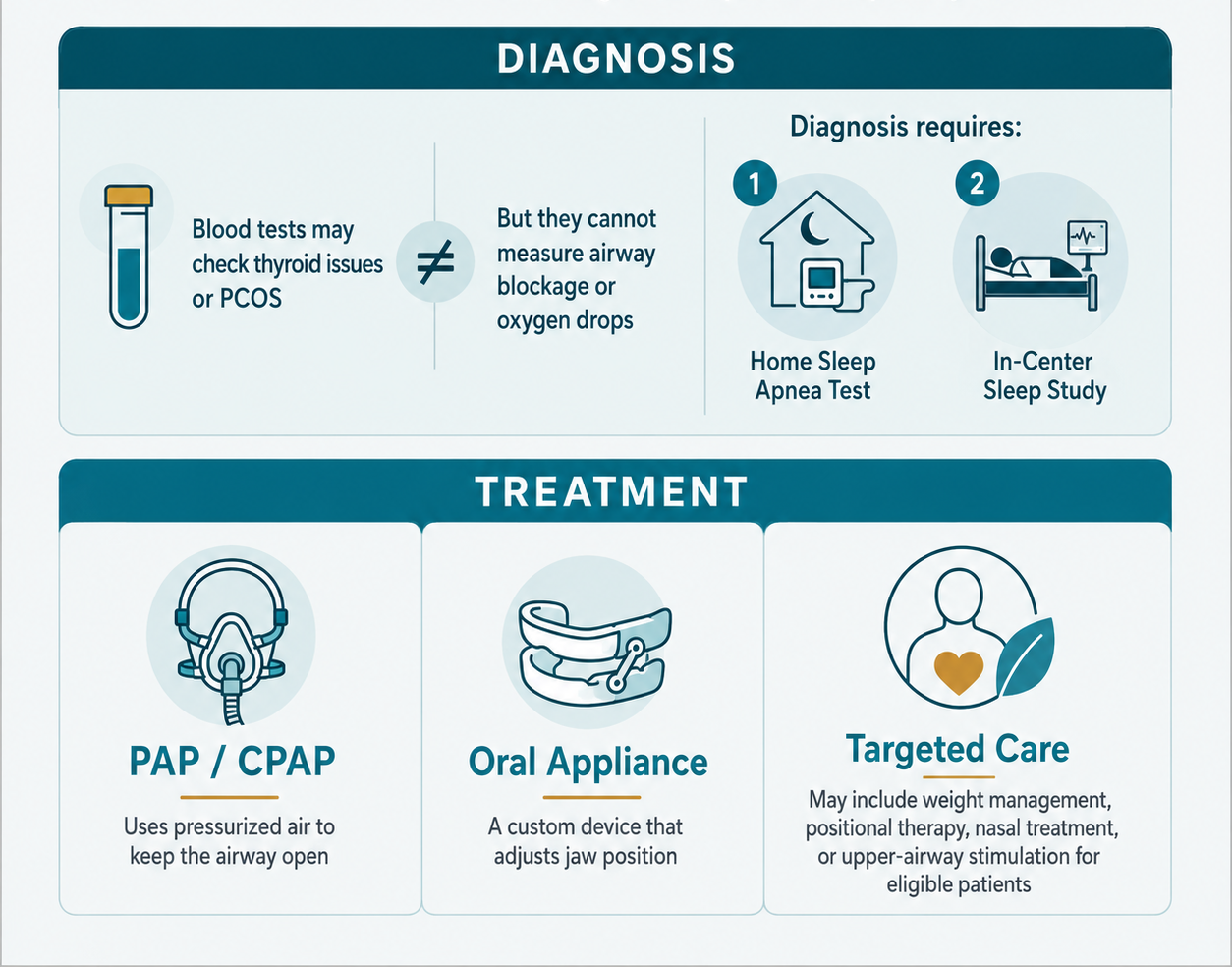
Sleep apnea cannot be diagnosed with a blood test. It requires an objective sleep study and is treated with proven airway therapies.
While hormone blood tests can identify underlying endocrine issues like thyroid dysfunction or PCOS, they cannot measure airway blockage or oxygen levels (9). Diagnosis requires a home sleep apnea test or in-center polysomnography to evaluate nighttime breathing (9).
Treatment plans are customized to individual health history, airway structure, and symptom severity:
- Positive Airway Pressure (PAP/CPAP): The standard treatment to keep the airway open with pressurized air (10).
- Oral Appliance Therapy: Custom devices that adjust jaw placement to prevent airway collapse (10).
- Targeted Care: Weight management, positional therapy, nasal treatments, or upper-airway stimulation for eligible patients (10).
Modern Advances in Sleep Medicine
Modern CPAP devices are whisper-quiet and auto-adjusting, while custom oral appliances offer low-profile alternatives for eligible patients. Treating the underlying airway block gives the body the restorative sleep it needs to balance hormones naturally.
There are also new surgical options that either open the airway or stimulate the tongue electronically to move out of the airpath during regular breathing.
At our practice, we utilize the full spectrum of treatment options to address obstructive sleep apnea based on severity, health history, and patient preference. Resolving nighttime breathing interruptions restores the steady, uninterrupted sleep required to maintain balanced endocrine function.
Consult The Insomnia and Sleep Institute of Arizona
Hormonal changes can make sleep apnea easier to develop, harder to recognize, or more severe. Persistent fatigue, broken sleep, new snoring, gasping, or morning headaches deserve a proper sleep evaluation rather than being automatically blamed on pregnancy, menopause, PCOS, testosterone treatment, or aging.
We are a physician-owned sleep medicine practice founded by Dr. Ruchir P. Patel and supported by fellowship-trained and board-certified sleep medicine professionals. Our team evaluates obstructive sleep apnea, insomnia, restless legs syndrome, narcolepsy, and other sleep concerns through an established Arizona practice.
We provide care through our Phoenix, Scottsdale, and Gilbert locations. Our team can review your symptoms, discuss the appropriate type of sleep testing, and explain treatment choices based on your results. Contact The Insomnia and Sleep Institute of Arizona through our online contact page or phone us at (480) 745-3547 to schedule a consultation.
References
- What Is Sleep Apnea? (2025, January 9). Nhlbi, NIH. https://www.nhlbi.nih.gov/health/sleep-apnea
- Sleep Apnea and Women. (2025, February 4). Nhlbi, NIH. https://www.nhlbi.nih.gov/health/sleep-apnea/women
- Krüger, M., Obst, A., Till Ittermann, Bernhardt, O., Ivanovska, T., Zygmunt, M., Ewert, R., Ingo Fietze, Penzel, T., Biffar, R., & Amro Daboul. (2023). Menopause Is Associated with Obstructive Sleep Apnea in a Population-Based Sample from Mecklenburg–Western Pomerania, Germany. Journal of Clinical Medicine, 12(6), 2101. https://doi.org/10.3390/jcm12062101
- Sigurðardóttir, E. S., Gislason, T., Benediktsdottir, B., Hustad, S., Dadvand, P., Demoly, P., Franklin, K. A., Heinrich, J., Holm, M., van der Plaat, D. A., Jõgi, R., Leynaert, B., Lindberg, E., Martinez-Moratalla, J., Sainz De Aja, L., Pesce, G., Pin, I., Raherison, C., Pereira-Vega, A., … Triebner, K. (2022). Female sex hormones and symptoms of obstructive sleep apnea in European women of a population-based cohort. PLOS ONE, 17(6), e0269569. https://doi.org/10.1371/journal.pone.0269569
- Wang, Y., Liu, H., Zhou, B., Yue, W., Wang, M., & Hu, K. (2025). Menopause and obstructive sleep apnea: revealing an independent mediating role of visceral fat beyond body mass index. BMC Endocrine Disorders, 25(1). https://doi.org/10.1186/s12902-025-01850-2
- NIH-funded researchers identify risk factors for sleep apnea during pregnancy. (2025, April 17). National Institutes of Health (NIH). https://www.nih.gov/news-events/news-releases/nih-funded-researchers-identify-risk-factors-sleep-apnea-during-pregnancy
- Facco, F. L., Parker, C. B., Reddy, U. M., Silver, R. M., Koch, M. A., Louis, J. M., Basner, R. C., Chung, J. H., Nhan-Chang, C.-L., Pien, G. W., Redline, S., Grobman, W. A., Wing, D. A., Simhan, H. N., Haas, D. M., Mercer, B. M., Parry, S., Mobley, D., Hunter, S., … Zee, P. C. (2017). Association Between Sleep-Disordered Breathing and Hypertensive Disorders of Pregnancy and Gestational Diabetes Mellitus. Obstetrics & Gynecology, 129(1), 31–41. https://doi.org/10.1097/aog.0000000000001805
- Abdul Jafar, N. K., Al Balushi, A., Subramanian, A., Lee, S. I., Bennett, C. J., Moran, L. J., Mousa, A., Tay, C. T., Teede, H. J., & Mansfield, D. R. (2025). Obstructive sleep apnea syndrome in polycystic ovary syndrome: a systematic review and meta-analysis. Frontiers in Endocrinology, 16. https://doi.org/10.3389/fendo.2025.1532519
- Diagnosis. (2025, January 9). Nhlbi, NIH. https://www.nhlbi.nih.gov/health/sleep-apnea/diagnosis
- Treatment. (2025, January 9). Nhlbi, NIH. https://www.nhlbi.nih.gov/health/sleep-apnea/treatment
- Davina McCall: Sex, Mind and the Menopause. (2022). Channel4.Com. https://www.channel4.com/programmes/davina-mccall-sex-mind-and-the-menopause
- https://menopause.org/wp-content/uploads/press-release/sleep-apnea-and-joint-pain.pdf
- Winfrey, O. (2019, September 18). Oprah Reveals How Heart Palpitations Led Her to Discover She Was Approaching Menopause. Oprah Daily. https://www.oprahdaily.com/life/health/a29109829/oprah-menopause-symptoms/
Disclaimer: The information provided in this blog post is for educational and informational purposes only and is not intended as a substitute for professional medical advice, diagnosis, or treatment. Always consult with a licensed healthcare provider for recommendations specific to your individual health needs.