Most Inspire therapy side effects fall into two temporary phases: standard post-surgical soreness during the first 1 to 2 weeks, and mild tongue or throat adaptation when the device is turned on. Side effects require immediate medical evaluation if you develop signs of infection (fever over 100.5°F, spreading redness, warmth), severe or worsening tongue weakness, or painful stimulation that disturbs your sleep.
At The Insomnia and Sleep Institute of Arizona, our sleep physicians guide patients through every step of upper airway stimulation. Knowing what to expect helps you heal comfortably and achieve optimal sleep quality.
Understanding Inspire Therapy
Inspire Upper Airway Stimulation is an FDA-approved medical implant for adults with moderate to severe obstructive sleep apnea who cannot tolerate CPAP therapy (1). Unlike traditional CPAP machines that pump pressurized air through a facial mask, Inspire works entirely inside the body. The small pulse generator delivers targeted stimulation to the hypoglossal nerve, moving the tongue forward during sleep to prevent airway collapse (2). Because components are placed in the chest, neck, and ribs, side effects are directly related to surgical healing and gentle nerve stimulation.
Phase 1: Post-Surgical Healing (Weeks 1 to 4)
The implant procedure is typically performed as an outpatient surgery under general anesthesia. During the initial recovery period, your body needs time to heal around the pulse generator, breathing sensor, and stimulation lead.
Expected Surgical Symptoms:
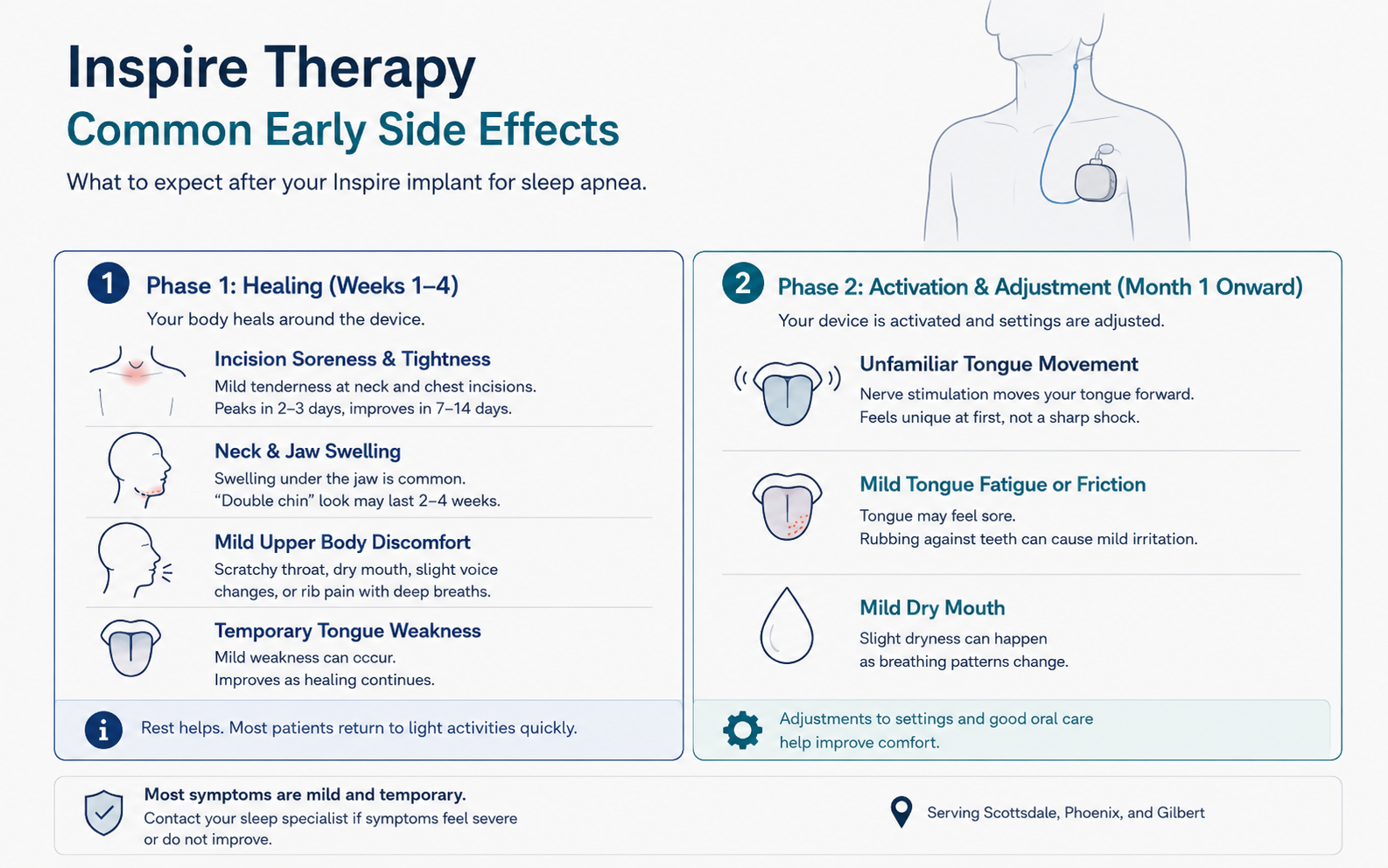
- Incision Soreness and Tightness: Mild tenderness and tightness around the neck and chest incisions usually peak within 2 to 3 days and resolve within 7 to 14 days (3).
- Temporary Neck and Jaw Swelling: Swelling under the jaw is common. Patients often notice a temporary “double chin” appearance that gradually subsides over 2 to 4 weeks (3).
- Mild Upper Body Discomfort: Scratchy throat, dry mouth, minor voice changes, or slight rib pain when taking a deep breath can occur immediately after surgery (4).
While surgical recovery requires rest, most patients return to light activities quickly.
During early healing, temporary tongue weakness can occur because the procedure involves the hypoglossal nerve (5). When these symptoms are mild and steadily improving, they fit expected post-operative healing.
Phase 2: Device Activation and Setting Adjustments (Month 1 Onward)
We wait approximately four weeks after surgery before activating your Inspire device. This ensures that surgical swelling has resolved and healing is complete.
When the device is turned on, you begin a titration phase. We set the device to a gentle stimulation level and gradually adjust it over several weeks.
Normal Adjustment Symptoms:
- Unfamiliar Tongue Movement: The initial sensation of nerve stimulation feels unique. As one sleep surgeon described it, “It feels like your tongue is moving, and you’re not the one moving it” (6). Because the hypoglossal nerve is a motor nerve, stimulation produces muscle motion rather than a sharp electrical shock.
- Mild Tongue Fatigue or Friction: You may notice mild tongue soreness as muscles adapt to nightly movement. Friction against teeth can occasionally cause mild surface abrasion (7).
- Mild Dry Mouth: Slight dryness can occur as breathing patterns shift during sleep.
These adjustment symptoms are manageable with minor setting modifications or routine oral care. Finding the right setting requires patience, but the long-term benefits are substantial.
If a stimulation level feels uncomfortable, our team can lower the voltage or adjust the time-delay feature (7). The goal is to keep your airway open while allowing you to sleep undisturbed.
Red Flags: When to Contact Sleep Physicians
While mild discomfort is normal, certain symptoms indicate potential complications like infection, nerve irritation, or device displacement. You should contact the clinic promptly if you experience any of the following:
- Signs of Surgical Infection: A fever above 100.5°F, increasing redness, heat, swelling, or foul-smelling drainage at incision sites (8).
- Severe or Persistent Tongue Symptoms: Tongue weakness that worsens, affects only one side, causes the tongue to pull heavily to one side, or creates severe difficulty with speaking or swallowing (5)(8).
- Painful Stimulation: Nerve stimulation that feels like a sharp shock, causes choking, or repeatedly awakens you during the night (7)(8).
- Urgent Warning Signs: Seek emergency medical care immediately for shortness of breath, severe chest pain, heavy bleeding, or rapid neck swelling.
Reassuringly, clinical trial data, including the landmark STAR trial, confirm that serious procedure-related complications occur in less than 2% of patients (9). When side effects do arise, early communication with your care team allows for quick resolution.
How We Optimize Your Care at The Insomnia and Sleep Institute of Arizona
Inspire therapy works best when the patient has the right evaluation, the right airway pattern, careful follow-up, and a team that listens when something feels off.
The Insomnia and Sleep Institute of Arizona helps patients understand whether Inspire therapy makes sense for their obstructive sleep apnea, CPAP history, sleep study results, airway anatomy, and long-term treatment goals. We do not treat Inspire as a quick device decision. We treat it as a medical plan that needs the right diagnosis, the right expectations, and the right adjustments.
And if you already have Inspire and something feels uncomfortable, we can help you understand what may be normal and what deserves medical attention. If you are considering Inspire because CPAP has been difficult, we can help you find out whether you are a strong candidate before you make a decision.
We serve patients in Scottsdale, Gilbert, and Phoenix.
Schedule a consultation with The Insomnia and Sleep Institute of Arizona today.
References
- Center. (2023). Inspire Upper Airway Stimulation – P130008/S090. U.S. Food and Drug Administration. https://www.fda.gov/medical-devices/recently-approved-devices/inspire-upper-airway-stimulation-p130008s090
- Hypoglossal Nerve Stimulation Implant for Sleep Apnea. (2023, August 4). Hopkinsmedicine.Org. https://www.hopkinsmedicine.org/health/conditions-and-diseases/obstructive-sleep-apnea/hypoglossal-nerve-stimulation
- Postoperative Instructions for Inspire Hypoglossal Nerve Stimulator – University of Mississippi Medical Center. (2026). Umc.Edu. https://umc.edu/Healthcare/ENT/Patient-Handouts/Adult/Sleep_Surgery/Inspire.html
- Postoperative Instructions for Inspire Hypoglossal Nerve Stimulator – University of Mississippi Medical Center. (2026). Umc.Edu. https://umc.edu/Healthcare/ENT/Patient-Handouts/Adult/Sleep_Surgery/Inspire.html
- Sleep Apnea Side Effects | Inspire Sleep Apnea Innovation. (2026). Inspiresleep.Com. https://www.inspiresleep.com/en-us/safety-information/
- Melani, D. (2023, August 28). What Is Inspire for Sleep Apnea and Will It Work for Me? Cuanschutz.Edu; University of Colorado Anschutz Medical Campus. https://news.cuanschutz.edu/news-stories/what-is-inspire-for-sleep-apnea-and-will-it-work-for-me
- PATIENT MANUAL Rx Only Inspire II Implantable Pulse Generator Model 3024. (n.d.). Retrieved June 2, 2026, from https://www.accessdata.fda.gov/cdrh_docs/pdf13/P130008c.pdf
- Hypoglossal Nerve Stimulation Implant for Sleep Apnea. (2023, August 4). Hopkinsmedicine.Org. https://www.hopkinsmedicine.org/health/conditions-and-diseases/obstructive-sleep-apnea/hypoglossal-nerve-stimulation
- Strollo, P. J., Soose, R. J., Maurer, J. T., de Vries, N., Cornelius, J., Froymovich, O., Hanson, R. D., Padhya, T. A., Steward, D. L., Gillespie, M. B., Woodson, B. T., Van de Heyning, P. H., Goetting, M. G., Vanderveken, O. M., Feldman, N., Knaack, L., & Strohl, K. P. (2014). Upper-Airway Stimulation for Obstructive Sleep Apnea. New England Journal of Medicine, 370(2), 139–149. https://doi.org/10.1056/nejmoa1308659
Disclaimer: The information provided in this blog post is for educational and informational purposes only and is not intended as a substitute for professional medical advice, diagnosis, or treatment. Always consult with a licensed healthcare provider for recommendations specific to your individual health needs.