

The difference between Narcolepsy Type 1 and Type 2 centers on cataplexy and the loss of hypocretin in the brain. Both conditions cause severe daytime sleepiness, but they appear differently and are diagnosed and treated differently.
For many people, this distinction explains why symptoms feel unpredictable and why getting clear answers often takes time. Identifying the correct type helps make sense of persistent fatigue and unusual sleep experiences when daily life becomes harder to manage.
What Is Narcolepsy, And What Does It Do To The Brain?
Narcolepsy is a chronic neurological disorder in which the brain cannot reliably regulate sleep and wake states. This instability causes excessive daytime sleepiness even after adequate nighttime sleep, and nearly all patients experience this symptom at diagnosis. People with narcolepsy often struggle to stay awake during routine activities such as meetings, meals, or driving, which can affect safety and daily functioning.
At the brain level, narcolepsy disrupts the normal timing of REM sleep. In healthy individuals, REM sleep usually begins about 60 to 90 minutes after falling asleep. In narcolepsy, REM sleep can occur within minutes of falling asleep, both at night and during daytime naps (1). The brain circuits that normally keep wakefulness and dreaming separate become unstable. (1).
In many patients, particularly those with Type 1 narcolepsy, this instability is linked to damage in the hypothalamus, where hypocretin is produced (1). Hypocretin helps maintain alertness and suppress REM sleep during wakefulness. When hypocretin signaling is lost, the brain shifts unpredictably between sleep and wake states, leading to sleep attacks, hallucinations, and sleep paralysis. Narcolepsy is therefore a disorder of sleep regulation.
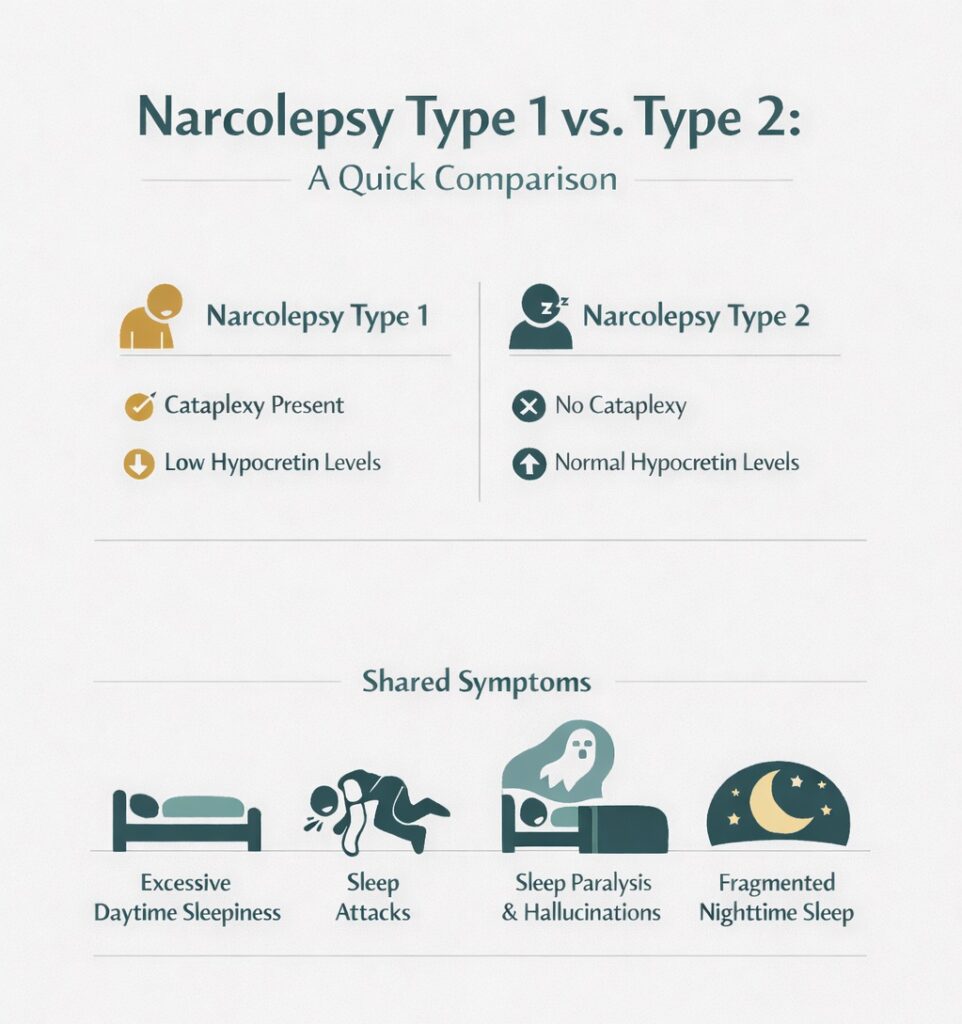
What are Narcolepsy Type 1 and Type 2 in one quick comparison?
Narcolepsy Type 1 and Type 2 are classified based on the presence of cataplexy and levels of hypocretin in the cerebrospinal fluid. Type 1 narcolepsy is defined by cataplexy or documented hypocretin deficiency, whereas Type 2 narcolepsy involves excessive daytime sleepiness without cataplexy and with normal hypocretin levels (1).
Epidemiologic studies estimate narcolepsy affects roughly 30 to 50 people per 100,000.Type 2 appears to be about twice as common as Type 1 (2, 3). Despite its rarity, narcolepsy is frequently misdiagnosed, with delays averaging 5 to 10 years from symptom onset to diagnosis (4).
What Symptoms Do Type 1 and Type 2 Share?
Type 1 and Type 2 narcolepsy share excessive daytime sleepiness as their central symptom. This sleepiness reflects a biological drive to sleep that persists regardless of motivation, discipline, or sleep hygiene.
People with either type may experience sudden sleep episodes, commonly called sleep attacks, where a person falls asleep rapidly with little warning (1). Nighttime sleep is often fragmented, with frequent awakenings and reduced sleep efficiency. Many individuals may also experience sleep paralysis, a temporary inability to move when falling asleep or waking, and hypnagogic or hypnopompic hallucinations, which are vivid dreamlike experiences that feel real (1).
These symptoms occur because REM sleep intrudes into wakefulness, allowing muscle paralysis, dreaming imagery, and altered consciousness to appear outside their normal boundaries.
What Is Cataplexy, And Why Is It The Key Sign Of Type 1?
Cataplexy is sudden muscle weakness triggered by strong emotions and is the defining clinical feature of Type 1 narcolepsy (1). Episodes often occur during laughter, surprise, excitement, or embarrassment and can range from mild facial weakness to complete collapse. Importantly, consciousness remains fully intact during cataplexy, distinguishing it from seizures or fainting (5).
Cataplexy is rare outside narcolepsy, making it one of the most powerful diagnostic indicators (6). Because patients may describe these episodes as clumsiness or fatigue, clinicians rely heavily on detailed history to identify them accurately.
What Is Hypocretin (Orexin), And How Does It Separate Type 1 From Type 2?
Hypocretin, also called orexin, is a neurotransmitter produced in the hypothalamus that stabilizes wakefulness and regulates REM sleep boundaries. It acts as a central coordinator that keeps the brain alert and prevents inappropriate REM activation. (7).
In Type 1 narcolepsy, hypocretin-producing neurons are lost, resulting in extremely low cerebrospinal fluid levels(6). In Type 2 narcolepsy, hypocretin levels remain normal, indicating preserved neurons but impaired regulation.
In simple terms, hypocretin loss removes the brain’s ability to prevennt REM paralysis during emotional activation, whereas Type 2 retains enough hypocretin signaling to prevent this phenomenon.
What Causes Type 1 Narcolepsy, And Is It Autoimmune?
Type 1 narcolepsy is believed to result from immune mediated destruction of hypocretin-producing neurons in genetically susceptible individuals. Many patients carry a gene that is strongly associated with autoimmune disorders (8).
Large U.S. studies found a noticeable increase in pediatric Type 1 narcolepsy following the 2009 H1N1 influenza pandemic. The timing suggested that immune activation may play a role in triggering the condition in vulnerable individuals. (9).
As Dr. Emmanuel Mignot’s research demonstrated, narcolepsy is caused by a “disruption of the hypocretin (orexin) receptor 2 gene (Hcrtr2).” This discovery identified hypocretins as “major sleep-modulating neurotransmitters,” fundamentally changing our understanding of how the brain regulates the transition between wakefulness and REM sleep (10).
What Causes Type 2 Narcolepsy, And Why Can It Be Harder To Confirm?
The cause of Type 2 narcolepsy remains less clear and does not involve the hypocretin neuron loss seen in Type 1. Currently, there is no definitive biological marker (11).
Some patients initially diagnosed with Narcolepsy Type 2 later develop cataplexy and show evidence of hypocretin deficiency, suggesting the possibility of disease progression in certain cases (12).
How Do Doctors Officially Diagnose Narcolepsy Type 1 Vs Type 2?
Doctors diagnose narcolepsy using criteria from the DSM-5 and the International Classification of Sleep Disorders, Third Edition (ICSD-3). Both require persistent excessive daytime sleepiness, followed by objective testing to evaluate REM-sleep abnormalities (13).
Diagnostic criteria include the presence of cataplexy, hypocretin deficiency, shortened REM sleep latency, or abnormal findings on the Multiple Sleep Latency Test (14, 15).
Why Are Both an Overnight Study and an MSLT Needed?
Narcolepsy diagnosis requires an overnight sleep study followed by a Multiple Sleep Latency Test because symptoms alone are not enough to confirm the condition.
The overnight study rules out other causes of sleepiness such as obstructive sleep apnea, while the daytime test measures how quickly someone falls asleep and whether REM sleep occurs unusually fast (16).
What Can Mimic Narcolepsy?
Many conditions can resemble narcolepsy, including chronic sleep deprivation, obstructive sleep apnea, circadian rhythm disorders, depression, neurological illnesses, and medication side effects.
As sleep medicine pioneer Dr. William C. Dement observed, many people go through life exhausted without recognizing the true cause of their sleepiness, which highlights how easily symptoms can be misunderstood. (17).
How Is Treatment Similar For Both Types?
Treatment for both types focuses on reducing excessive daytime sleepiness and improving alertness. FDA-approved medications for narcolepsy, such as modafinil, armodafinil, solriamfetol, and pitolisant, are Commonly used. (18).
Lifestyle strategies are a core part of narcolepsy management. Harvard Medical School’s Division of Sleep Medicine emphasizes behavioral approaches such as taking planned daytime naps and maintaining consistent sleep habits. Keeping a regular bedtime and wake time helps stabilize sleep patterns and can reduce the severity of daytime sleepiness. (19).
How Is Treatment Different When Cataplexy Is Present?
When cataplexy is present in Type 1 narcolepsy, treatment must specifically address sudden muscle weakness in addition to sleepiness. Medications such as sodium oxybate can reduce cataplexy frequency while improving nighttime sleep quality. (20).
What Is Daily Life Like With Type 1 Vs Type 2?
People with Type 2 narcolepsy often experience persistent mental fog, slowed reaction time, memory difficulty, and fatigue that worsens throughout the day. Many rely on structured routines and medication timing to function effectively.
Life with Type 1 narcolepsy includes these challenges plus the unpredictability of cataplexy, which can be triggered by strong emotions such as laughter or excitement. Public figures including Harriet Tubman and Jimmy Kimmel have spoken about living with narcolepsy, helping raise awareness of its real world impact. (21).
When to See a Sleep Specialist
At The Insomnia and Sleep Institute of Arizona, we focus on outcomes that start with the right diagnosis. Our patients meet directly with sleep specialists who guide testing and treatment using FDA approved options such as modafinil, armodafinil, Xyrem, Sunosi, Wakix, and Evekeo, along with carefully selected off-label therapies when appropriate.
Since opening our doors in 2013, we have built a multidisciplinary team that includes sleep physicians, nurse practitioners trained in sleep medicine, a physician assistant with a Masters in Sleep Medicine, respiratory therapists, sleep technicians, and a clinical psychologist specializing in cognitive behavioral therapy for insomnia. With Scottsdale, Gilbert, and Phoenix locations and deep expertise in narcolepsy and hypersomnia, we help patients move from uncertainty to clarity.
If daytime sleepiness is controlling your life, contact us. Clear answers begin with the right team.
References
- Narcolepsy. (2019). National Institute of Neurological Disorders and Stroke. https://www.ninds.nih.gov/health-information/disorders/narcolepsy
- Recognizing the Symptom Spectrum of Narcolepsy to Improve Timely Diagnosis: A Narrative Review. (2021). Nature and Science of Sleep. https://doi.org/10.2147//NSS.S278046
- Ohayon, M. M., Stéphanie Duhoux, Grieco, J., & Marie-Lise Côté. (2023). Prevalence and incidence of narcolepsy symptoms in the US general population. Sleep Medicine X, 6, 100095–100095. https://doi.org/10.1016/j.sleepx.2023.100095
- Slowik, J. M., Collen, J. F., & Yow, A. G. (2023, June 12). Narcolepsy. Nih.gov; StatPearls Publishing. https://www.ncbi.nlm.nih.gov/books/NBK459236/
- Dauvilliers, Y., Siegel, J. M., Lopez, R., Torontali, Z. A., & Peever, J. H. (2014). Cataplexy—clinical aspects, pathophysiology and management strategy. Nature Reviews Neurology, 10(7), 386–395. https://doi.org/10.1038/nrneurol.2014.97
- Cascio, F., Borges, E., Teixeira, S. S., Coelho, F. M., & Oliveira, P. (2019). Thinking outside the box: cataplexy without narcolepsy. Sleep Medicine, 61, 118–121. https://doi.org/10.1016/j.sleep.2019.03.006
- Wang, Y., Fu, S., Mao, J., Cui, K., & Jiang, H. (2025). Hypocretin: a promising target for the regulation of homeostasis. Frontiers in Neuroscience, 19, 1638270–1638270. https://doi.org/10.3389/fnins.2025.1638270
- Mahlios, J., De la Herrán-Arita, A. K., & Mignot, E. (2013). The autoimmune basis of narcolepsy. Current Opinion in Neurobiology, 23(5), 767–773. https://doi.org/10.1016/j.conb.2013.04.013
- Simakajornboon, N., Mignot, E., Maski, K., Owens, J., Rosen, C., Ibrahim, S., Hassan, F., Chervin, R. D., Perry, G., Brooks, L., Kheirandish-Gozal, L., Gozal, D., Mason, T., Robinson, A., Malow, B., Naqvi, K., Chen, M. L., Jambhekar, S., Halbower, A., & Graw-Panzer, K. (2022). Increased incidence of pediatric narcolepsy following the 2009 H1N1 pandemic: a report from the pediatric working group of the sleep research network. Sleep, 45(9). https://doi.org/10.1093/sleep/zsac137
- Lin, L., Faraco, J., Li, R., Hiroshi Kadotani, Rogers, W., Lin, X., Qiu, X., Jong, Nishino, S., & Mignot, E. (1999). The Sleep Disorder Canine Narcolepsy Is Caused by a Mutation in the Hypocretin (Orexin) Receptor 2 Gene. Cell, 98(3), 365–376. https://doi.org/10.1016/s0092-8674(00)81965-0
- Slowik, J. M., Collen, J. F., & Yow, A. G. (2023, June 12). Narcolepsy. Nih.gov; StatPearls Publishing. https://www.ncbi.nlm.nih.gov/books/NBK459236/
- Plazzi, G., Clawges, H. M., & Owens, J. A. (2018). Clinical Characteristics and Burden of Illness in Pediatric Patients with Narcolepsy. Pediatric Neurology, 85, 21–32. https://doi.org/10.1016/j.pediatrneurol.2018.06.008
- Ruoff, C., & Rye, D. (2016). The ICSD-3 and DSM-5 guidelines for diagnosing narcolepsy: clinical relevance and practicality. Current Medical Research and Opinion, 32(10), 1611–1622. https://doi.org/10.1080/03007995.2016.1208643
- International Classification of Sleep Disorders Third Edition, Text Revision Summary of Diagnostic Criteria Changes SUMMARY OF DIAGNOSTIC CRITERIA CHANGES. (n.d.). https://aasm.org/wp-content/uploads/2023/05/ICSD-3-Text-Revision-Supplemental-Material.pdf
- Ruoff, C., & Rye, D. (2016). The ICSD-3 and DSM-5 guidelines for diagnosing narcolepsy: clinical relevance and practicality. Current Medical Research and Opinion, 32(10), 1611–1622. https://doi.org/10.1080/03007995.2016.1208643
- Flygare, J., & Parthasarathy, S. (2014). Narcolepsy: Let the Patient’s Voice Awaken Us! The American Journal of Medicine, 128(1), 10–13. https://doi.org/10.1016/j.amjmed.2014.05.037
- CLINICAL PSYCHIATRY NEWS (2005). BOOKS, THE CHILDREN OF THE BRAIN ‘The Promise of Sleep’. https://cdn.mdedge.com/files/s3fs-public/issues/articles/70748_main_4.pdf
- Kiran Maski, Trotti, L. M., Suresh Kotagal, Auger, R. R., Rowley, J. A., Hashmi, S. D., & Watson, N. F. (2021). Treatment of central disorders of hypersomnolence: an American Academy of Sleep Medicine clinical practice guideline. Journal of Clinical Sleep Medicine, 17(9), 1881–1893. https://doi.org/10.5664/jcsm.9328
- Self-Care. (2025). Harvard.edu. https://sleep.hms.harvard.edu/education-training/public-education/sleep-and-health-education-program/sleep-health-education-14?utm_source=chatgpt.com
- Alshaikh, M. K., Tricco, A. C., Tashkandi, M., Mamdani, M., Straus, S. E., & BaHammam, A. S. (2012). Sodium Oxybate for Narcolepsy with Cataplexy: Systematic Review and Meta-Analysis. Journal of Clinical Sleep Medicine, 08(04), 451–458. https://doi.org/10.5664/jcsm.2048
- Wikimedia list article. (2005, December 18). Wikipedia.org; Wikimedia Foundation, Inc. https://en.wikipedia.org/wiki/List_of_people_with_narcolepsy
Disclaimer: The information provided in this blog post is for educational and informational purposes only and is not intended as a substitute for professional medical advice, diagnosis, or treatment. Always consult with a licensed healthcare provider for recommendations specific to your individual health needs.







