The connection between teeth grinding, known medically as bruxism, and sleep apnea lies in how the body responds to blocked airways during the night. When breathing temporarily stops, the brain sends stress signals that trigger jaw clenching and grinding as part of the body’s effort to reopen the airway and restore airflow.
Over time, this repeated cycle can damage teeth, strain the jaw, and disrupt sleep quality. What may begin as subtle enamel wear or morning jaw soreness can actually signal an undiagnosed sleep disorder with potentially serious health consequences if left untreated.
What Is Bruxism and How Does It Relate to Sleep Apnea?
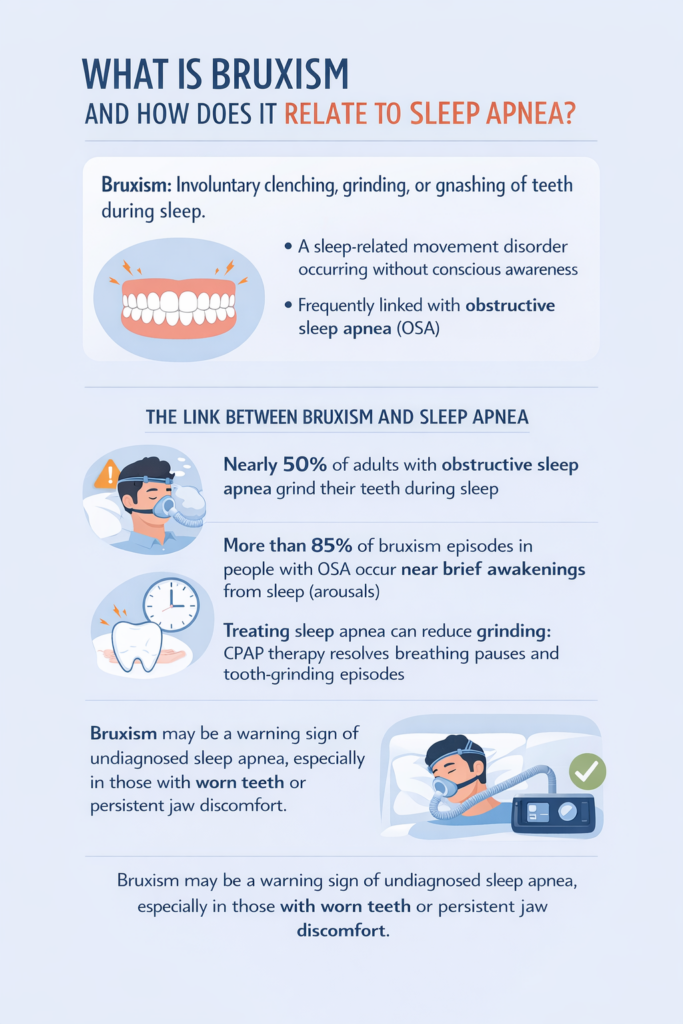
Bruxism refers to the involuntary clenching, grinding, or gnashing of teeth, most often during sleep. It is classified as a sleep-related movement disorder because it typically occurs during specific sleep stages and without conscious awareness.
Sleep bruxism frequently occurs alongside obstructive sleep apnea (OSA). Research suggests that nearly half of adults with OSA experience bruxism during sleep (1). Bruxism appears more commonly in individuals with mild to moderate apnea than in those with severe cases, indicating that condition severity influences the relationship (2). More than 85% of bruxism episodes in people with OSA occur close to brief awakenings from sleep, known as arousals. This pattern strongly suggests that airway obstruction and the body’s effort to restore breathing trigger jaw muscle activity (1).
Treating sleep apnea can also reduce grinding. In some documented cases, continuous positive airway pressure (CPAP) therapy not only resolved breathing pauses but also eliminated tooth-grinding episodes entirely (3). Because of this connection, bruxism may serve as an important warning sign of undiagnosed sleep apnea, especially in patients with worn teeth or persistent jaw discomfort.
How Does Teeth Grinding Start During Sleep?
Teeth grinding during sleep is not a random event but a response triggered by neurological and physiological processes tied to sleep regulation (4). Most bruxism episodes occur during lighter stages of sleep or during transitions between sleep stages. During these times, the brain is more prone to micro-arousals, which are very brief awakenings lasting only a few seconds (5).
During a sleep apnea event, oxygen levels fall while carbon dioxide levels rise. This imbalance activates the autonomic nervous system, which controls involuntary functions such as heart rate and muscle tension. As a reflex response, the body increases heart rate, tightens muscles, and briefly activates the jaw, resulting in clenching or grinding without conscious awareness.
Studies using polysomnography, the gold standard for sleep testing, show that bruxism episodes are commonly preceded by increased heart rate and bursts of brain activity on EEG readings. This pattern indicates that teeth grinding is closely linked to stress responses during sleep.
Neurochemistry also plays a role. Neurotransmitters such as dopamine help regulate motor activity, and disruptions in dopamine signaling have been associated with higher rates of bruxism.
Environmental and behavioral factors can further increase risk. Alcohol, caffeine, and nicotine all raise nighttime arousal frequency, making grinding more likely. Psychological stress and anxiety also increase jaw muscle tension that may carry into sleep. In addition, structural factors, such as a narrow airway, misaligned bite, or enlarged tonsils, may also predispose individuals to both apnea and bruxism.
What Are the Signs of Nighttime Bruxism?
Bruxism often occurs without the individual’s awareness, but it leaves clear physical signs. These can usually be recognized through morning symptoms, dental changes, and jaw discomfort.
Common warning signs include:
- Morning jaw pain or stiffness: Jaw muscles remain sore or fatigued after hours of clenching during sleep.
- Tension headaches: Grinding puts strain on the muscles around the temples, leading to headaches upon waking.
- Worn or flattened teeth: Enamel gradually erodes, leaving teeth shorter and sometimes chipped.
- Tooth sensitivity: Exposed dentin from enamel wear makes teeth more sensitive to hot, cold, or sweet foods.
- Earaches or ringing in the ears: The jaw joint sits close to the ear canal, and stress on the temporomandibular joint can radiate as ear pain or tinnitus.
- Clicking or popping in the jaw: The temporomandibular joint may develop dysfunction from repeated strain.
- Changes in bite alignment: Teeth no longer align the same way due to enamel erosion or shifting.
- Indentations on the tongue or cheeks: Repetitive clenching can leave visible impressions.
Bed partners may also report hearing grinding sounds at night, which may be loud enough to disrupt their sleep. Children with bruxism may complain of toothaches without clear cavities, or parents may notice unusual tooth wear early. Left untreated, these signs progress into more serious damage, including cracked teeth, gum recession, and chronic temporomandibular joint disorder.
Are There Risk Factors That Increase Both Conditions?
Several shared risk factors raise the likelihood of developing both sleep apnea and bruxism simultaneously. Identifying these overlapping factors helps clinicians determine who should be evaluated for both conditions.
- Obesity: Excess tissue around the neck and airway raises the risk of apnea. At the same time, obesity increases inflammation that can affect muscles and joints, which may contribute to clenching.
- Stress and anxiety: Psychological stress increases jaw tension and contributes to fragmented sleep, making apnea events and grinding more likely.
- Alcohol and sedatives: These substances relax airway muscles and increase nighttime arousals, worsening both conditions.
- Caffeine and nicotine: As stimulants, they disrupt normal sleep cycles and increase micro-arousals that trigger jaw contractions.
- Age and gender: Sleep apnea is more common in middle-aged men, while bruxism is often reported in younger adults. However, both can occur across all age groups, and children with enlarged tonsils or adenoids may experience both conditions together.
Because of these shared risks, dentists and sleep specialists commonly see patients affected by both disorders. Recognizing the overlap supports earlier screening and intervention.
How Does Treating Sleep Apnea Improve Bruxism?
Treating sleep apnea reduces the nighttime disruptions that trigger teeth grinding.
CPAP therapy, which gently delivers air through a mask to keep the airway open, is considered the most effective treatment for OSA. It prevents pauses in breathing, reduces sleep-fragmentations that trigger jaw clenching, and allows steadier airflow. Many patients experience fewer grinding episodes and improved sleep quality after starting therapy (6).
Oral appliance therapy can also help. These custom mouthpieces move the lower jaw slightly forward, opening the airway while also repositioning the jaw in a way that reduces grinding intensity. (7). Many patients report improvement when switching from a basic night guard to a medical-grade mandibular advancement device (8).
Additionally, when sleep is deeper and more continuous, the body produces fewer stress hormones, and allows the muscles and jaw to relax more fully (9).
Consult The Insomnia and Sleep Institute of Arizona Today
The Insomnia and Sleep Institute of Arizona provides comprehensive care for patients with sleep apnea, a condition often linked to nighttime teeth grinding and jaw discomfort. Our board-certified physicians use in-lab polysomnography and multi-night home testing to deliver accurate diagnoses.
Treatment plans are tailored to each patient’s needs. Services include CPAP optimization, Inspire implant evaluations, and cognitive behavioral therapy for insomnia (CBT-I). For patients unable to tolerate CPAP, alternative therapies are available to maintain effective treatment.
With locations in Phoenix, Gilbert, and Scottsdale, our institute makes expert sleep care accessible throughout the Valley. Many patients first notice worn teeth or jaw soreness before discovering an underlying sleep disorder. Addressing these signs early can protect oral health, improve sleep quality, , and restore daytime energy. Contact us today to schedule a consultation with our team.
References
- Li, D., Kuang, B., Lobbezoo, F., Nico de Vries, Antonius Hilgevoord, & Ghizlane Aarab. (2022). Sleep bruxism is highly prevalent in adults with obstructive sleep apnea: a large-scale polysomnographic study. Journal of Clinical Sleep Medicine, 19(3), 443–451. https://doi.org/10.5664/jcsm.10348
- Martynowicz, H., Gac, P., Brzecka, A., Rafal Poreba, Wojakowska, A., Mazur, G., Smardz, J., & Mieszko Wieckiewicz. (2019). The Relationship between Sleep Bruxism and Obstructive Sleep Apnea Based on Polysomnographic Findings. Journal of Clinical Medicine, 8(10), 1653–1653. https://doi.org/10.3390/jcm8101653
- Oksenberg, A., & Arons, E. (2002). Sleep bruxism related to obstructive sleep apnea: the effect of continuous positive airway pressure. Sleep Medicine, 3(6), 513–515. https://doi.org/10.1016/s1389-9457(02)00130-2
- Lavigne, G. J., Kato, T., Kolta, A., & Sessle, B. J. (2003). Neurobiological Mechanisms Involved in Sleep Bruxism. Critical Reviews in Oral Biology & Medicine, 14(1), 30–46. https://doi.org/10.1177/154411130301400104
- HUYNH, N., KATO, T., ROMPRÉ, P. H., OKURA, K., SABER, M., LANFRANCHI, P. A., MONTPLAISIR, J. Y., & LAVIGNE, G. J. (2006). Sleep bruxism is associated to micro‐arousals and an increase in cardiac sympathetic activity. Journal of Sleep Research, 15(3), 339–346. https://doi.org/10.1111/j.1365-2869.2006.00536.x
- Jean-Benoit Martinot, Borel, J.-C., Nhat-Nam Le-Dong, Silkoff, P. E., Denison, S., Gozal, D., & Jean-Louis Pépin. (2020). Bruxism Relieved Under CPAP Treatment in a Patient With OSA Syndrome. CHEST Journal, 157(3), e59–e62. https://doi.org/10.1016/j.chest.2019.07.032
- Landry. (2015). Reduction of sleep bruxism using a mandibular advancement device: an experimental controlled study. The International Journal of Prosthodontics, 19(6). https://pubmed.ncbi.nlm.nih.gov/17165292/
- Solanki, N., Singh, B. P., Chand, P., Siddharth, R., Arya, D., Kumar, L., Tripathi, S., Jivanani, H., & Dubey, A. (2017). Effect of mandibular advancement device on sleep bruxism score and sleep quality. The Journal of Prosthetic Dentistry, 117(1), 67–72. https://doi.org/10.1016/j.prosdent.2016.04.009
- Pavlou, I., Spandidos, D., Zoumpourlis, V., & Papakosta, V. (2024). Neurobiology of bruxism: The impact of stress (Review). Biomedical Reports, 20(4). https://doi.org/10.3892/br.2024.1747
Disclaimer: The information provided in this blog post is for educational and informational purposes only and is not intended as a substitute for professional medical advice, diagnosis, or treatment. Always consult with a licensed healthcare provider for recommendations specific to your individual health needs.