When you look at your CPAP display each morning, three primary metrics indicate how well your therapy is working: your AHI (which should stay below 5 events per hour), your Leak Rate (on ResMed devices, unintentional mask leak should stay at or below 24 L/min), and your Usage Hours (insurers typically require at least 4 hours per night, and longer use gives more benefit). While these numbers provide valuable feedback, understanding what they actually mean for your sleep health is essential.
What Your CPAP Machine Tracks Each Night
A modern CPAP machine does far more than push air into your airway. It acts as an overnight monitoring device that records your breathing patterns, mask fit, and compliance every single night (1).
Most standard CPAP devices record:
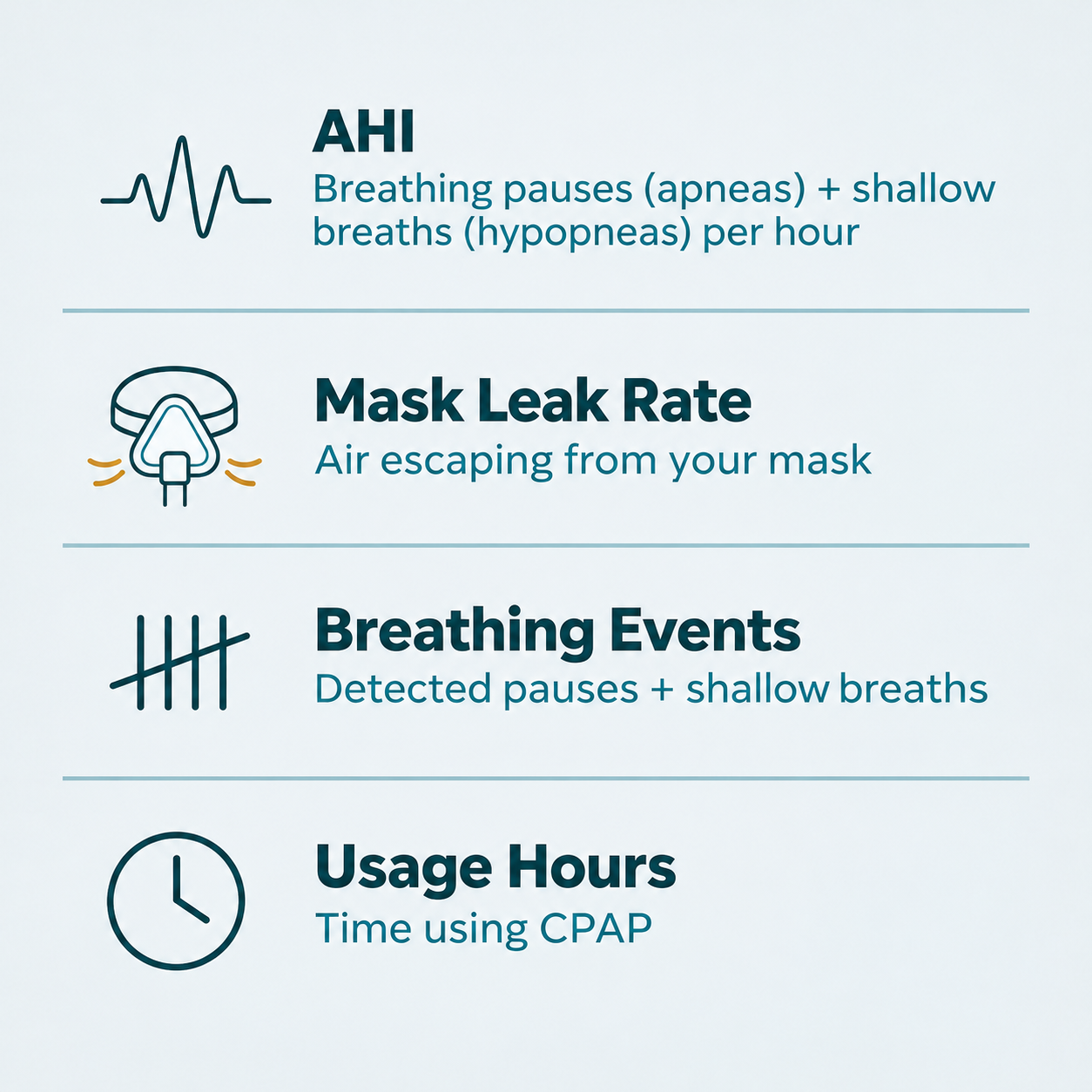
- AHI (Apnea-Hypopnea Index): The average number of breathing pauses per hour (1).
- Mask Leak Rate: The volume of air escaping around the mask cushion (1)(2).
- Breathing Events: The exact tally of apneas and shallow breathing episodes (1).
- Usage Hours: Total time the machine delivered pressure during the night (1).
Advanced devices also monitor subtle airway changes such as flow limitation, snoring vibrations, pressure changes on auto-adjusting models, and the difference between obstructive and central apneas (3). Each metric represents a distinct component of your sleep, which is why our clinic reviews them together rather than looking at any single number in isolation (1)(3).
Understanding AHI: Your Primary Treatment Metric
Your Apnea-Hypopnea Index (AHI) is the standard benchmark for sleep apnea severity and treatment success (4). AHI counts how many times per hour of use your airway completely closes (an apnea) or partially narrows (a hypopnea) for at least 10 seconds (4).
The clinical goal of CPAP therapy is to maintain an AHI below 5 events per hour, which is considered the normal range for treated sleep (4)(5). You do not need a perfect zero on your screen every morning; occasional shifts in sleep stage or position can cause minor breathing fluctuations that are usually not a concern (4).
Why Your AHI Might Still Be Elevated
If your morning report consistently shows an AHI above 5, your therapy may require clinical adjustment (4). Several common factors can elevate your event count:
- Mask Leaks: Escaping air prevents the device from delivering the calibrated pressure needed to support your airway tissues (4).
- Treatment-Emergent Central Apneas: In some patients, standard positive airway pressure can trigger central breathing pauses where the brain temporarily pauses respiratory signals (6).
- Sleeping Position: Sleeping flat on your back (the supine position) allows gravity to pull the tongue and soft palate downward, worsening airway collapse (7).
- Weight and Health Changes: Significant changes in body weight or alcohol consumption close to bedtime can increase airway resistance (8).
Breaking Down Breathing Events: Obstructive, Central, and Hypopneas
Your device categorizes respiratory disruptions based on airway behavior:
- Obstructive Apneas: The upper airway collapses physically while your chest and diaphragm continue working to pull air into the lungs (9)(10). Continuous positive pressure prevents this collapse (9).
- Central Apneas: The airway remains open, but the brain temporarily stops sending signals to the respiratory muscles (10)(11). CPAP does not treat all forms of central apnea, which is why frequent central events require a physician’s evaluation (6)(10).
- Hypopneas: Partial reductions in airflow that last at least 10 seconds and result in a drop in blood oxygen or a brief awakening (12). High hypopnea counts still disrupt sleep architecture and keep your overall AHI elevated (12).
Leak Rate and Pressure: The Supporting Metrics
A low AHI requires a stable mask seal. CPAP masks feature built-in exhalation ports to vent carbon dioxide, which is considered intentional airflow (2). Unintentional leak occurs when air escapes around your eyes, cheeks, or mouth (2). For most ResMed systems, unintentional leak should remain at or below 24 L/min at the 95th percentile (2).
When a significant leak occurs, your machine cannot maintain target pressure, leading to hidden airway disruptions even if you wear the mask all night (4).
Your report may also display average pressure or 95th percentile pressure, indicating the pressure your device stayed at or below for 95% of the night (14). If your event count remains elevated or the pressure feels difficult to tolerate, our physicians may adjust comfort settings, re-titrate your pressure, or consider bilevel PAP therapy (14)(15).
How to Read Your Data Without Overthinking It
Patients often worry when their AHI shifts from 1.5 one night to 3.8 the next. Normal day-to-day variation is expected (13). Focus your attention on three broader indicators:
- The Multi-Week Trend: Is your AHI staying under 5 on average, or is it steadily climbing upward over several weeks (13)?
- Mask Seal Stability: Is your leak rate consistently in the green zone, or are you waking up with dry eyes and air blowing across your face (2)?
- Daytime Symptoms: Are your energy, focus, and daytime alertness improving?
Get Expert Help Interpreting Your CPAP Data With The Insomnia and Sleep Institute of Arizona
Understanding your CPAP numbers should not feel confusing. We review your data alongside how you actually feel each day.
At our practice, your first visit is with a sleep specialist who evaluates your results and guides treatment from the start.
We care for patients across Phoenix, Scottsdale, and Gilbert, helping them move from simply using CPAP to actually sleeping better.
If your numbers do not make sense, or your sleep still feels off, there is a reason behind it.
We’ll help you work out why and what to change.
Reach out to us for clear answers grounded in real sleep medicine.
References
- User guide. (n.d.). https://document.resmed.com/documents/products/machine/airsense-11/user-guide/airsense11_user-guide_anz_eng.pdf
- https://resmedwebinars.com/hubfs/resmed-webinars/clinical-education/AirView_Report_Guide_1018991.pdf
- Clinical guide. (n.d.). https://ap.resmed.com/hubfs/1%20Official%20-%20B2B%20Product%20Marketing%20Collateral/Marketing%20Materials/AirSense/AirSense10_ClinicalGuide_EN.pdf
- Resmed. (2024, November 19). Why does my apnea–hypopnea index (AHI) change? Resmed. https://www.resmed.com/en-us/sleep-health/blog/why-does-my-apnea-hypopnea-index-ahi-change/
- ANZ, R. (2026). What Does Events Per Hour Mean on MyAir? | ResMed Australia. Resmed.Com.Au. https://www.resmed.com.au/knowledge-hub/myair-what-does-events-per-hour-mean
- Central sleep apnea – Symptoms and causes. (2026). Mayo Clinic; . https://www.mayoclinic.org/diseases-conditions/central-sleep-apnea/symptoms-causes/syc-20352109
- Resmed. (2026, February 13). Best Sleep Positions For Sleep Apnea. Resmed. https://www.resmed.com/en-us/sleep-health/blog/best-sleep-positions-sleep-apnea/
- The Link Between Obesity and Obstructive Sleep Apnea Quick Facts. (n.d.). https://aasm.org/wp-content/uploads/2022/07/ProviderFS-Obesity-and-Obstructive-Sleep-Apnea.pdf
- American Thoracic Society. (2015). PATIENT EDUCATION | INFORMATION SERIES. https://www.thoracic.org/patients/patient-resources/resources/cpap-for-osa.pdf
- Morgenthaler, T. I., Malhotra, A., Berry, R. B., Johnson, K. G., Raphaelson, M., Gay, P. C., Owens, R. L., Wolfe, L. F., Benditt, J. O., Aboussouan, L. S., Coleman, J. M., Hess, D. R., Hill, N. S., Criner, G. J., Branson, R. D., Celli, B. R., MacIntyre, N. R., Sergew, A., Morgenthaler, T. I., … Vohra, K. P. (2021). Optimal NIV Medicare Access Promotion: Patients With Central Sleep Apnea. Chest, 160(5), e419–e425. https://doi.org/10.1016/j.chest.2021.07.039
- Central sleep apnea: MedlinePlus Medical Encyclopedia. (2024). Medlineplus.Gov. https://medlineplus.gov/ency/article/003997.htm
- Cumpston, E., & Chen, P. (2023, September 4). Sleep Apnea Syndrome. Nih.Gov; StatPearls Publishing. https://www.ncbi.nlm.nih.gov/books/NBK564431/
- Resmed. (2024, November 19). Why does my apnea–hypopnea index (AHI) change? Resmed. https://www.resmed.com/en-us/sleep-health/blog/why-does-my-apnea-hypopnea-index-ahi-change/
- Clinical guide. (n.d.). https://ap.resmed.com/hubfs/1%20Official%20-%20B2B%20Product%20Marketing%20Collateral/Marketing%20Materials/AirSense/AirSense10_ClinicalGuide_EN.pdf
- https://www.thoracic.org/patients/patient-resources/resources/pap-troubleshooting.pdf
Disclaimer: The information provided in this blog post is for educational and informational purposes only and is not intended as a substitute for professional medical advice, diagnosis, or treatment. Always consult with a licensed healthcare provider for recommendations specific to your individual health needs.