Expiratory Pressure Relief or ERP is a comfort feature on ResMed CPAP devices that lowers the pressure when you breathe out, making exhaling feel easier (1)(2). While standard continuous positive airway pressure delivers a single fixed pressure across the entire breathing cycle (3), EPR softens exhalation resistance so breathing against the machine feels natural and relaxed.
How EPR Adjusts Your Breathing Cycle
Standard CPAP therapy delivers constant airflow to keep your upper airway from collapsing. While inhalation usually feels effortless, exhaling against incoming pressure can feel like blowing into a strong wind.
EPR actively tracks your breath cycle. When you begin to exhale, the device instantly decreases air pressure based on your selected setting:
- Level 1: Decreases pressure by 1 cm H₂O during exhalation (4).
- Level 2: Decreases pressure by 2 cm H₂O during exhalation (4).
- Level 3: Decreases pressure by 3 cm H₂O during exhalation (4).
If your prescribed therapy pressure is 10 cm H₂O and EPR is set to Level 2, your machine delivers 10 cm H₂O when you breathe in and drops to 8 cm H₂O when you breathe out. To protect airway stability, ResMed programming ensures that delivered pressure never drops below the baseline clinical minimum of 4 cm H₂O (1).
Devices allow EPR to run in two modes: Ramp-Only or Full-Time (1). Ramp-Only applies pressure relief only while you are falling asleep, switching to standard pressure once you reach deep sleep. Full-Time keeps the pressure relief active through the entire night.
While pressure relief improves comfort, it requires clinical balance. A laboratory bench study published in the Journal of Clinical Sleep Medicine showed that maximum relief (Level 3) reduced delivered pressure enough to allow residual airway obstructions in certain test models (5). For this reason, settings should always be calibrated to ensure comfort never compromises airway support.
Why Expiratory Relief Improves Long-Term Adherence
CPAP therapy only protects your health when you use it consistently. Medicare defines therapy compliance as using the device for at least 4 hours per night on 70% of nights within a consecutive 30-day monitoring window (6).
Meeting the minimum coverage rule is helpful, but optimal recovery requires full-night use. Research published in Sleep demonstrated a direct dose-response relationship between total nightly CPAP hours and significant improvements in daytime alertness, memory, and cognitive functioning (7).
Exhalation resistance often leads patients to pull their masks off mid-sleep. ResMed clinical guidelines highlight EPR as an effective first-line adjustment when patients report feeling smothered, experience chest wall fatigue, or struggle to breathe out against higher pressures (8). Smoothing out the exhalation phase helps patients fall asleep faster and stay asleep with their equipment on.
EPR vs. BiPAP: Key Differences
Because EPR lowers pressure during exhalation, patients frequently ask if EPR turns a CPAP into a BiPAP machine. While the concepts sound similar, they serve different medical functions:
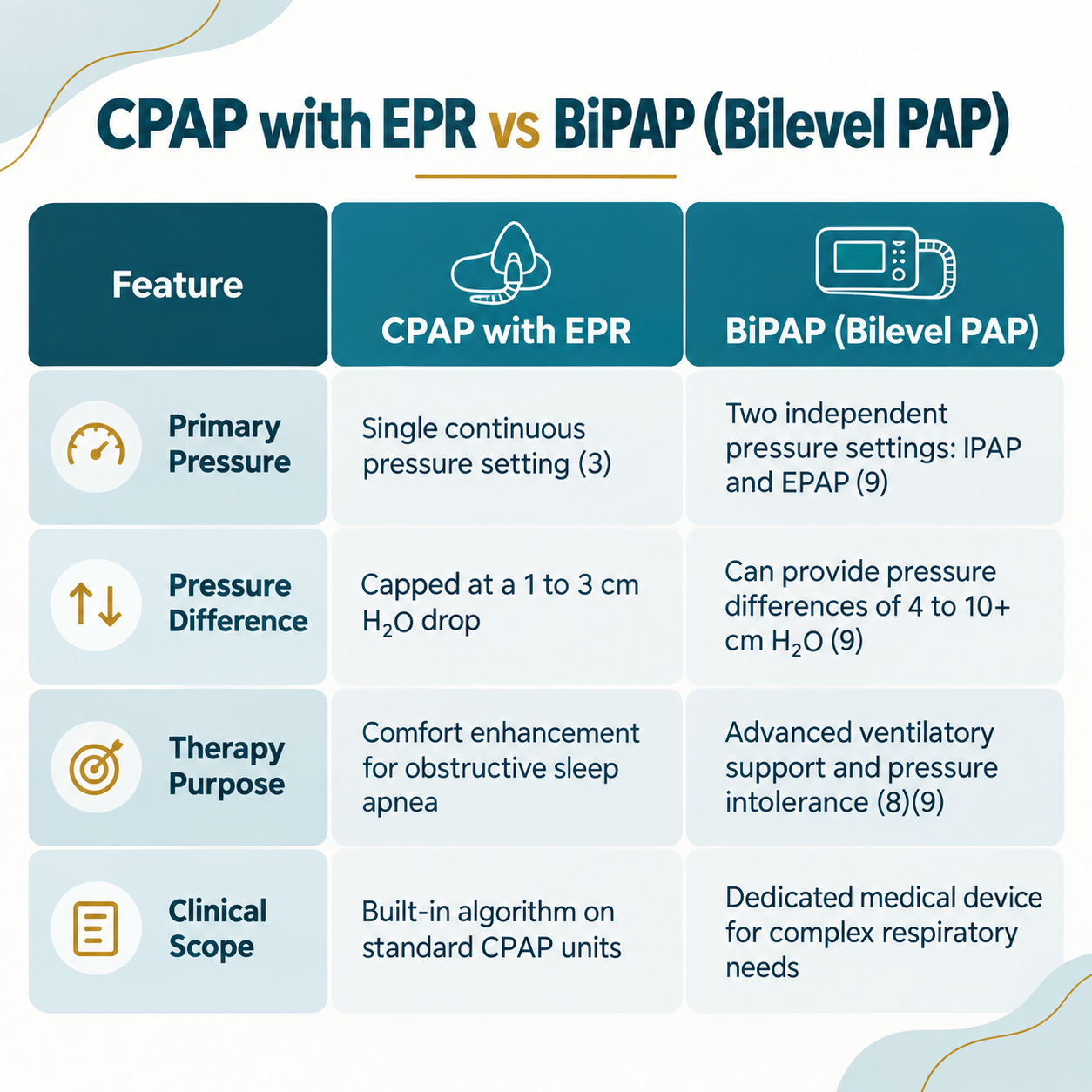
Bilevel therapy is prescribed when patients require significant ventilatory assistance or continue having airway events at CPAP pressures above 15 cm H₂O (8)(9). EPR is simply a comfort feature within a standard CPAP device.
When Sleep Specialists Adjust EPR Settings
EPR lowers delivered mask pressure during exhalation while keeping treatment pressure during inhalation (8). That can make breathing out easier, but it also means the pressure is lower during part of the breathing cycle.
That pressure change needs to be watched, especially when a patient still has breathing events after starting therapy. A bench study found that EPR 3 failed to normalize breathing flow and did not reduce AHI under certain fixed-pressure test conditions (5).
Clinicians may adjust, limit, or re-check EPR when:
- AHI remains elevated
- hypopneas increase during therapy
- obstructive events continue despite CPAP use
- new or persistent central events appear in the data
- mask leak is high
- symptoms continue despite regular use
CPAP data gives providers something objective to review. ResMed devices can store AHI, total hours used, leak, flow, and pressure data (1).
That data matters, but it should not be read alone. CPAP data should not be interpreted in isolation. An American Thoracic Society workshop report recommends monitoring residual AHI, leak, and adherence together with patient-reported concerns, with attention to mask fit and other problems that may affect CPAP use (10).
Why Small Comfort Changes Lead to Long-Term Health Benefits
Untreated obstructive sleep apnea is linked to (11):
- hypertension
- coronary artery disease
- stroke
- insulin resistance
CPAP therapy reduces these risks by stabilizing airflow and oxygen levels during sleep.
The challenge is not prescribing therapy. The challenge is making sure patients use it every night.
EPR contributes to that goal by addressing one of the most common points of discomfort.
Struggling With CPAP? We Adjust Your Therapy Based on Real Data at The Insomnia and Sleep Institute of Arizona
CPAP should not feel like a nightly struggle. If it does, something in the setup needs attention.
We at the Insomnia and Sleep Institute of Arizona evaluate how your therapy is working using actual device data, not assumptions. That includes reviewing pressure patterns, breathing events, and comfort settings like EPR.
We adjust your therapy based on how you breathe, not based on a standard template. That will lead to better tolerance and better outcomes.
You meet with sleep specialists from the start. Your first visit focuses on understanding your symptoms and your data, not delaying care.
If your CPAP therapy feels uncomfortable or ineffective, we work through the details with you. We serve patients across Phoenix, Scottsdale, and Gilbert, making expert sleep care accessible across the region.
Contact us today to schedule your consultation. We help you get real results from your treatment.
References
- Clinical guide. (n.d.). https://ap.resmed.com/hubfs/1%20Official%20-%20B2B%20Product%20Marketing%20Collateral/Marketing%20Materials/AirSense/AirSense10_ClinicalGuide_EN.pdf
- Grad, G. F., Rosanelli, I., Fernandes, M. D., Monare, A. B., Yanagimori, M., Fragoso da Silva Cruz, I., Mariano, P. M. M. S., Lorenzi-Filho, G., & Genta, P. R. (2026). Impairment of upper airway patency and CPAP effectiveness during obstructive sleep apnea treatment with expiratory pressure alleviation: a randomized study. Chest. https://doi.org/10.1016/j.chest.2026.08.041
- Pinto, V. L., Abdulghani Sankari, & Sharma, S. (2025, July 7). Continuous Positive Airway Pressure. Nih.Gov; StatPearls Publishing. https://www.ncbi.nlm.nih.gov/books/NBK482178/
- User guide. (n.d.). https://document.resmed.com/documents/products/machine/airsense-11/user-guide/airsense11_user-guide_anz_eng.pdf
- Zhu, K., Aouf, S., Roisman, G., & Escourrou, P. (2016). Pressure-Relief Features of Fixed and Autotitrating Continuous Positive Airway Pressure May Impair Their Efficacy: Evaluation with a Respiratory Bench Model. Journal of Clinical Sleep Medicine: JCSM: Official Publication of the American Academy of Sleep Medicine, 12(3), 385–392. https://doi.org/10.5664/jcsm.5590
- LCD – Positive Airway Pressure (PAP) Devices for the Treatment of Obstructive Sleep Apnea (L33718). (2023). Cms.Gov. https://www.cms.gov/medicare-coverage-database/view/lcd.aspx?LCDId=33718
- Weaver, T. E., Maislin, G., Dinges, D. F., Bloxham, T., George, C. F. P., Greenberg, H., Kader, G., Mahowald, M., Younger, J., & Pack, A. I. (2007). Relationship Between Hours of CPAP Use and Achieving Normal Levels of Sleepiness and Daily Functioning. Sleep, 30(6), 711–719. https://doi.org/10.1093/sleep/30.6.711
- How to optimize therapy modes to improve patient outcomes Understanding therapy modes to support patient outcomes Therapy Handbook. (n.d.). https://document.resmed.com/documents/us/10114280r1_ResMed_Therapy_Handbook_AMER_Eng_v07_cw_Interactive.pdf
- Summary of AASM Clinical Guidelines for the Manual Titration of Positive Airway Pressure in Patients with Obstructive Sleep Apnea. (n.d.). Retrieved May 5, 2026, from https://aastweb.org/wp-content/uploads/2025/03/AAST-Titration-Technical-Guideline-2021-RB-7-30-21.pdf
- Genta, P. R., Kaminska, M., Edwards, B. A., Ebben, M. R., Krieger, A. C., Tamisier, R., Ye, L., Weaver, T. E., Vanderveken, O. M., Lorenzi-Filho, G., DeYoung, P., Hevener, W., & Strollo, P. (2020). The Importance of Mask Selection on Continuous Positive Airway Pressure Outcomes for Obstructive Sleep Apnea. An Official American Thoracic Society Workshop Report. Annals of the American Thoracic Society, 17(10), 1177–1185. https://doi.org/10.1513/annalsats.202007-864st
- Kohli, P., Balachandran, J. S., & Malhotra, A. (2011). Obstructive Sleep Apnea and the Risk for Cardiovascular Disease. Current Atherosclerosis Reports, 13(2), 138–146. https://doi.org/10.1007/s11883-011-0161-8
Disclaimer: The information provided in this blog post is for educational and informational purposes only and is not intended as a substitute for professional medical advice, diagnosis, or treatment. Always consult with a licensed healthcare provider for recommendations specific to your individual health needs.