
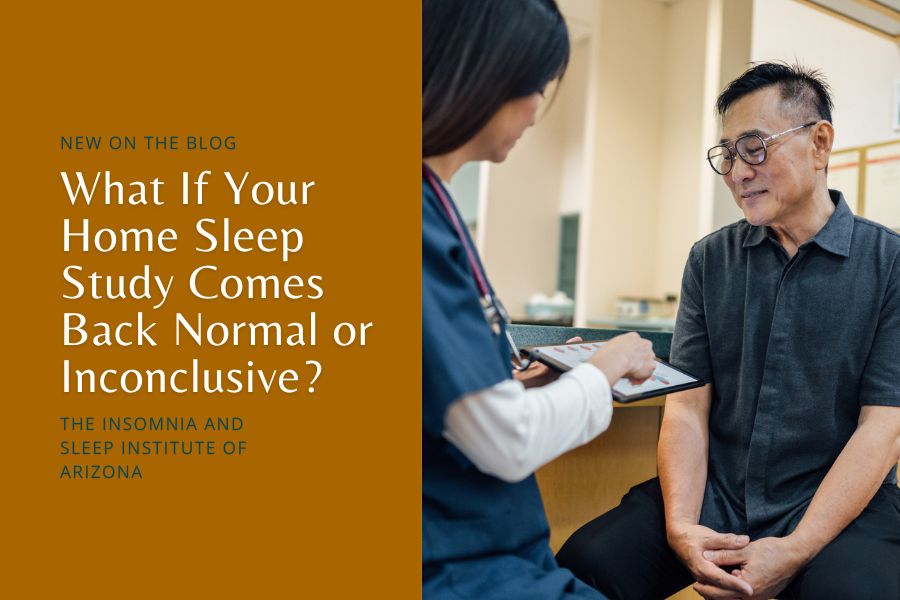
If your home sleep study comes back normal, it means no moderate or severe sleep apnea was detected. But it doesn’t always mean everything is fine.
Many people still struggle with exhaustion, snoring, or poor-quality sleep despite a “normal” result. That’s because home tests are limited in what they measure, and what they miss can still affect your health. Also, a lot can go wrong with a home sleep study, such as incorrect setup, to make it not work effectively. Still, home sleep studies are an excellent first step: they’re convenient, accessible, and highly effective at identifying common sleep breathing disorders. When symptoms persist, an in-lab study can provide a more detailed examination.
Does a Normal Home Sleep Study Mean Nothing Is Wrong?
A normal home sleep study doesn’t fully rule out sleep apnea – and it definitely doesn’t rule out other sleep disorders.
Home sleep tests primarily screen for moderate to severe obstructive sleep apnea (OSA). They are not designed to detect every type of sleep disorder or even mild cases of OSA in some instances.
Home studies typically monitor:
- Airflow (through a nasal cannula)
- Oxygen saturation (with a fingertip sensor)
- Breathing effort (using chest or abdominal belts)
- Heart rate
However, they do not measure:
- Sleep stages (light, deep, REM)
- Brain activity (EEG)
- Leg movements or micro-arousals
- Complex cardiac rhythms
Many sleep disorders, like insomnia, restless legs syndrome, narcolepsy, or REM behavior disorder, do not cause significant breathing disruptions but can still severely impair sleep quality. Because home sleep studies are mainly focused on breathing quality, they miss all these other issues.
In addition, even some forms of apnea, like REM-related or position-dependent OSA, can go undetected if the patient doesn’t reach REM sleep or doesn’t sleep in their typical at-risk positions during the test.
Can You Still Have Sleep Apnea with a Normal Home Study?
Yes, several real-world factors can cause home studies to miss cases of sleep apnea:
- Mild OSA: Home devices are less sensitive for detecting mild cases (Apnea-Hypopnea Index or AHI of 5–15 events per hour).
- REM-Only Apnea: If a person didn’t spend much time in REM sleep during the study (which often happens due to “first night effect”), apnea events tied to REM could be missed.
- Positional Apnea: Some individuals only experience apnea when sleeping on their backs. If they slept mostly on their side during the test, the disorder might not appear.
- Low Sleep Efficiency: If a patient barely slept, the amount of sleep data collected is too small to reliably assess true breathing patterns across sleep stages.
In one study, 5.5% of people with a “normal” home test were later found to have moderate to severe sleep apnea when tested in a lab. That’s why it’s important to talk with your doctor if symptoms like snoring, fatigue, or morning headaches continue — a more comprehensive in-lab study may be needed. (1).
Thus, if you have classic symptoms, loud snoring, daytime sleepiness, choking at night, but your home study is normal, it does not automatically mean you don’t have sleep apnea. It means the apnea was not captured that night.
What Are Other Sleep Disorders That a Home Study Might Miss?
If your symptoms persist after a normal test, the following possibilities should be considered:
- Chronic Insomnia: Difficulty falling or staying asleep despite proper opportunity. Insomnia affects about 10–15% of adults and is a leading cause of daytime fatigue.
- Restless Legs Syndrome (RLS): A neurological disorder causing uncomfortable leg sensations at night, often missed because breathing isn’t affected.
- Periodic Limb Movement Disorder (PLMD): Repetitive leg movements during sleep, causing micro-awakenings. PLMD affects up to 4% of adults and requires EEG and limb sensors for diagnosis.
- Narcolepsy: A disorder of sleep-wake regulation, resulting in uncontrollable daytime sleepiness. Narcolepsy diagnosis needs a Multiple Sleep Latency Test (MSLT), not a home apnea study.
- Circadian Rhythm Disorders: Such as delayed sleep phase syndrome, where sleep timing is shifted. These are diagnosed through sleep diaries and actigraphy, not home testing.
Without brain wave, muscle movement, and comprehensive sleep stage monitoring, home tests simply cannot detect these problems.
An in-lab study, or thorough clinical evaluation, is needed when symptoms suggest more than basic apnea.
What If Your Symptoms Persist Despite a Normal Home Sleep Study?
Your symptoms continuing after a normal home sleep study means something is still going on. It just hasn’t been detected yet.
Common reasons symptoms persist include:
- Mild or positional obstructive sleep apnea that wasn’t recorded.
- Sleep movement disorders like Periodic Limb Movement Disorder.
- Narcolepsy or hypersomnia, which home tests can’t detect.
- Primary insomnia disrupts sleep without breathing interruptions.
- Poor sleep hygiene or circadian rhythm disruptions overlooked by home tests.
How Can an In-Lab Sleep Study Offer More Clarity?
An in-lab sleep study, also called polysomnography, offers a far more complete picture of your sleep health. It’s the gold standard test because it measures everything happening in your body and brain during sleep, not just breathing.
An in-lab sleep study records:
- Brain waves (EEG) to track true sleep stages and depth.
- Eye movements to assess REM sleep.
- Muscle tone to detect movements or abnormal activity.
- Heart rhythms (EKG) to uncover hidden cardiac issues.
- Breathing patterns, oxygen saturation, and airflow.
- Limb movements to check for restless legs or periodic limb movement disorder.
This level of detail allows doctors to diagnose complex sleep conditions that home testing simply cannot catch.
For example, narcolepsy diagnosis requires measuring how quickly you fall asleep and how soon you enter REM, something only in-lab studies can detect with precision.
In addition, because in-lab studies track brain waves, they can separate true sleep time from simply lying in bed awake, making the results much more accurate than home studies, which often assume you’re sleeping if you’re still.
Should You Repeat a Sleep Study If Symptoms Get Worse?
Yes, and in many cases, it’s absolutely necessary to repeat sleep study if symptoms get worse. Sleep disorders are dynamic, not static. They can progress, worsen, or change character over time due to:
- Weight gain or loss.
- Aging (especially post-menopause).
- Medication changes (antidepressants, pain meds, etc.).
- New medical conditions (e.g., heart failure, neurological diseases).
For example, mild sleep apnea can worsen into moderate or severe apnea as weight increases or muscle tone decreases with age.
Retesting may be worth considering if your symptoms get worse. New nighttime issues like gasping or choking can be a red flag. Unexplained daytime sleepiness that persists is another warning sign. Big life changes like surgery or menopause can also affect your sleep.
Reassessing allows doctors to catch new or evolving issues early, avoiding years of untreated damage to cardiovascular health, cognitive function, and quality of life.
Why Work with a Sleep Specialist?
Not all doctors are trained equally in sleep medicine. Primary care providers manage many conditions well, but sleep disorders require the specific expertise of a board-certified sleep specialist.
A sleep specialist offers:
- Deeper understanding of the 80+ different sleep disorders.
- Access to advanced diagnostic tools beyond basic home studies.
- The ability to differentiate between overlapping conditions (e.g., apnea + insomnia).
- Expertise in interpreting complex sleep data accurately.
- Customized treatment options, ranging from CPAP, positional therapy, cognitive behavioral therapy for insomnia (CBT-I), to circadian rhythm management.
When your symptoms persist, expertise matters. Getting the right diagnosis from the start saves time, money, and prevents unnecessary suffering.

We Can Help You Sleep Again at The Insomnia and Sleep Institute of Arizona
The Insomnia and Sleep Institute of Arizona doesn’t settle for quick answers or surface-level testing. If your home sleep study looked normal but you’re still tired and frustrated, we take the time to look closer.
Our board-certified sleep doctors use advanced tools and proven methods to figure out what’s really going on. From overlooked apnea to movement issues to hard-to-explain insomnia, we take your symptoms seriously.
We go beyond running a test. We work to find what’s actually disrupting your sleep. And we stay with you until things improve and you feel more like yourself again.
References
- Zeidler, M. R., Santiago, V., Dzierzewski, J. M., Mitchell, M. N., Santiago, S., & Martin, J. L. (2015). Predictors of Obstructive Sleep Apnea on Polysomnography after a Technically Inadequate or Normal Home Sleep Test. Journal of Clinical Sleep Medicine, 11(11), 1313–1318. https://doi.org/10.5664/jcsm.5194
Disclaimer: The information provided in this blog post is for educational and informational purposes only and is not intended as a substitute for professional medical advice, diagnosis, or treatment. Always consult with a licensed healthcare provider for recommendations specific to your individual health needs.







