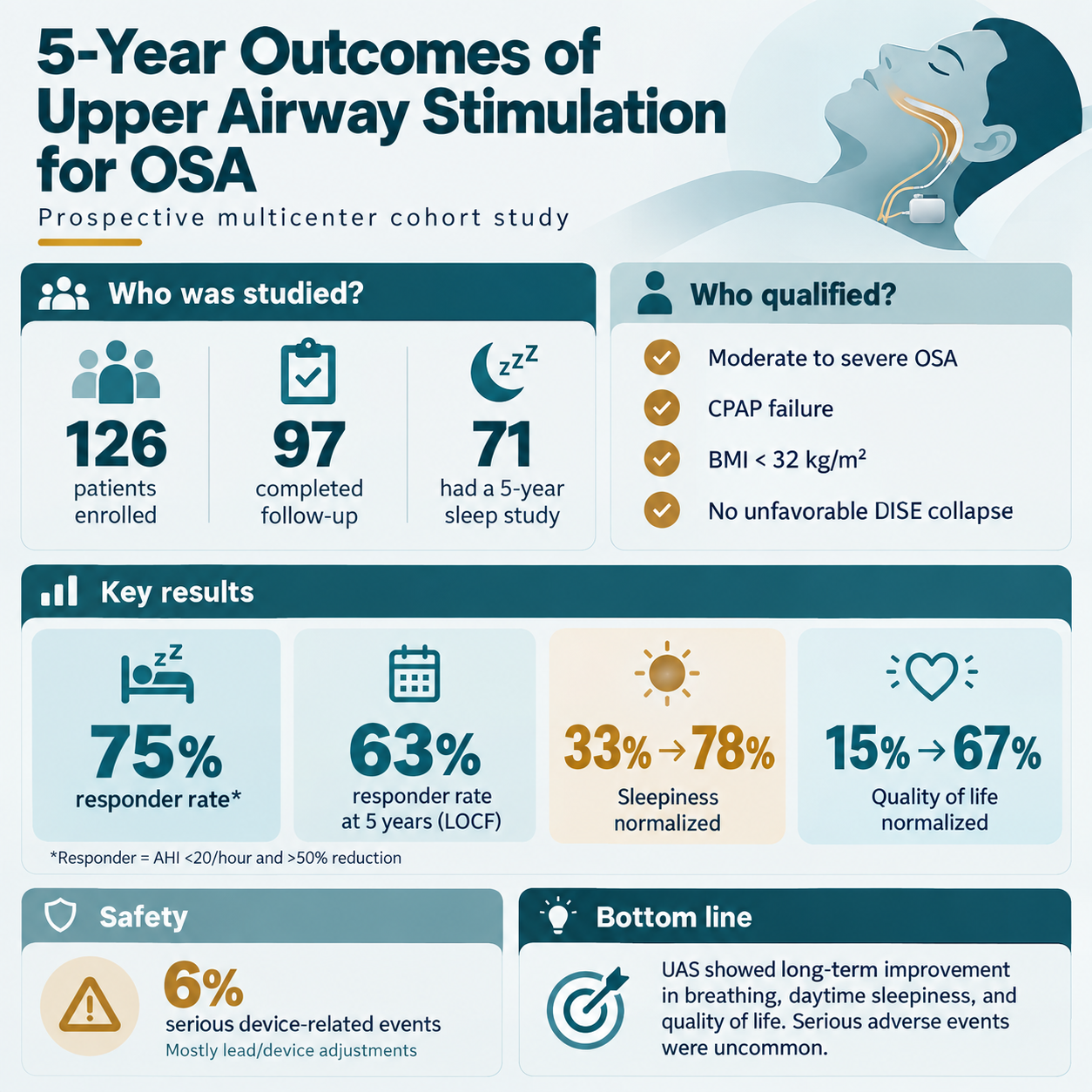
For people with moderate to severe obstructive sleep apnea who cannot tolerate CPAP, a sleep apnea implant has an average clinical success rate between 66% and 80% in the first year (1)(2). Long-term studies found that 75% of people who completed five-year sleep testing still responded well to treatment, or 63% using a stricter analysis (3).
In sleep medicine, “success” rarely means your sleep apnea completely disappears overnight. Instead, doctors evaluate your progress using the apnea-hypopnea index, or AHI, which measures how many times your breathing pauses or becomes dangerously shallow per hour of sleep. In clinical trials, a successful outcome generally means cutting a patient’s breathing pauses by at least 50% and bringing their total score below 20 events per hour (1)(2). F
Frustration with Sleep Apnea
Living with untreated obstructive sleep apnea is exhausting. The constant nighttime gasping strains your cardiovascular system, clouds your daytime focus, and disrupts your bed partner’s sleep. For decades, Continuous Positive Airway Pressure, better known as CPAP, has served as the gold-standard therapy. Yet, as many patients know firsthand, sleeping with a pressurized mask strapped to your face every night can feel unbearable.
This daily struggle is far more common than most people realize. Television personality Rosie O’Donnell publicly discussed her obstructive sleep apnea diagnosis after testing found that she stopped breathing more than 200 times in one night, with some pauses lasting about 40 seconds. While treatment changed her life, millions of people find themselves wrestling with mask leaks, skin irritation, and claustrophobia. When patients cannot wear their CPAP, their sleep apnea remains untreated. That frustrating reality is why hypoglossal nerve stimulation implants, such as Inspire, have become such an important alternative.
How Does the Inspire Implant Work?
Inspire works inside your body as a gentle pacemaker for your airway. During a minor outpatient procedure, a surgeon places a small pulse generator in the upper chest with two thin leads: one that monitors your natural breathing rhythm and one that connects to the hypoglossal nerve. This nerve controls the muscles of your tongue. Every time you breathe in, the device sends a mild electrical signal to move the tongue gently forward, preventing it from collapsing backward and blocking your throat (4). You control the entire system using a small handheld remote, clicking it on when you go to bed and clicking it off when you wake up.
First-Year Results: What Clinical Studies Show
The clinical numbers behind Inspire come from extensive patient trials and large medical reviews:
- The STAR Clinical Trial:In the foundational STAR trial, 66% of patients met responder criteria at 12 months, with at least a 50% reduction in AHI and an AHI below 20 events per hour. (1).
- Large Meta-Analysis Data: A comprehensive review across 44 studies and 8,670 patients reported an average clinical success rate of approximately 80% during the first year (2). In that analysis, 82% of patients got their AHI below 15 events per hour, 72% dropped below 10, and 47% reached an AHI below 5, which represents a normal breathing range (2).
- Long-Term Durability: Follow-up data at the five-year mark found a 75% response rate among patients who completed their five-year sleep study (3). Daytime sleepiness scores in that group normalized for 78% of participants, compared to only 33% before surgery (3).
- Real-World Practice (The ADHERE Registry): Real-world clinic registries tell an even more practical story than controlled trials. In the ADHERE registry, which analyzed 1,849 everyday patients, individuals experienced an average reduction of nearly 21 breathing disruptions per hour and wore their device an average of 5.6 hours each night (5).
Event Reduction vs. Patient Success Rate
You may see advertisements mentioning a 79% reduction in sleep apnea events. It helps to understand that a 79% reduction in events across a group of patients is not the same thing as a 79% guaranteed success rate for every single person.
The 79% figure describes the average drop in total breathing pauses recorded across clinical trials. Meanwhile, clinical research measures how many individual patients cross a specific medical finish line (2). Long-term outcomes were favorable. After five years of upper airway stimulation, patients showed improvements in sleepiness, quality of life, and breathing-related outcomes, with 75% meeting the study’s AHI response criteria among those who completed the follow-up sleep study (6).
Who Gets the Best Results with an Implant?
Not everyone with sleep apnea is an ideal candidate for surgery. Researchers have identified several clear physical factors that make a positive outcome much more likely:
- Body Mass Index (BMI): While Inspire can help people of varying sizes, body weight plays a measurable role in how well the tongue moves during stimulation. A 2024 study in JAMA Otolaryngology found that patients with a BMI between 32 and 35 had 75% lower odds of meeting formal response criteria compared to patients with a BMI of 32 or lower (7). ADHERE registry data mirrored this trend, reporting surgical success in 72.2% of patients with a BMI of 32 or lower compared to 59.8% for those between 32 and 35 (5). BMI is not an automatic disqualifier, but staying closer to 32 provides the highest statistical chance of a strong result.
- Sleeping Position: The same JAMA study observed that response rates can be less predictable when sleeping flat on your back, which is a position where gravity naturally pulls the soft tissues straight down into the airway (7).
- Airway Collapse Pattern: The way your throat closes during sleep is critical. Candidates must undergo a short diagnostic evaluation called drug-induced sleep endoscopy (DISE) (8). While you rest under light sedation, a specialist uses a tiny camera to watch your airway collapse. If your soft palate collapses in a circular motion, known as complete concentric collapse, the implant cannot open the airway properly and surgery should not be performed (8).
Qualifying for Treatment and Insurance Guidelines
The FDA currently approves Inspire for adults with moderate to severe obstructive sleep apnea who have an AHI between 15 and 100 events per hour, a BMI up to 40, and a documented inability to use CPAP (4).
However, approval from the FDA does not automatically guarantee that insurance will pay for the procedure. Major payers, including Medicare, often use narrower coverage rules (8). Medicare guidelines generally require:
- A diagnostic AHI between 15 and 65 events per hour.
- A BMI below 35.
- Documented failure or intolerance of CPAP therapy.
- Confirmation during endoscopy that concentric collapse is absent (8).
Because insurance requirements can differ from general FDA labels, having an experienced team review your diagnostic sleep studies and medical history is a vital first step.
Is Inspire a Permanent Cure?
Inspire should be viewed as an effective nightly treatment rather than a permanent cure. It manages the mechanical collapse of your airway while it is running, but it does not change your underlying throat anatomy.
In the landmark STAR trial, researchers conducted a temporary therapy-withdrawal test where stimulation was turned off for a brief period (1). When the device was inactive, patients’ sleep apnea events immediately returned to their original severity (1). The device must be turned on each night with your remote to keep your airway open.
Safety and Potential Side Effects
Like any surgical treatment, hypoglossal nerve stimulation involves recovery and possible side effects. A 2024 systematic review of 17 studies found that major complications are rare, with an overall device survival rate of 98.34% over five years (9). The most common issues include minor tongue abrasions from movement against lower teeth, temporary incision soreness, and initial discomfort as patients adapt to the electrical sensation (9).
Real-world registry data reported serious adverse events in only 2.3% of individuals, with a surgical revision rate of 1.9% (5). The registry also showed that when people experience discomfort, they tend to use their device for fewer hours each night, leading to higher final AHI scores (5). Working closely with your sleep doctor to fine-tune voltage settings and tongue movement during follow-up visits makes all the difference in staying comfortable.
Evaluating Your Candidacy
A published success rate tells you what happened in a study. Your sleep study and airway anatomy tell us far more about whether Inspire may work for you.
At The Insomnia and Sleep Institute of Arizona, our physician-led sleep center evaluates obstructive sleep apnea and Inspire candidacy across our Phoenix, Scottsdale, and Gilbert locations.
We can review your previous CPAP experience, current OSA severity, sleep-study findings, anatomy, and other factors that may affect your expected result. Our goal is to determine whether Inspire fits your case rather than relying on a general percentage taken from another person’s outcome.
Contact us to schedule an Inspire consultation and find out whether you meet the criteria for sleep apnea implant therapy.
References
- Strollo, P. J., Soose, R. J., Maurer, J. T., de Vries, N., Cornelius, J., Froymovich, O., Hanson, R. D, Padhya, T. A., Steward, D. L., Gillespie, M. B., Woodson, B. T., Van de Heyning, P. H., Goetting, M. G., Vanderveken, O. M., Feldman, N., Knaack, L., Strohl, K. P., & STAR Trial Group. (2014). Upper-airway stimulation for obstructive sleep apnea. The New England Journal of Medicine, 370(2), 139–149. https://doi.org/10.1056/NEJMoa1308659
- Kim, D. H., Kim, S. W., Han, J. S., Kim, G. J., Basurrah, M. A., & Hwang, S. H. (2023). Hypoglossal Nerve Stimulation Effects on Obstructive Sleep Apnea Over Time: A Systematic Review and Meta‐analysis. Otolaryngology–Head and Neck Surgery, 170(3), 736–746. https://doi.org/10.1002/ohn.617
- Woodson, B. T., Strohl, K. P., Soose, R. J., Gillespie, M. B., Maurer, J. T., de Vries, N., Padhya, T. A., Badr, M. S., Lin, H., Vanderveken, O. M., Mickelson, S., & Strollo, P. J. (2018). Upper Airway Stimulation for Obstructive Sleep Apnea: 5‐Year Outcomes. Otolaryngology–Head and Neck Surgery, 159(1), 194–202. https://doi.org/10.1177/0194599818762383
- Center for Devices and Radiological Health. (2023, July 13). Inspire Upper Airway Stimulation – P130008/S090. U.S. Food and Drug Administration; FDA. https://www.fda.gov/medical-devices/recently-approved-devices/inspire-upper-airway-stimulation-p130008s090
- Suurna, M. V., Steffen, A., Boon, M., Chio, E., Copper, M., Patil, R. D., Green, K., Hanson, R., Heiser, C., Huntley, C., Kent, D., Larsen, C., Manchanda, S., Maurer, J. T., Soose, R., de Vries, N., Walia, H. K., & Thaler, E. (2021). Impact of Body Mass Index and Discomfort on Upper Airway Stimulation: ADHERE Registry 2020 Update. The Laryngoscope, 131(11), 2616–2624. https://doi.org/10.1002/lary.29755
- Woodson, B. T., Strohl, K. P., Soose, R. J., Gillespie, M. B., Maurer, J. T., de Vries, N., Padhya, T. A., Badr, M. S., Lin, H., Vanderveken, O. M., Mickelson, S., & Strollo, P. J. (2018). Upper Airway Stimulation for Obstructive Sleep Apnea: 5‐Year Outcomes. Otolaryngology–Head and Neck Surgery, 159(1), 194–202. https://doi.org/10.1177/0194599818762383
- Patel, R. M., Wang, H. Z., Jamro, E. L., Lindburg, M. R., Jackson, R. S., Malhotra, R. K., Lucey, B. P., & Landsness, E. C. (2024). Response to Hypoglossal Nerve Stimulation Changes With Body Mass Index and Supine Sleep. JAMA Otolaryngology–Head & Neck Surgery, 150(5), 421. https://doi.org/10.1001/jamaoto.2024.0261
- LCD – Hypoglossal Nerve Stimulation for Obstructive Sleep Apnea (L38276). (2020). Cms.Gov. https://www.cms.gov/medicare-coverage-database/view/lcd.aspx?=&lcdid=38276&ver=12
- Wollny, M., Heiser, C., Sommer, U., Schöbel, C., & Braun, M. (2024). Adverse Events with Hypoglossal Nerve Stimulation in the Treatment of Obstructive Sleep Apnea—A Systematic Review of Clinical Trials and Real-World Data. Journal of Clinical Medicine, 13(15), 4282. https://doi.org/10.3390/jcm13154282
Disclaimer: The information provided in this blog post is for educational and informational purposes only and is not intended as a substitute for professional medical advice, diagnosis, or treatment. Always consult with a licensed healthcare provider for recommendations specific to your individual health needs.