Most people have never seen a sleep specialist. Unfortunately many only seek out these experts when a sleep disorder becomes unbearable. Considering that around 70 million people in the U.S. alone have a sleep disorder, with many undiagnosed, it is important to view this specialty as just as crucial as seeing a dermatologist, dentist, or other healthcare professional (1).
In many cases, a patient is referred to a sleep specialist by their general physician, but this is not required, and referrals are sometimes overlooked (2, 3). You do not need a referral to make an appointment at The Insomnia and Sleep Institute of Arizona, and your initial consultation is always with a sleep specialist who can diagnose sleep disorders.
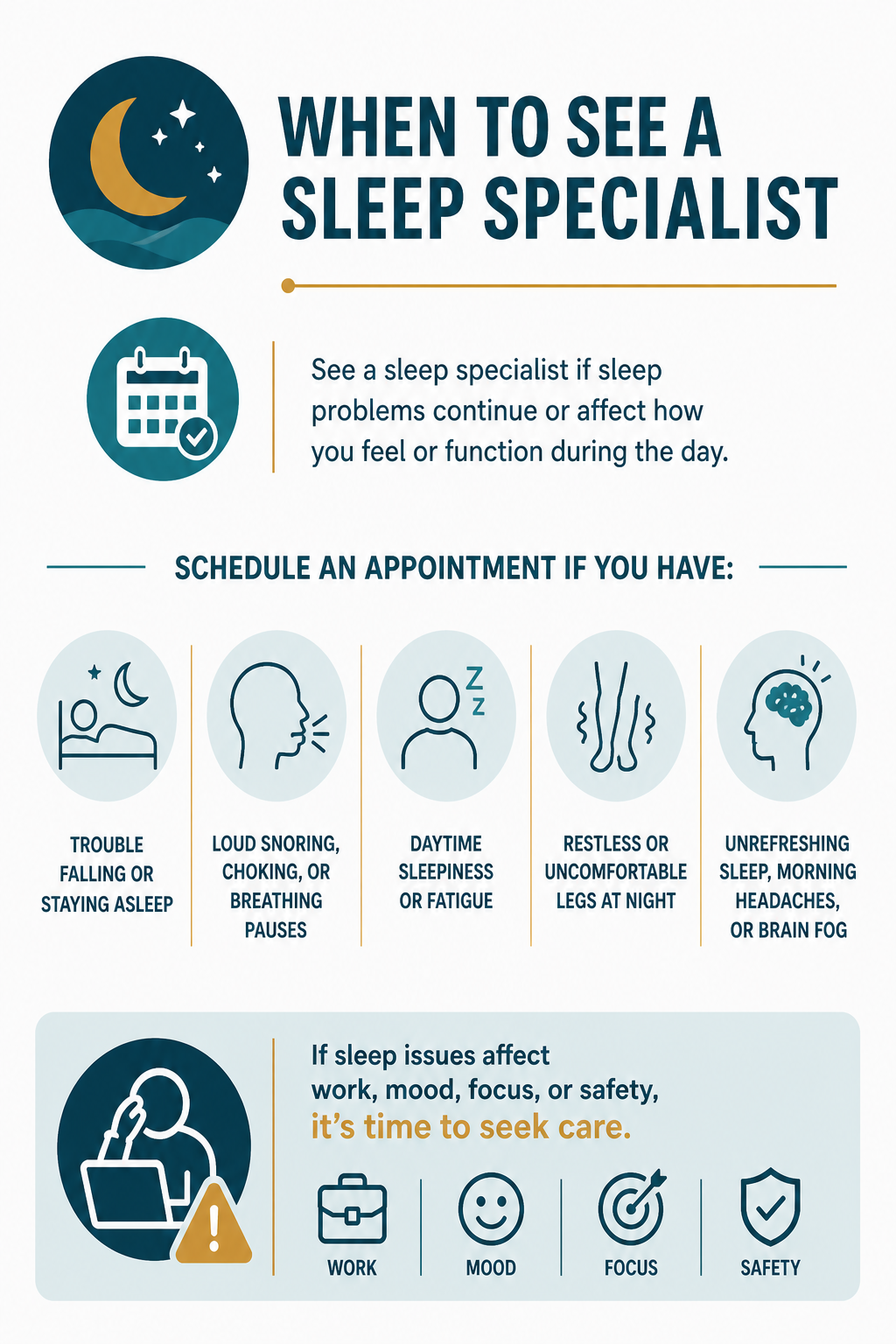
When to See a Sleep Specialist
See a sleep specialist if sleep problems continue or affect how you feel or function during the day (4).
Schedule an appointment if you have:
- Ongoing trouble falling or staying asleep
- Loud snoring, choking, or breathing pauses during sleep
- Excessive daytime sleepiness or constant fatigue
- Restless or uncomfortable legs at night
- Unrefreshing sleep, morning headaches, or brain fog
If sleep issues affect work, mood, focus, or safety, it’s time to seek care. At The Insomnia and Sleep Institute of Arizona, sleep specialists evaluate the cause of poor sleep and provide medical, evidence-based treatment.
Why Sleep Disorders Often Go Undiagnosed
Nearly half (48%) of people self-report snoring, and the true number is likely higher.(4). Because snoring is often reported by someone who overhears the sleeper, people who sleep alone may snore without realizing it.
Additionally, almost 38 percent of people report unintentionally falling asleep during the day at least once in the past month, which can be an indicator of various sleep disorders including insomnia and sleep apnea (5).
Many individuals normalize these symptoms, assuming fatigue or snoring is simply part of life. Over time, this normalization delays diagnosis and treatment, allowing sleep-related conditions to worsen.
The Many Types of Sleep Disorders
There are dozens of sleep disorders, and those that are more common (such as insomnia) are not always taken seriously by the general public due to their commonality. However, sleep disorders are also serious.
In fact, 4.2 percent of people report unintentionally falling asleep while driving in the last month (6). It is estimated that about 56,000 crashes each year in the United States are linked to drowsy driving, leading to around 1,550 deaths and 40,000 nonfatal injuries (7).
Insomnia is the most common sleep disorder, self-reported by around 30%of adults, with 10% experiencing chronic insomnia (8). It is also estimated that 83 million adults in the U.S. have obstructive sleep apnea (OSA), which is most often treated with CPAP therapy (9).
The Insomnia and Sleep Institute is proud to serve the Phoenix region as the “Face of Sleep Medicine,” achieving the title of “Top Doc” for the past six consecutive years, and offering Inspire implants for OSA patients who have not had success with CPAP therapy.
Historically, cultural beliefs about snoring varied across societies and were often neutral or even positive. (10, 11, 12). Modern sleep medicine, however, has shown that snoring is actually the sound of respiratory resistance (12). In fact, the word “apnea” comes from the Greek apnoia, meaning “without breath.” (13) Understanding this shifts the cultural view of snoring from a harmless habit to a medical red flag.
Why Sleep Disorders Have Serious Safety Implications
Sleep disorders are not limited to nighttime symptoms. Excessive daytime sleepiness can impair judgment, reaction time, and decision-making, increasing the risk of workplace accidents, driving incidents, and medical errors. Fatigue-related impairment has been shown to mirror the effects of alcohol intoxication, making untreated sleep disorders a significant public safety concern (14).
What to Expect During Your First Sleep Consultation
During your first visit, the focus is on understanding your sleep patterns and overall health. You can typically expect:
- A review of your sleep habits, schedule, and routines
- Discussion of symptoms such as snoring, fatigue, or daytime sleepiness
- Review of medical history, medications, and lifestyle factors
- Time to ask questions and share concerns about your sleep
The goal is to build a complete picture before deciding on next steps.
Do You Need a Sleep Study to See a Sleep Specialist?
A sleep study is not always required at the first visit (15). Many patients assume overnight testing happens immediately, but a sleep specialist typically begins with a detailed clinical assessment.
Some sleep disorders can be identified through history alone, while others may require additional testing to confirm a diagnosis.
When a sleep study is recommended, it gathers detailed information about breathing, oxygen levels, movement, and sleep stages. This helps determine whether conditions such as sleep apnea or movement disorders are present. Testing decisions are always based on individual symptoms, risk factors, and clinical judgment.
How Untreated Sleep Problems Affect Long-Term Brain Health
Sleep plays a vital role in brain function and nightly recovery. When sleep problems go untreated, long-term effects may include (16, 17):
- Difficulty with focus, attention, and memory
- Increased emotional reactivity or mood changes
- Reduced ability to manage stress and decision-making
- Greater risk of cognitive decline over time
Addressing sleep concerns early supports long-term brain health and daily functioning.
The Brain’s “Glymphatic System”
A key reason sleep matters for brain health is a process discovered by researchers called the glymphatic system (18). During deep sleep, the brain essentially “washes” itself, clearing out metabolic waste such as beta-amyloid that accumulates during the day.. Without restorative sleep, this “waste” remains, which is why chronic sleep loss is closely studied in relation to cognitive decline.
Sleep Matters in Phoenix and the Greater East Valley
On average, more men (24–31%) than women (9–21%) experience OSA (19). Obesity is a known risk factor. (20). Poor adherence to CPAP therapy is a well-recognized challenge in chronic obstructive sleep apnea, with studies showing that only about 60–66%t of patients use CPAP at levels considered clinically adequate, typically defined as at least four hours per night (21). One common reason is improper equipment fit At The Insomnia and Sleep Institute, our team works with patients to ensure a comfortable and effective CPAP setup.
While OSA is more common in men, women experience insomnia more frequently. . National survey data also show that about 37% of adults sleep less than seven hours per night — a known health risk factor. (22, 23)
On average, 35.5% of adults report sleeping less than seven hours in a 24-hour period (24). Insufficient sleep is linked to reduced alertness and impaired decision-making. Large healthcare safety reports estimate tens of thousands of deaths annually from preventable medical errors, a burden worsened by clinician fatigue and sleep deprivation. (25).
Author and poet Maya Angelou once said:
“Every person needs to take one day away. A day in which one consciously separates the past from the future. Jobs, family, employers, and friends can exist one day without any one of us, and if our egos permit us to confess, they could exist eternally in our absence. Each person deserves a day away in which no problems are confronted, no solutions searched for.”
She was talking about rest in the broadest sense, but the principle lands just as personally when applied to sleep. We are not machines. We were never meant to run without pause.
Get the Sleep You Need in the East Valley
Have you noticed that you, your partner, or your child seems to be struggling with a sleep disorder?
We are home to unprecedented staffing levels with a clinical psychologist focused in cognitive behavioral therapy (CBT) for insomnia, three sleep specialists, and many other sleep experts. Your first consultation is with a sleep specialist who can diagnose sleep disorders, which is the first step before testing and treating can begin (as needed).
To book your consultation with The Insomnia and Sleep Institute, complete the quick online form or call the office today.
References
- Sleep Science and Sleep Disorders. (2023, September). NHLBI, NIH. https://www.nhlbi.nih.gov/science/sleep-science-and-sleep-disorders
- Ng, L., & Cunnington, D. (2021). Management of insomnia in primary care. Australian Prescriber, 44(4), 124–128. https://doi.org/10.18773/austprescr.2021.027
- Saleem, A. H., Al Rashed, F. A., Alkharboush, G. A., Almazyed, O. M., Olaish, A. H., Almeneessier, A. S., & BaHammam, A. S. (2017). Primary care physicians’ knowledge of sleep medicine and barriers to transfer of patients with sleep disorders. Saudi Medical Journal, 38(5), 553–559. https://doi.org/10.15537/smj.2017.5.17936
- Moffa, A., Giorgi, L., Nardelli, D., Iafrati, F., Iannella, G., Magliulo, G., Baptista, P., Vicini, C., & Casale, M. (2024). The Potential Effect of Changing Patient Position on Snoring: A Systematic Review. Journal of Personalized Medicine, 14(7), 715. https://doi.org/10.3390/jpm14070715
- temporary episode of sleep or drowsiness. (2004, September 3). Wikipedia.org; Wikimedia Foundation, Inc. https://en.wikipedia.org/wiki/Microsleep
- Drowsy Driving — 19 States and the District of Columbia, 2009–2010. (2020). Cdc.gov. https://www.cdc.gov/mmwr/preview/mmwrhtml/mm6151a1.htm
- Kashani, A. T., Moghadam, M. R., & Saeideh Amirifar. (2022). Factors affecting driver injury severity in fatigue and drowsiness accidents: a data mining framework. Journal of Injury and Violence Research, 14(1), 75. https://doi.org/10.5249/jivr.v14i1.1679
- Insomnia. (2008). https://aasm.org/resources/factsheets/insomnia.pdf
- Sönmez, I., Vo Dupuy, A., Yu, K. S., Cronin, J., Yee, J., & Azarbarzin, A. (2025). Unmasking obstructive sleep apnea: Estimated prevalence and impact in the United States. Respiratory Medicine, 248, 108348. https://doi.org/10.1016/j.rmed.2025.108348
- Arber, S., Meadows, R., & Venn, S. (2012). Sleep and Society. In Oxford University Press eBooks. Oxford University Press. https://doi.org/10.1093/oxfordhb/9780195376203.013.0012
- Hicks, R. A., Bautista, J., & McCullough, M. (1994). Snoring may be linked to culture. Medical Hypotheses, 42(1), 24–26. https://doi.org/10.1016/0306-9877(94)90030-2
- to, C. (2003, April 3). involuntary, vibratory noises made while sleeping. Wikipedia.org; Wikimedia Foundation, Inc. https://en.wikipedia.org/wiki/Snoring
- Polkey, M. (2009, March 19). Sleep apnea | Causes, Symptoms & Treatment. Encyclopedia Britannica. https://www.britannica.com/science/sleep-apnea
- Williamson, A. M., & Anne-Marie Feyer. (2000). Moderate sleep deprivation produces impairments in cognitive and motor performance equivalent to legally prescribed levels of alcohol intoxication. Occupational and Environmental Medicine, 57(10), 649–655. https://doi.org/10.1136/oem.57.10.649
- Ellender, C. M., Ruehland, W. R., Duce, B., Joyce, R., Worsnop, C., Mercer, J., Naughton, M., Hukins, C. A., Wheatley, J., & Cunnington, D. (2024). Australasian Sleep Association 2024 guidelines for sleep studies in adults. SLEEP, 47(10). https://doi.org/10.1093/sleep/zsae107
- Spira, A. P., Chen-Edinboro, L. P., Wu, M. N., & Yaffe, K. (2014). Impact of sleep on the risk of cognitive decline and dementia. Current Opinion in Psychiatry, 27(6), 478–483. https://doi.org/10.1097/yco.0000000000000106
- Gottesman, R. F., Lutsey, P. L., Benveniste, H., Brown, D. L., Full, K. M., Lee, J.-M., Osorio, R. S., Pase, M. P., Redeker, N. S., Redline, S., & Spira, A. P. (2024). Impact of Sleep Disorders and Disturbed Sleep on Brain Health: A Scientific Statement From the American Heart Association. Stroke, 55(3), e61–e76. https://doi.org/10.1161/str.0000000000000453
- Xie, L., Kang, H., Xu, Q., Chen, M. J., Liao, Y., Thiyagarajan, M., O’Donnell, J., Christensen, D. J., Nicholson, C., Iliff, J. J., Takano, T., Deane, R., & Nedergaard, M. (2013). Sleep Drives Metabolite Clearance from the Adult Brain. Science, 342(6156), 373–377. https://doi.org/10.1126/science.1241224
- Garvey, J. F., Pengo, M. F., Panagis Drakatos, & Kent, B. D. (2015). Epidemiological aspects of obstructive sleep apnea. Journal of Thoracic Disease, 7(5). https://doi.org/10.3978/j.issn.2072-1439.2015.04.52
- Messineo, L., Bakker, J. P., Cronin, J., Yee, J., & White, D. P. (2024). Obstructive sleep apnea and obesity: A review of epidemiology, pathophysiology and the effect of weight-loss treatments. Sleep Medicine Reviews, 78, 101996–101996. https://doi.org/10.1016/j.smrv.2024.101996
- Weaver, T. E., & Sawyer, A. M. (2010). Adherence to Continuous Positive Airway Pressure Treatment for Obstructive Sleep Apnea: Implications for Future Interventions. The Indian Journal of Medical Research, 131, 245. https://pmc.ncbi.nlm.nih.gov/articles/PMC2972705/
- Li, J., Somers, V. K., Xu, H., Lopez-Jimenez, F., & Covassin, N. (2022). Trends in Use of Melatonin Supplements Among US Adults, 1999-2018. JAMA, 327(5), 483. https://doi.org/10.1001/jama.2021.23652
- Effect of Short Sleep Duration on Daily Activities — United States, 2005–2008. (2026). Cdc.gov. https://www.cdc.gov/mmwr/preview/mmwrhtml/mm6008a3.htm
- Explore Insufficient Sleep in the United States | AHR. (2026). Americashealthrankings.org. https://www.americashealthrankings.org/explore/measures/sleep
- preventable adverse effect of medical care, whether evident or harmful to the patient or not. (2004, June 12). Wikipedia.org; Wikimedia Foundation, Inc. https://en.wikipedia.org/wiki/Medical_error
Disclaimer: The information provided in this blog post is for educational and informational purposes only and is not intended as a substitute for professional medical advice, diagnosis, or treatment. Always consult with a licensed healthcare provider for recommendations specific to your individual health needs.