Many people with narcolepsy drive safely, but it requires consistent symptom control, medical oversight, and strict self-monitoring.
Driving requires rapid reaction times and constant vigilance. For someone living with narcolepsy, sudden daytime sleepiness can turn a routine commute into a dangerous situation. The central challenge is not a lack of motivation, but whether your brain can maintain wakefulness consistently behind the wheel.
As Stoic philosopher Epictetus famously wrote in The Enchiridion, “Some things are up to us and some things are not up to us” (1). While a sudden sleep attack is out of your control, choosing when to drive, when to pull over, and how to manage your condition is entirely within your power. At our sleep clinic, we work directly with patients to build personalized driving safety plans that protect both independence and peace of mind.
What Is Narcolepsy, And Why Does It Affect Driving So Strongly?
Narcolepsy impairs driving because it disrupts sustained attention, reaction speed, and awake awareness simultaneously.
Narcolepsy is a neurological sleep-wake disorder that causes severe daytime sleepiness regardless of how long you slept the night before. Beyond sleepiness, it can trigger cataplexy, which is a sudden loss of muscle tone during strong emotions, as well as sleep paralysis and vivid hallucinations (2, 3). In the brain, this condition stems from a loss of hypocretin neurons that regulate wakefulness, a milestone discovery led by sleep researcher Dr. Emmanuel Mignot (4).
Driving is uniquely hazardous for individuals with narcolepsy because sleepiness often intensifies during low-stimulation settings, such as long stretches of highway. Real-world experiences illustrate this constant struggle.
One individual with narcolepsy described their experience vividly: “Highway driving became very difficult without conversation and sometimes even with conversation. There were many days I had no recollection of leaving the house or driving to work.” (5) This illustrates how narcolepsy affects not just alertness but also memory and awareness during driving.
How Can You Tell The Difference Between Normal Tiredness And Narcolepsy Sleepiness Behind The Wheel?
Narcolepsy sleepiness is an intrusive neurological urge to sleep that cannot be overcome by willpower, cold air, or loud music.
Every driver gets tired occasionally, but narcolepsy sleepiness is persistent and unpredictable. It occurs even after a full night of rest and intensifies during passive tasks like waiting at red lights or driving on quiet roads.
Many drivers attempt to cope using temporary tricks like blasting music, opening windows, or drinking extra caffeine. In our clinical practice, we remind patients that these tactics buy only a few minutes and cannot prevent sudden sleep episodes. If you experience head nodding, lane drifting, or lost memory of past miles, you are experiencing severe impairment that demands immediate action.
Why Are Microsleeps So Dangerous, And What Does The Research Say About Crash Risks?
Microsleeps freeze your brain for critical seconds while your eyes remain open, drastically increasing crash rates.
A microsleep is a brief episode of sleep lasting from a fraction of a second up to thirty seconds. During a microsleep, your brain stops processing visual information even if your eyes appear open. At highway speeds, a three-second microsleep means traveling the length of a football field completely unguided.
According to federal crash data, drowsy driving accounts for at least 91,000 police-reported crashes, 50,000 injuries, and nearly 800 deaths annually (6). Research confirms that individuals with narcolepsy experience higher rates of sleep-related crashes and near-misses compared to drivers with other sleep conditions (7). This is why our sleep physicians treat driving safety as a primary medical priority rather than a secondary concern.
When Should You Stop Driving Immediately And Consult Our Sleep Physicians?
You must pull over and pause driving whenever you experience dozing at the wheel, near-misses, or unpredictable symptom spikes.
Our medical team advises immediate cessation of driving if you encounter any of the following warning signs:
- Falling asleep at the wheel, even for a brief second.
- Near-miss incidents involving lane drifting, late braking, or blackout stretches.
- Inability to stay awake on short, routine drives.
- Cataplexy that weakens your grip, posture, or neck control while driving.
- Recent medication changes or the addition of sedating substances.
What Regulations, Paperwork, And Medical Reviews Apply To Narcolepsy Drivers?
Driving regulations require objective medical documentation showing that your symptoms are fully controlled before you take the wheel.
Licensing rules vary by state, but most require physician certification. As noted by Harvard’s Division of Sleep Medicine, drivers often need formal medical letters confirming their narcolepsy is well-controlled and unlikely to cause daytime dozing (8).
For commercial drivers, standards are far stricter. Federal regulations generally disqualify commercial motor vehicle drivers with narcolepsy due to safety risks (9). While individual exemption applications exist, approval is rare and handled on a strict case-by-case basis (10).
In Arizona, the Medical Review Program evaluates drivers with medical conditions affecting alertness (11). At our Arizona practice, we help patients navigate these state reporting requirements and complete all necessary medical review paperwork proactively.
How Sleep Specialists Evaluate Driving Safety And Which Treatments Improve Daytime Wakefulness
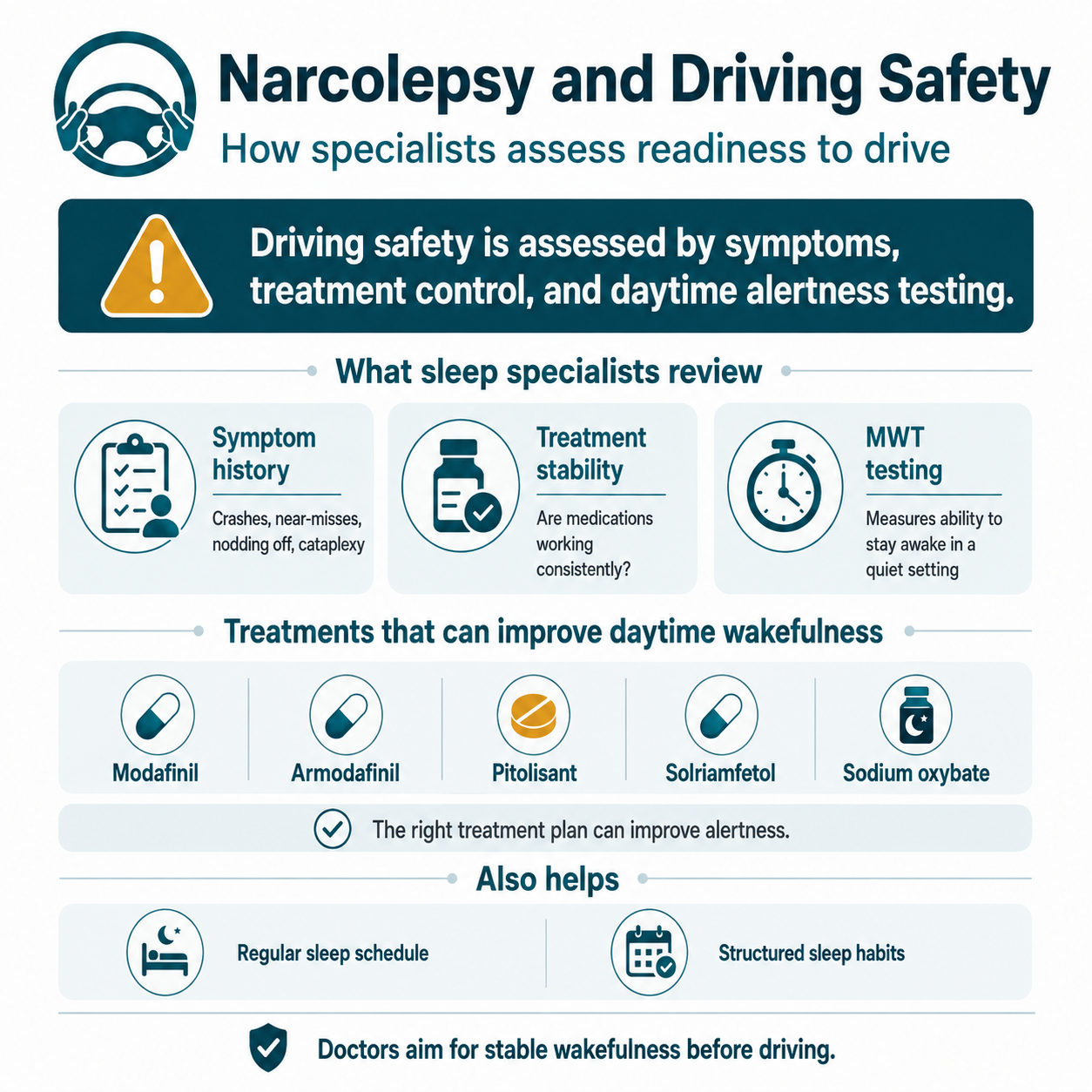
Sleep specialists assess driving readiness through clinical history, sleepiness scales, objective testing, and targeted medical therapies.
When evaluating fitness to drive, sleep physicians analyze three core factors:
- Symptom History: Specialists review any history of crashes, near-misses, daytime nodding, and cataplexy triggers.
- Treatment Stability: Physicians evaluate how consistently medications are taken and whether daytime sleepiness is fully controlled.
- Objective Testing: Clinics may perform a Maintenance of Wakefulness Test (MWT), which measures a person’s physical ability to stay awake in a quiet environment (12).
To achieve driving stability, doctors prescribe FDA-approved medications recommended by the American Academy of Sleep Medicine. These include modafinil, armodafinil, pitolisant, solriamfetol, and sodium oxybate (13). Combining the right medication plan with structured sleep habits helps stabilize sleep-wake cycles and improve daytime alertness.
Practical Strategies And Pre-Drive Safety Checklists
Safe driving with narcolepsy relies on strategic daily habits and honest pre-drive self-evaluations.
In addition to medical treatment, we recommend combining daily behavioral strategies to minimize driving risk:
- Planned naps (strategic, not accidental). A short, planned nap can restore alertness for some people, but the effect may be temporary. The key is planning the nap before driving, not “pushing through” until sleep attacks you.
- A consistent sleep schedule. Fragmented nighttime sleep worsens daytime instability. A stable wake time often matters more than a perfect bedtime.
- Caffeine with a plan. Caffeine is most helpful when used intentionally, timed earlier, and not piled on all day until it wrecks your night sleep. If caffeine makes you jittery, anxious, or gives you a “crash,” tell your doctor, because that pattern can quietly worsen driving safety.
- Avoid alcohol and sedating meds before driving. This includes some antihistamines, sleep aids, pain medications, and anxiety medications. Even if a medication is “legal,” it can be unsafe for your brain.
- Treat comorbid sleep issues. If you also have sleep apnea, circadian rhythm problems, or chronic insomnia, treating those can improve daytime function and reduce overall sleepiness burden.
Before turning your ignition, run through this quick pre-drive checklist:
- Drive during your peak alertness hours, avoiding late afternoon slumps.
- Ask yourself honestly: “Could I fall asleep in a quiet room right now?”
- Schedule mandatory rest stops every 45 to 60 minutes on longer trips.
- If you start thinking “I can probably make it,” pull over and rest immediately.
What To Do If Sleepiness Hits While Driving And How To Maintain Independence
If sleepiness hits while you are driving, pull over safely as soon as possible and do not try to outsmart it. NHTSA emphasizes that drowsy driving is risky and commonly underestimated, which is exactly why “just a few more minutes” is not a reliable plan (6). Park in a safe, well-lit location, set an alarm, and take a 15-minute nap. If you use caffeine, consume it immediately before your nap so it takes effect as you wake up.
If driving needs to be reduced or paused, you can maintain full independence by building a reliable transportation strategy. Many of our patients successfully utilize rideshare services, carpools, public transit, delivery services, and remote work options.
Proper diagnosis quality is critical to building this safety plan. Diagnostic criteria, including overnight sleep studies and hypocretin testing, ensure we are treating the correct underlying disorder (14).
Narcolepsy Care At The Insomnia And Sleep Institute Of Arizona
The Insomnia and Sleep Institute of Arizona is a physician-owned sleep medicine practice with clinics in Scottsdale, Gilbert, and Phoenix, dedicated exclusively to diagnosing and treating sleep disorders. Our care is focused on improving daytime alertness, safety, and long-term function for patients living with narcolepsy.
We diagnose and treat both types of narcolepsy. And because chronic sleepiness is not always narcolepsy, evaluation by a sleep specialist is essential. Conditions such as sleep apnea, circadian rhythm disorders, and restless legs syndrome can produce similar symptoms and require different treatments.
Care is provided by a multidisciplinary sleep medicine team, including board-certified sleep physicians, advanced practice providers trained in sleep disorders, a clinical psychologist specializing in CBT-I, respiratory therapists, and experienced sleep technologists. Message us to schedule your consultation.
Treating Narcolepsy
Treatment begins with an expert consultation and is tailored to symptom pattern and daily demands. FDA-approved therapies for narcolepsy may include modafinil or armodafinil, sodium oxybate, solriamfetol, pitolisant, and amphetamine-based medications, with off-label options considered when appropriate.
Since 2013, we have focused solely on sleep medicine, delivering outcomes-driven care for patients whose safety, work, and quality of life are affected by narcolepsy.
References
- The Internet Classics Archive | The Enchiridion by Epictetus. (2026). Mit.edu. https://classics.mit.edu/Epictetus/epicench.html
- Narcolepsy. (n.d.). https://aasm.org/resources/factsheets/narcolepsy.pdf
- Humphreys, C. J., Liu, R. R., & Simms, T. M. (2024). Narcolepsy. Canadian Medical Association Journal, 196(1), E17–E17. https://doi.org/10.1503/cmaj.230650
- Bai, N. (2022, September 22). Emmanuel Mignot wins Breakthrough Prize for discovering cause of narcolepsy. News Center. https://med.stanford.edu/news/all-news/2022/09/emmanuel-mignot-wins-breakthrough-prize-for-discovering-cause-of.html
- Isler, A., Berman, E. O., & MyNarcolepsyTeam. (2021, December 28). Narcolepsy and Driving. Mynarcolepsyteam.com; MyNarcolepsyTeam. https://www.mynarcolepsyteam.com/resources/narcolepsy-and-driving
- NHTSA. (2023). NHTSA. https://www.nhtsa.gov/risky-driving/drowsy-driving
- McCall, C. A., & Watson, N. F. (2020). Therapeutic Strategies for Mitigating Driving Risk in Patients with Narcolepsy. Therapeutics and Clinical Risk Management, Volume 16, 1099–1108. https://doi.org/10.2147/tcrm.s244714
- Safety. (2025). Harvard.edu. https://sleep.hms.harvard.edu/education-training/public-education/sleep-and-health-education-program/sleep-health-education-8
- Is Narcolepsy disqualifying? | FMCSA. (2021). Dot.gov. https://www.fmcsa.dot.gov/faq/narcolepsy-disqualifying
- Qualification of Drivers; Exemption Applications; Narcolepsy. (2015, August 17). Federal Register. https://www.federalregister.gov/documents/2015/08/17/2015-20187/qualification-of-drivers-exemption-applications-narcolepsy
- Medical Review | Department of Transportation. (n.d.). Azdot.gov. https://azdot.gov/mvd/services/driver-services/medical-review
- Philip, P., Chaufton, C., Taillard, J., Sagaspe, P., Léger, D., Raimondi, M., Vakulin, A., & Capelli, A. (2013). Maintenance of Wakefulness Test scores and driving performance in sleep disorder patients and controls. International Journal of Psychophysiology, 89(2), 195–202. https://doi.org/10.1016/j.ijpsycho.2013.05.013
- Kiran Maski, Trotti, L. M., Suresh Kotagal, Auger, R. R., Rowley, J. A., Hashmi, S. D., & Watson, N. F. (2021). Treatment of central disorders of hypersomnolence: an American Academy of Sleep Medicine clinical practice guideline. Journal of Clinical Sleep Medicine, 17(9), 1881–1893. https://doi.org/10.5664/jcsm.9328
- International Classification of Sleep Disorders Third Edition, Text Revision Summary of Diagnostic Criteria Changes SUMMARY OF DIAGNOSTIC CRITERIA CHANGES. (n.d.). https://aasm.org/wp-content/uploads/2023/05/ICSD-3-Text-Revision-Supplemental-Material.pdf
Disclaimer: The information provided in this blog post is for educational and informational purposes only and is not intended as a substitute for professional medical advice, diagnosis, or treatment. Always consult with a licensed healthcare provider for recommendations specific to your individual health needs.