You should not change your prescribed CPAP pressure without guidance from your sleep specialist. Adjusting your machine settings on your own can compromise how well your therapy controls obstructive sleep apnea (OSA). More importantly, an uncomfortable setting does not automatically mean your prescribed pressure is wrong. Discomfort is frequently caused by a mask leak, poor mask fit, or improper positioning rather than incorrect pressure.
Clinical practice guidelines emphasize that positive airway pressure therapy requires objective data monitoring and professional follow-up to ensure treatment remains safe and effective (1). Here is what the clinical evidence shows about CPAP pressure, what warning signs to monitor, and what steps to take instead.
How Sleep Specialists Determine Your Prescribed Pressure
Your CPAP pressure is calibrated to deliver the minimum pressure necessary to keep your upper airway open during sleep.
During an in-lab titration study, a specialist gradually adjusts the pressure while recording your breathing patterns, oxygen levels, sleep stages, and physiological data. Standard adult titration protocols begin at 4 centimeters of water pressure (cm H₂O) and increase up to a recommended maximum of 20 cm H₂O based on observed breathing events, including apneas, hypopneas, snoring, and respiratory effort-related arousals (2). These figures represent testing benchmarks, not an automatic prescription for every patient.
Many patients also use auto-adjusting devices (APAP), which fluctuate within a programmed minimum and maximum range based on real-time breathing patterns. Because airway anatomy and obstruction patterns differ from person to person, a setting that works for someone else is rarely appropriate for you.
What Happens If Your CPAP Pressure Is Too Low?
If your pressure is too low, it cannot adequately keep your upper airway open.
Common warning signs of insufficient pressure include:
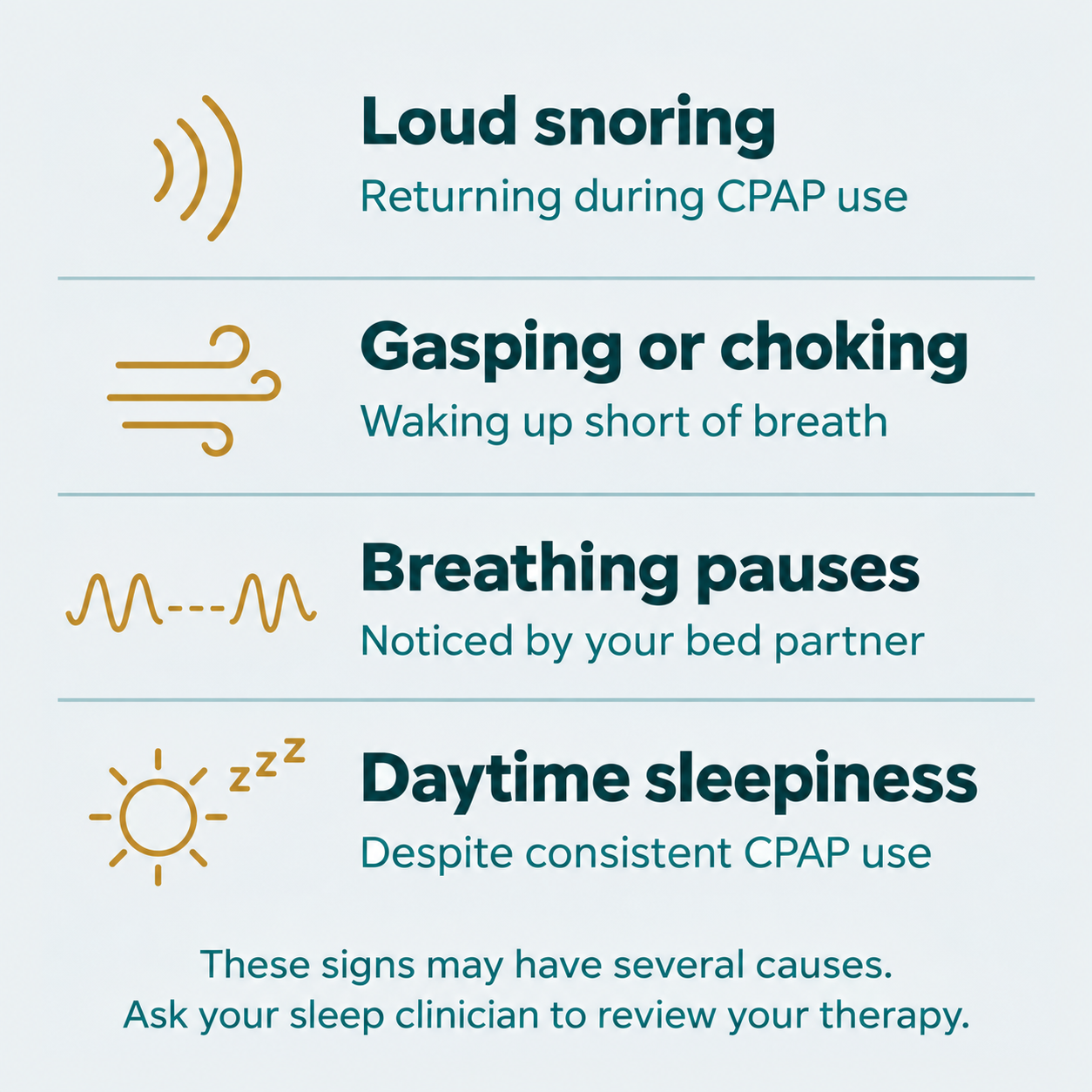
- Persistent, loud snoring returning during treatment
- Waking up gasping or choking
- Witnessed pauses in breathing
- Lingering daytime sleepiness despite using the device consistently
When pressure is inadequate, sleep apnea events return. A randomized controlled trial of 41 individuals with OSA examined the effects of withdrawing CPAP therapy for two weeks. Sleep apnea recurred within days, subjective daytime sleepiness spiked, and participants experienced an average increase of 8.5 mm Hg in morning systolic blood pressure compared to those who maintained treatment (3). While this trial evaluated complete treatment withdrawal rather than a small pressure decrease, it illustrates how quickly cardiovascular strain and daytime symptoms return when effective airway support is compromised.
What Happens If Your CPAP Pressure Is Too High?
Higher pressure does not translate to better treatment. Once your airway is stabilized, delivering extra pressure provides no additional clinical benefit and frequently produces uncomfortable side effects.
Key warning signs that pressure may be excessive include:
- Frequent aerophagia (swallowing air), which results in morning bloating, belching, and abdominal pain
- Uncomfortable airflow that makes exhalation difficult
- Air escaping forcefully around the mask cushion
A 2025 study evaluating 1,461 adults on positive airway pressure therapy found that 8.3% reported aerophagia, with higher average pressures directly linked to higher odds of the condition. In fact, each additional 1 cm H₂O of average pressure was associated with an approximate 13% increase in the odds of experiencing aerophagia (4). In a separate trial of 56 patients with aerophagia, switching to auto-adjusting APAP significantly reduced bloating, belching, and flatulence because the device delivered lower average pressures without sacrificing treatment adherence or apnea control (5).
Some people develop treatment-emergent central sleep apnea after starting positive airway pressure, and its causes are not fully understood. Unlike obstructive sleep apnea, where the airway physically blocks, central sleep apnea occurs when the brain temporarily stops sending the signal to breathe. Rapid changes in airflow can wash out too much carbon dioxide, dropping levels below the threshold needed to trigger normal breathing. Clinical reviews report that treatment-emergent central sleep apnea appears in roughly 8% of titration studies (6). In most people it resolves with continued therapy (6). If central events persist, your specialist may recommend repeat testing (10), so have them reviewed instead of adjusting your pressure at home.
Is It a Pressure Problem or a Mask Leak?
Many patients assume forceful airflow means their pressure needs to be lowered, when the actual issue is a mask leak. Escaping air can blow into your eyes, make loud noises, and prevent therapeutic pressure from reaching your airway.
Mask design plays a substantial role in treatment comfort. A randomized trial comparing nasal masks, nasal masks with chinstraps, and full-face masks showed that residual apnea-hypopnea index (AHI) levels were noticeably higher with full-face masks (averaging 7.1 events per hour) compared to nasal masks (4.0 events per hour) and nasal masks with chinstraps (4.2 events per hour) (7). Participants also reported fewer leaks and fewer fitting difficulties with nasal masks. Adjusting your headgear or evaluating your mask cushion often resolves the issue without touching the pressure.
Understanding Device AHI and Pressure Relief
Modern machines display an estimated AHI score, but you should not change your pressure to chase a lower number. A study of 217 patients found that automated machine scoring detected an elevated AHI (at least 5 events per hour) in 32.3% of participants, whereas manual review of the airflow tracings identified an elevated AHI in 60.8% (8). Automated scores are useful indicators, but device algorithms do not reflect every physiological event.
Similarly, adjusting expiratory pressure relief features without clinical input can impact therapy. While these settings drop pressure during exhalation to improve breathing comfort, a September 2026 study of 29 adults with severe OSA showed that average residual AHI was 3.7 events per hour with pressure relief enabled, compared to 1.3 events per hour when turned off (9). The participants required higher titrated pressures when relief was activated, and the feature did not produce significant gains in nightly adherence.
When Body Weight Changes Your Pressure Needs
Significant changes in your body weight can alter the severity of your sleep apnea. Weight gain can cause further narrowing of the upper airway, while weight loss can reduce the level of obstruction.
Clinical practice guidance recommends considering repeat sleep testing or evaluation if your body weight changes by approximately 10% to 20%, or if daytime fatigue returns despite consistent treatment (10). Rather than altering settings based on assumptions, having your data evaluated confirms whether your pressure needs recalibration.
What to Do Instead of Changing Settings Yourself
The safest approach is to document your symptoms and have your sleep specialist review your machine data. In our clinical experience, objective data reviews resolve most comfort complaints without unauthorized pressure adjustments.
A clinical trial of 60 adults demonstrated that patients supported by remote telemonitoring achieved significantly higher therapy adherence at four weeks (64.2%) compared to those receiving standard care (34.4%) (11).
Before your next appointment, take these practical steps:
- Log your symptoms: Note whether you wake up feeling bloated, whether your mouth is dry, or at what time you wake during the night.
- Inspect your mask: Check for worn-out cushions, loose straps, and leaks that happen when you turn onto your side.
- Check your machine report: Write down your nightly hours of use, residual AHI, and leak rates.
- Note health changes: Inform your clinician of any recent weight gain, weight loss, or medication adjustments.
- Contact your clinic: Request a clinical review so your specialist can interpret your download data and make adjustments safely.
Professional CPAP Guidance at The Insomnia and Sleep Institute of Arizona
If your CPAP pressure feels uncomfortable or your sleep apnea symptoms are not resolving, our team at The Insomnia and Sleep Institute of Arizona is available to help.
We provide comprehensive sleep evaluations, pressure titrations, and second opinions led by Dr. Ruchir P. Patel, MD, FACP.
Our specialists serve Gilbert, Phoenix, or Scottsdale, offering comprehensive care for CPAP troubleshooting as well as alternative options like Inspire therapy for eligible patients.
Contact our clinic team to schedule a review before altering your prescribed settings. Call us at (480) 745-3547 or request an appointment.
References
- Patil, S. P., Ayappa, I. A., Caples, S. M., Kimoff, R. J., Patel, S. R., & Harrod, C. G. (2019, February 15). Treatment of Adult Obstructive Sleep Apnea with Positive Airway Pressure: An American Academy of Sleep Medicine Clinical Practice Guideline. Journal of Clinical Sleep Medicine : JCSM : Official Publication of the American Academy of Sleep Medicine; PubMed Central. https://doi.org/10.5664/jcsm.7640
- Kushida, C. A., Chediak, A., Berry, R. B., Brown, L. K., Gozal, D., Iber, C., Parthasarathy, S., Quan, S. F., Rowley, J. A., Positive Airway Pressure Titration Task Force, & American Academy of Sleep Medicine. (2008, April 15). Clinical guidelines for the manual titration of positive airway pressure in patients with obstructive sleep apnea. Journal of Clinical Sleep Medicine : JCSM : Official Publication of the American Academy of Sleep Medicine; PubMed Central. https://pubmed.ncbi.nlm.nih.gov/18468315/
- Kohler, M., Stoewhas, A.-C., Ayers, L., Senn, O., Bloch, K. E., Russi, E. W., & Stradling, J. R. (2011, November 15). Effects of continuous positive airway pressure therapy withdrawal in patients with obstructive sleep apnea: a randomized controlled trial. American Journal of Respiratory and Critical Care Medicine; PubMed. https://doi.org/10.1164/rccm.201106-0964OC
- Vidal, C., Mallet, J.-P., Skinner, S., Gilson, R., Gaubert, O., Prigent, A., Gagnadoux, F., Borel, J.-C., Bourdin, A., Molinari, N., & Jaffuel, D. (2025, September 11). Positive Airway Pressure-Related Aerophagia in Obstructive Sleep Apnea: Results from the InterfaceVent Real-Life Study. Journal of Clinical Medicine; PubMed Central. https://doi.org/10.3390/jcm14186424
- Shirlaw, T., Hanssen, K., Duce, B., & Hukins, C. (2017, July 15). A Randomized Crossover Trial Comparing Autotitrating and Continuous Positive Airway Pressure in Subjects With Symptoms of Aerophagia: Effects on Compliance and Subjective Symptoms. Journal of Clinical Sleep Medicine : JCSM : Official Publication of the American Academy of Sleep Medicine; PubMed Central. https://doi.org/10.5664/jcsm.6658
- Zeineddine, S., & Badr, M. S. (2021, June). Treatment-Emergent Central Apnea: Physiologic Mechanisms Informing Clinical Practice. Chest; PubMed Central. https://doi.org/10.1016/j.chest.2021.01.036
- Rowland, S., Aiyappan, V., Hennessy, C., Catcheside, P., Chai-Coezter, C. L., McEvoy, R. D., & Antic, N. A. (2018, January 15). Comparing the Efficacy, Mask Leak, Patient Adherence, and Patient Preference of Three Different CPAP Interfaces to Treat Moderate-Severe Obstructive Sleep Apnea. Journal of Clinical Sleep Medicine : JCSM : Official Publication of the American Academy of Sleep Medicine; PubMed Central. https://doi.org/10.5664/jcsm.6892
- Reiter, J., Zleik, B., Bazalakova, M., Mehta, P., & Thomas, R. J. (2016, August 15). Residual Events during Use of CPAP: Prevalence, Predictors, and Detection Accuracy. Journal of Clinical Sleep Medicine : JCSM : Official Publication of the American Academy of Sleep Medicine; PubMed Central. https://doi.org/10.5664/jcsm.6056
- Grad, G. F., Rosanelli, I., Fernandes, M. D., Monare, A. B., Yanagimori, M., Cruz, I. F. da S., Mariano, P. M. M. S., Lorenzi-Filho, G., & Genta, P. R. (2026, September 3). Impairment of Upper Airway Patency and CPAP Effectiveness During OSA Treatment With Expiratory Pressure Alleviation: A Randomized Study. Chest; PubMed. https://doi.org/10.1016/j.chest.2026.08.041
- Caples, S. M., Anderson, W. M., Calero, K., Howell, M., & Hashmi, S. D. (2021, June 1). Use of polysomnography and home sleep apnea tests for the longitudinal management of obstructive sleep apnea in adults: an American Academy of Sleep Medicine clinical guidance statement. Journal of Clinical Sleep Medicine : JCSM : Official Publication of the American Academy of Sleep Medicine; PubMed Central. https://doi.org/10.5664/jcsm.9240
- Chumpangern, W., Muntham, D., & Chirakalwasan, N. (2021, January 1). Efficacy of a telemonitoring system in continuous positive airway pressure therapy in Asian obstructive sleep apnea. Journal of Clinical Sleep Medicine : JCSM : Official Publication of the American Academy of Sleep Medicine; PubMed Central. https://doi.org/10.5664/jcsm.8772
Disclaimer: The information provided in this blog post is for educational and informational purposes only and is not intended as a substitute for professional medical advice, diagnosis, or treatment. Always consult with a licensed healthcare provider for recommendations specific to your individual health needs.