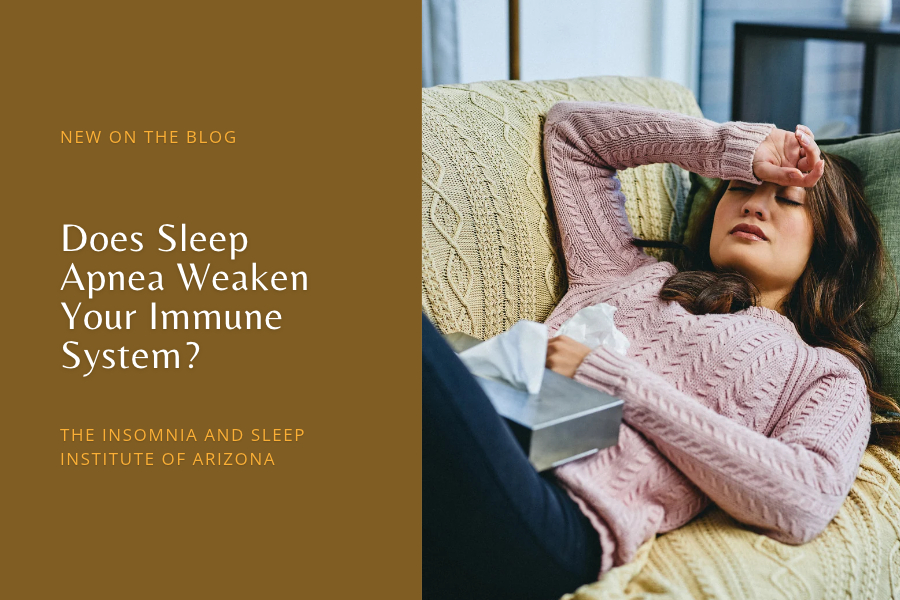
Sleep apnea does not simply shut down or weaken your immune system. Instead, it throws it off balance.
When you have obstructive sleep apnea (OSA), repeated breathing pauses cut off your oxygen throughout the night. This cycle triggers widespread, chronic inflammation while simultaneously hindering your body’s ability to coordinate targeted defenses against everyday bugs. It is less like an immune system that has turned off, and more like an alarm system that is stuck blaring while the security doors are left unlocked.
Medical research links these repeated drops in nighttime oxygen to a persistent pro-inflammatory state and changes across several types of immune cells. This means sleep apnea alters how your immune defenses are regulated rather than causing a simple across-the-board drop in immune strength. (1)
The Problem with Chronic Nighttime Inflammation
Every time your airway closes during sleep, your oxygen drops and then suddenly spikes back up when you gasp awake. Your body interprets this sudden drop in oxygen as an emergency.
Over time, this constant emergency response leads to systemic inflammation. A major meta-analysis pooling 51 clinical studies and over 5,700 participants confirmed that people with sleep apnea have significantly higher levels of key inflammatory markers, including C-reactive protein (CRP), tumor necrosis factor-alpha (TNF-alpha), and interleukin-6 (IL-6). (2)
When your body is constantly producing inflammatory signals like CRP and IL-6, your immune system is essentially working overtime. However, high inflammation is not proof of strong immunity. It simply means your body is stuck in a state of ongoing stress. (2)
The Immune System Paradox: High Alert, Low Defense
To understand how sleep apnea alters your defenses, it helps to divide your immune system into two main branches:
- Innate immunity: Your rapid-response team. These cells react quickly to general injuries and foreign invaders by triggering inflammation.
- Adaptive immunity: Your specialized tactical unit. These cells, especially T cells, learn specific viruses and bacteria to eliminate them efficiently.
In obstructive sleep apnea, these two branches stop communicating properly. Studies show that low oxygen levels activate innate pathways that increase systemic inflammation, but those same low oxygen levels can hinder T cells from multiplying and activating properly. (3)
This creates a frustrating paradox. One half of your immune system is overly reactive, driving body-wide inflammation, while the targeted half is left sluggish and less capable of fighting off specific infections. (3)
What Happens to Your Immune Cells?
Deep inside the bloodstream, researchers can see this imbalance playing out among specialized white blood cells.
Clinical reviews note that sleep apnea alters the behavior of CD4 and CD8 T cells, which are critical for recognizing and destroying infected cells. At the same time, people with sleep apnea may have altered numbers of invariant natural killer T (iNKT) cells, which act as a vital bridge between your fast-acting and specialized immune forces. (4)
Because each person has a unique medical history, these cellular changes do not look identical in every individual. Factors like body weight, underlying health, and the severity of your nighttime oxygen drops all play a role. Even so, the overall pattern remains clear: sleep apnea disrupts how your cells coordinate their defense. (4)
Does Sleep Apnea Make You Catch More Infections?
If your immune balance is disrupted, does that mean you will automatically catch every cold or respiratory infection that goes around?
Long-term medical data shows there is an association between sleep apnea and serious infections. In a community study that tracked nearly 1,600 adults over two decades, patients with severe sleep apnea were nearly twice as wide open to hospitalization for pneumonia compared to people who slept normally. (5)
It is important to look at this finding carefully. When researchers accounted for other factors like body mass index (BMI), asthma, and chronic lung disease, the direct statistical link became less definitive. (5) Conditions like asthma and excess weight also affect your lungs and immune signaling. While severe sleep apnea certainly places extra strain on your respiratory defenses, it works alongside your overall physical health rather than acting entirely on its own.
Why Respiratory Viruses Can Hit Harder
While sleep apnea might not guarantee you catch a minor cold, untreated airway obstruction can make standard respiratory illnesses harder to handle.
A targeted clinical study reviewed hospital records of adults diagnosed with both sleep apnea and laboratory-confirmed influenza. The researchers found that patients with untreated sleep apnea had significantly higher odds of being hospitalized for the flu compared to patients who consistently used their prescribed continuous positive airway pressure (CPAP) therapy. (6)
While this was a smaller retrospective study, the clinical takeaway aligns with what our sleep physicians observe in practice: when your airway is chronically irritated and your body is starved of restorative rest, recovering from a respiratory infection takes a heavier physical toll. (6)
Can CPAP Therapy Help Restore Immune Balance?
The most encouraging news is that treating sleep apnea helps ease this internal strain.
A 2025 meta-analysis examining 15 randomized controlled trials found that CPAP therapy was associated with lower levels of key inflammatory markers like CRP, IL-6, and TNF-alpha, although results varied considerably between trials. (7) By stabilizing your breathing and preventing nocturnal oxygen drops, CPAP gives your body the chance to turn down its chronic emergency alarm.
At the same time, we do not view CPAP as a magic immunity booster. It does not replace balanced nutrition, vaccines, or handwashing, and trials have not yet proven that CPAP alone stops you from catching everyday colds. (7) What CPAP does achieve is clear: it removes the nightly oxygen crashes that keep your immune system dysregulated.
When to Seek a Professional Sleep Evaluation
If you feel constantly run down or notice that common respiratory bugs seem to linger, it is worth looking at your nighttime breathing habits.
We recommend a comprehensive sleep evaluation if you experience persistent warning signs such as:
- Loud, habitual snoring
- Pauses in breathing witnessed by a partner
- Waking up choking, gasping, or with a dry throat
- Unrefreshing sleep and heavy daytime exhaustion (8)
Standard blood panels for inflammation cannot diagnose sleep apnea. A proper diagnosis requires objective testing, such as a home sleep apnea test or an in-lab sleep study (polysomnography), to directly evaluate your airway and oxygen stability throughout the night. (8)
At The Insomnia and Sleep Institute of Arizona, our team provides patient-centered care across our Phoenix, Scottsdale, and Gilbert locations. Founded by Dr. Ruchir P. Patel, who is triple board-certified in Internal Medicine, Sleep Medicine, and Obesity Medicine, our focus is diagnosing the root causes of disrupted sleep and guiding you toward lasting recovery. Schedule a comprehensive consultation today.
References
- Ludwig, K., Huppertz, T., Radsak, M., & Gouveris, H. (2022, July 6). Cellular Immune Dysfunction in Obstructive Sleep Apnea. Frontiers in Surgery; PubMed Central. https://doi.org/10.3389/fsurg.2022.890377
- Nadeem, R., Molnar, J., Madbouly, E. M., Nida, M., Aggarwal, S., Sajid, H., Naseem, J., & Loomba, R. (2013, October 15). Serum inflammatory markers in obstructive sleep apnea: a meta-analysis. Journal of Clinical Sleep Medicine : JCSM : Official Publication of the American Academy of Sleep Medicine; PubMed Central. https://doi.org/10.5664/jcsm.3070
- Feuth, T. (2024, October). Interactions between sleep, inflammation, immunity and infections: A narrative review. Immunity, Inflammation and Disease; PubMed Central. https://doi.org/10.1002/iid3.70046
- Dong, N., & Yue, H. (2025, October 21). Advances in immunology of obstructive sleep apnea: mechanistic insights, clinical impact, and therapeutic perspectives. Frontiers in Immunology; PubMed Central. https://doi.org/10.3389/fimmu.2025.1654450
- Lutsey, P. L., Zineldin, I., Misialek, J. R., Full, K. M., Lakshminarayan, K., Ishigami, J., Cowan, L. T., Matsushita, K., & Demmer, R. T. (2023, April). OSA and Subsequent Risk of Hospitalization With Pneumonia, Respiratory Infection, and Total Infection: The Atherosclerosis Risk in Communities Study. Chest; PubMed Central. https://doi.org/10.1016/j.chest.2022.11.028
- Mok, E. M., Greenough, G., & Pollack, C. C. (2020, December 15). Untreated obstructive sleep apnea is associated with increased hospitalization from influenza infection. Journal of Clinical Sleep Medicine : JCSM : Official Publication of the American Academy of Sleep Medicine; PubMed Central. https://doi.org/10.5664/jcsm.8744
- Zhu, Q., Luo, Q., Wang, Z., Chen, S., Chen, G., & Huang, S. (2025). Effects of continuous positive airway pressure therapy on inflammatory markers in patients with obstructive sleep apnea: a meta-analysis of randomized controlled trials. Sleep and Breathing, 29(2). https://doi.org/10.1007/s11325-025-03348-6
- Kapur, V. K., Auckley, D. H., Chowdhuri, S., Kuhlmann, D. C., Mehra, R., Ramar, K., & Harrod, C. G. (2017, March 15). Clinical Practice Guideline for Diagnostic Testing for Adult Obstructive Sleep Apnea: An American Academy of Sleep Medicine Clinical Practice Guideline. Journal of Clinical Sleep Medicine : JCSM : Official Publication of the American Academy of Sleep Medicine; PubMed Central. https://doi.org/10.5664/jcsm.6506
Disclaimer: The information provided in this blog post is for educational and informational purposes only and is not intended as a substitute for professional medical advice, diagnosis, or treatment. Always consult with a licensed healthcare provider for recommendations specific to your individual health needs.